
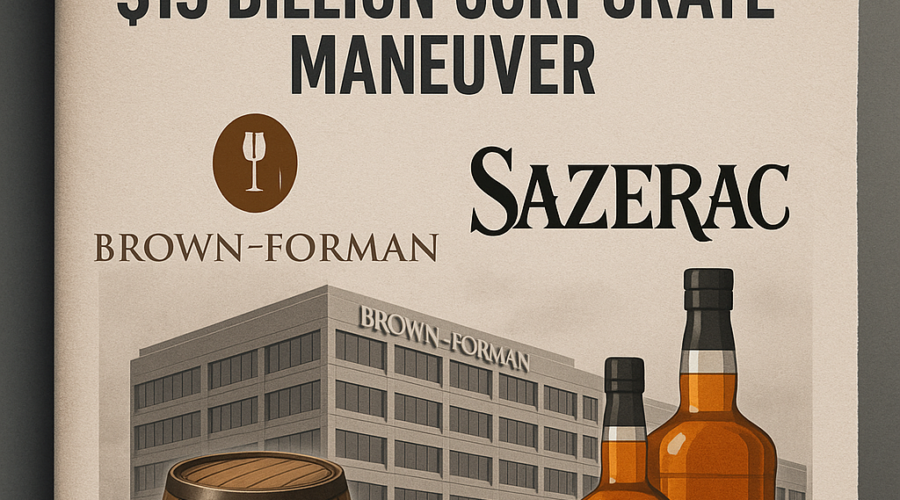
In a move that has sent ripples through the global spirits market, Brown-Forman Corporation (NYSE: BFA, BFB) has formally rejected a $15 billion unsolicited takeover bid from its Louisville neighbor, Sazerac Company Inc. The reported $32-per-share all-cash offer, backed by Wells Fargo and Apollo Global Management, represented a roughly 20% premium over the recent trading price of Brown-Forman’s Class B shares. However, the rejection underscores a formidable barrier in the consumer staples M&A landscape: the “Family Wall” of voting control.
Most “AI for Diligence” tools are lying to you. The truth is, they are just ChatGPT wrappers. Experience what real AI for Diligence looks like, built like Claude Code, but for M&A/ PE Diligence:
💼 When Claude Code Marries Due Diligence!
The Arithmetic of Control: Voting Rights vs. Economic Interests
The deal’s collapse highlights the complex governance structures of legacy American distillers. While Brown-Forman is publicly traded, the Brown family maintains a vice-like grip on the enterprise, controlling approximately 73% of the voting rights through Class A shares despite holding an economic stake of roughly 26%. This dual-class structure effectively insulated the board from Sazerac’s aggressive overture.
According to analysts at Bernstein, the rejection of such a significant premium creates a widening rift between the controlling family and Class B shareholders, who possess no voting power. Legal experts from firms like Kirkland & Ellis note that such rejections often invite “litigation risk,” as non-voting shareholders may argue that the board’s fiduciary duty to maximize value was superseded by the family’s desire to maintain multi-generational control.
Strategic Rationale: Building a Whiskey Colossus
The proposed tie-up sought to create an unprecedented concentration of American whiskey assets. A combined entity would have united Jack Daniel’s and Woodford Reserve with Sazerac’s elite stable, including Buffalo Trace, Pappy Van Winkle, and Weller.
Market Concentration and Distribution Clout
A merger would have reshaped the competitive landscape of the U.S. spirits market. Industry data indicates a combined Brown-Forman and Sazerac would control approximately 30% of the American whiskey market. This scale offers significant advantages in the traditional “three-tier system” of alcohol distribution:
- Enhanced Pricing Power: Greater leverage with distributors to secure shelf space and premium positioning.
- Supply Chain Synergies: Optimized production and aging facilities across Kentucky and Tennessee.
- Portfolio Depth: A “one-stop shop” for premium bourbon, rye, and Tennessee whiskey.
Comparative Overview: Strategic Landscape (Estimated 2026)
| Metric | Brown-Forman | Sazerac |
|---|---|---|
| Annual Net Sales | ~$4.0 Billion | ~$6.0 Billion+ |
| Ownership | Public (Family Controlled) | Private (Family Owned) |
| Core Whiskey Brands | Jack Daniel’s, Woodford Reserve | Buffalo Trace, Fireball, Pappy Van Winkle |
| Global Volume | ~46 Million Cases | ~55 Million Cases |
The Antitrust Hurdles: A Regulatory Non-Starter?
Beyond family control, regulatory headwinds loom large. Antitrust experts suggest the Federal Trade Commission (FTC) would have scrutinized the deal’s impact on the “super-premium” bourbon segment. In a 2026 market where “strategic discipline” is the mandate from Goldman Sachs and other investment banks, the concentration of so many iconic “allocated” brands under one roof would likely have triggered divestiture requirements that could have eroded the deal’s core value proposition.
The 2026 M&A Landscape: Quality Over Growth
The Sazerac bid arrived amidst a broader shift in cross-border M&A trends 2026. Following a record-setting 2025 for mega-deals, the bar for quality has risen. Investment professionals are moving away from “collection-style” portfolio building toward capability-driven acquisitions that offer defensive margins against shifting consumer habits.
Brown-Forman’s rejection follows the recent collapse of its “merger of equals” talks with Pernod Ricard. Sources suggest the Brown family viewed the French distiller as a more “prestigious” strategic partner, despite the lower cash component of that proposal. This indicates that for family-controlled entities, private equity exit strategies in SaaS or other high-churn sectors do not apply; here, brand prestige and autonomy are the primary currencies.
Market Headwinds: The “Hangover” in Spirits
The rejection comes as the industry navigates several cyclical challenges:
- Geopolitical Volatility: The ongoing trade tensions and the 2025-2026 Canada boycott of U.S. alcohol have impacted exports, with some distillers reporting an 85% decline in northern cross-border shipments.
- Consumer Shifts: The “premiumization” trend is being tested by lower consumer confidence and the rise of GLP-1 medications, which have subtly shifted caloric and alcohol consumption patterns.
- Valuation Compression: While 2024 saw multiples as high as 25x EV/EBITDA, 2026 benchmarks for scaled spirits businesses have normalized to the 12x–15x range.
Conclusion: Independence at a Price
By rebuffing Sazerac, Brown-Forman has signaled its commitment to a standalone future, betting on its 82-year history of dividend increases and the resilience of the Jack Daniel’s franchise. However, with organic net sales growth currently hovering in the low single digits (1%–3%), the pressure on management to prove that independence is more valuable than a $15 billion payday will be immense during the upcoming June 4 earnings call. For now, the “Family Wall” remains intact, but the cracks in shareholder alignment may define the next era of whiskey consolidation.