
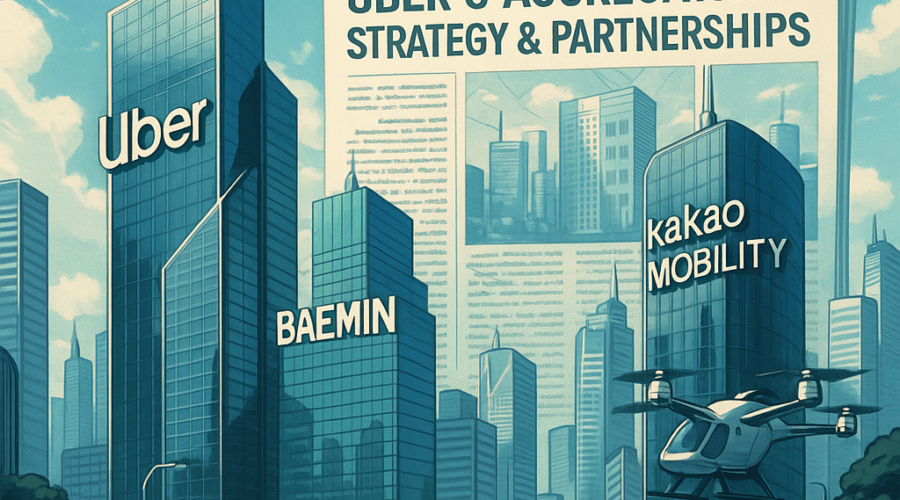
Uber is pursuing a dual-acquisition strategy in South Korea, targeting food delivery leader Baedal Minjok (Baemin) and ride-hailing giant Kakao Mobility. The proposed Baemin acquisition, valued at $4.9 to $5.6 billion, involves a consortium with Naver to buy the asset from Delivery Hero. Concurrently, Uber is bidding for a controlling stake in Kakao Mobility, valued at an estimated $3.7 billion, to provide an exit for PE investors TPG and Carlyle. This aggressive, multi-billion dollar consolidation play signals Uber's strategic pivot to dominate high-ARPU international markets, aiming to secure the "last mile" of the Korean economy against rivals like Coupang Eats, though it faces significant antitrust hurdles from the Korea Fair Trade Commission (KFTC).
- Acquirer
- Uber Technologies Inc.
- Target 1
- Baedal Minjok (Baemin)
- Target 2
- Kakao Mobility
- Baemin Est. Valuation
- ₩7.0T – ₩8.0T ($4.9B – $5.6B)
- Kakao Mobility Est. Valuation
- ₩5.5T ($3.7B)
- Baemin Seller
- Delivery Hero SE
- Kakao Mobility Sellers
- TPG Capital, The Carlyle Group, Kakao Corp
- Baemin Deal Structure
- Proposed 70:30 consortium with Naver
- Kakao Mobility Deal Structure
- Direct purchase of a controlling stake (>50%)
- Strategic Driver
- Consolidate South Korea's delivery and mobility sectors and build a defensive moat against Coupang Eats.
- Primary Risk
- Antitrust review and potential structural remedies required by the Korea Fair Trade Commission (KFTC).
- Acquirer Financial Capacity
- $10B in net income (FY2025) and a cash pile of approx. $9.1B.
SEOUL/NEW YORK — In a move that would fundamentally reorganize Asia’s most competitive platform economy, Uber Technologies Inc. is exploring a dual-acquisition strategy to take control of South Korea’s leading delivery and mobility giants. According to sources familiar with the matter, the San Francisco-based titan is in early-stage talks to acquire Baedal Minjok (Baemin) from Germany’s Delivery Hero and is simultaneously conducting due diligence to purchase a controlling stake in Kakao Mobility.
Most “AI for Diligence” tools are lying to you. The truth is, they are just ChatGPT wrappers. Experience what real AI for Diligence looks like, built like Claude Code, but for M&A/ PE Diligence:
💼 When Claude Code Marries Due Diligence!
The maneuvers represent a significant escalation of Uber’s “Go and Get” strategy. If successful, Uber would transform from a secondary player in South Korea—where it currently operates through its wholly-owned “Uber Taxi” unit—into the undisputed market leader across the nation’s ₩26.4 trillion ($18.3 billion) delivery and ₩6.5 trillion ($4.5 billion) mobility sectors.
The Baemin Play: A Strategic Alliance with Naver
Uber is reportedly considering a 70:30 consortium with Korean tech giant Naver to acquire Baedal Minjok, the dominant food delivery app with an approximate 65% market share. The inclusion of Naver is seen by investment bankers as a calculated effort to bypass the “foreign capital encroachment” narrative that has historically hampered cross-border M&A in Seoul.
Delivery Hero, under pressure from a consortium of activist investors including Aspex Management and Broad Peak, has designated JP Morgan to lead the sale of Baemin. The German conglomerate is seeking a valuation between ₩7 trillion and ₩8 trillion ($4.9 billion to $5.6 billion). The divestiture is primarily driven by Delivery Hero’s need to service a €6.17 billion debt load maturing in 2027.
Table 1: Key Financial & Strategic Metrics (Est. May 2026)
| Metric | Baedal Minjok (Baemin) | Kakao Mobility |
|---|---|---|
| Est. Valuation | ₩7.0T – ₩8.0T ($4.9B – $5.6B) | ₩5.5T ($3.7B) |
| Market Position | #1 Food Delivery (65% share) | #1 Ride-Hailing (90%+ share) |
| Primary Seller | Delivery Hero SE | TPG (28%), Carlyle (6.2%), Kakao Corp |
| Uber’s Strategy | Consortium with Naver (7:3 ratio) | Direct stake purchase (>50%) |
Consolidating Mobility: TPG and Carlyle Seek Exit
Simultaneous to the Baemin negotiations, Uber has submitted a Letter of Commitment (LOC) to acquire a stake exceeding 50% in Kakao Mobility. The deal would provide a long-awaited exit for private equity firms TPG Capital and The Carlyle Group, whose plans for a Kakao Mobility IPO have stalled amid rigorous regulatory scrutiny and a ban on duplicate listings by Korean financial authorities.
Analysts at Goldman Sachs and Bain & Co. suggest that Uber’s interest is timed to take advantage of Kakao Corp’s “regulatory fatigue.” Kakao Mobility has faced repeated fines and investigations by the Korea Fair Trade Commission (KFTC) regarding algorithm self-preferencing. By shifting management control to Uber, Kakao could offload a high-maintenance asset while retaining a minority interest in the nation’s transportation backbone.
Competitive Landscape: The Coupang Eats Factor
The urgency behind Uber’s interest in South Korea mobility M&A 2026 is fueled by the aggressive rise of Coupang Eats. Backed by the logistics prowess of Coupang Inc., Eats has rapidly displaced legacy players to become the primary challenger to Baemin. For Uber, acquiring Baemin isn’t just about market entry; it’s a defensive moat against Coupang’s expanding ecosystem, which recently integrated food delivery into its “Wow” membership—a direct competitor to the Uber One subscription service.
The KFTC: A Formidable Regulatory Hurdle
The primary risk to this “grand consolidation” remains the KFTC. The antitrust regulator has signaled a move toward more interventionist cross-border M&A trends in 2026, specifically targeting platform monopolies. “A combination of Kakao Mobility (90% share) and Uber Taxi would create a near-monopoly that the KFTC is unlikely to approve without significant structural remedies,” says a lead partner at Kirkland & Ellis.
Possible concessions could include:
- Divestiture of overlapping regional taxi franchises.
- Mandatory data-sharing with the government’s public transportation platform.
- Strict caps on commission fees for restaurant partners and taxi drivers.
Investment Implications
For institutional investors, Uber’s potential $9 billion+ bet on South Korea signals a pivot toward high-density, high-ARPU (Average Revenue Per User) international markets to sustain its 15-20% revenue CAGR. With Uber reporting $10 billion in net income for the 2025 fiscal year and a cash pile of roughly $9.1 billion, the company has the balance sheet capacity to execute these private equity exit strategies in SaaS and mobility without diluting shareholders significantly.
Should these deals close, Uber would effectively own the “last mile” of the Korean economy, controlling the flow of people and goods in one of the world’s most digitally integrated societies. However, as the KFTC prepares its 2026 enforcement plan, the road from “due diligence” to “deal closed” remains fraught with political and regulatory complexity.
Sources
 globalnewstop.com

 stockanalysis.com
 marketscreener.com
 mk.co.kr
 chosun.com
 digitaltoday.co.kr