
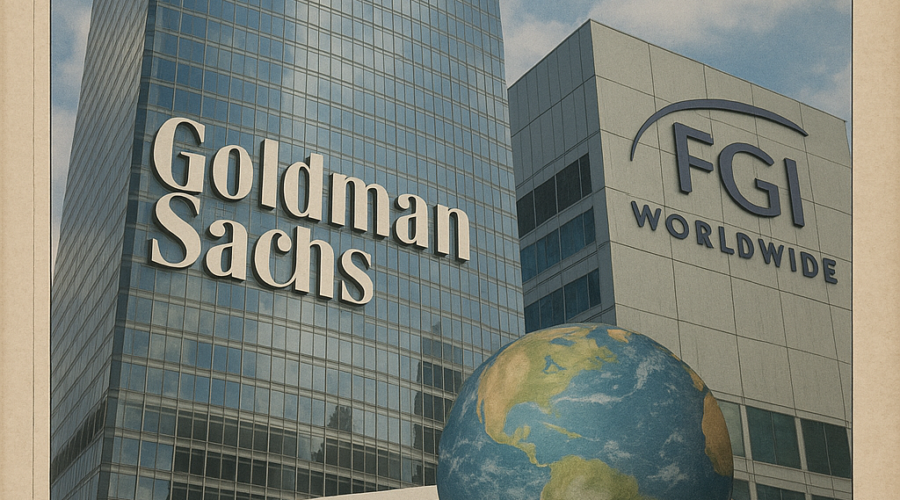
Goldman Sachs Alternatives' Private Equity business announced its acquisition of FGI Worldwide LLC on May 12, 2026, marking the specialty finance firm's first institutional investment. FGI provides cross-border working capital, asset-based loans, and trade credit insurance, supported by its proprietary Insurtech platform, TRUST™. The transaction provides Goldman with a diversified entry into the resilient asset-based finance (ABF) sector. This deal signals a strategic pivot by major asset managers away from crowded direct lending markets and toward specialized, collateral-heavy credit solutions that offer higher margins and structural resilience.
- Acquirer
- Goldman Sachs Alternatives (Private Equity)
- Target
- FGI Worldwide LLC
- Announced Date
- May 12, 2026
- Sector
- Specialty Finance / Asset-Based Lending
- Strategic Driver
- Expansion into asset-based finance (ABF) and multi-jurisdictional working capital solutions.
- Target's Core Business
- Asset-based loans, receivables financing, trade credit insurance, and Insurtech software.
- Leadership Change
- Sami Altaher named CEO, succeeding David DiPiero.
- Financial Advisor (Target)
- Keefe, Bruyette & Woods (A Stifel Company)
- Financial Advisor (Acquirer)
- Houlihan Lokey
- Legal Counsel (Target)
- Blank Rome LLP
- Legal Counsel (Acquirer)
- Sidley Austin LLP
In a significant consolidation within the private credit and specialty finance landscape, the Private Equity business within Goldman Sachs Alternatives announced today, May 12, 2026, the acquisition of FGI Worldwide LLC (FGI). The deal marks a pivotal shift for FGI, as Goldman Sachs becomes the firm’s first institutional investor, signaling a maturing market for multi-jurisdictional working capital solutions and asset-based finance.
Most “AI for Diligence” tools are lying to you. The truth is, they are just ChatGPT wrappers. Experience what real AI for Diligence looks like, built like Claude Code, but for M&A/ PE Diligence:
💼 When Claude Code Marries Due Diligence!
FGI, a New York-headquartered leader in commercial finance for over 25 years, specializes in providing cross-border working capital and trade credit insurance. The acquisition is poised to accelerate FGI’s expansion of its Insurtech capabilities and its global lending footprint at a time when traditional bank retrenchment has created a vacuum in middle-market liquidity.
Strategic Rationale: The Shift to Asset-Based Finance (ABF)
As of mid-2026, asset-based lending market trends indicate a decisive pivot among alternative asset managers toward collateral-heavy credit. While direct lending dominated the early 2020s, the current cycle favors ABF due to its structural resilience and self-liquidating nature. Goldman Sachs’ move to absorb FGI reflects a broader strategy to capture “sticky” yield through specialized underwriting expertise that is difficult for traditional banks to replicate under current capital requirements.
FGI operates through three core pillars that provide Goldman with a diversified entry point into the credit ecosystem:
- FGI Finance: Tailored asset-based loans (ABL) and receivables financing for mid-market enterprises.
- FGI Risk: Trade credit insurance brokerage and risk mitigation services.
- FGI Tech: Proprietary software, including the TRUST™ platform, a web-based credit insurance management system that optimizes policy value and administrative overhead.
Leadership Transition and Governance
In conjunction with the transaction, FGI announced a planned leadership transition. Sami Altaher, Co-Founder and former President, has been named Chief Executive Officer, succeeding David DiPiero. Altaher will lead the next phase of growth, focusing on scaling FGI’s technology-driven operating platform across its presence in six continents.
| Key Deal Component | Details |
|---|---|
| Acquirer | Goldman Sachs Alternatives (Private Equity) |
| Target | FGI Worldwide LLC |
| Announcement Date | May 12, 2026 |
| Financial Advisors (Target) | Keefe, Bruyette & Woods (A Stifel Company) |
| Financial Advisors (Acquirer) | Houlihan Lokey |
| Legal Counsel | Blank Rome LLP (FGI); Sidley Austin LLP (Goldman Sachs) |
Industry Implications: Scaling Beyond Niche Credit
For investment professionals, this acquisition highlights the institutionalization of specialized lending. FGI’s ability to manage multi-jurisdictional working capital solutions is a high-barrier-to-entry service. By integrating FGI into its $625 billion alternatives platform, Goldman Sachs is positioning itself to manage the upcoming “maturity wall” of 2028, where approximately $1 trillion in speculative-grade debt will require refinancing.
The deal also underscores the value of embedded finance and Insurtech within the private equity sphere. FGI Tech’s TRUST platform provides real-time data on receivables and insurance compliance—a level of transparency that enhances underwriting precision in volatile macroeconomic climates. This data-first approach aligns with private equity exit strategies in SaaS and fintech, where operational platforms are increasingly valued over simple lending balance sheets.
Market Outlook: Private Credit Diversification in 2026
The acquisition comes as private credit strategy diversification becomes a necessity for top-tier asset managers. With direct lending markets becoming increasingly crowded, the expansion into asset-backed finance offers a higher margin and lower correlation to traditional corporate credit cycles. Analysts from firms like BlackRock and PwC have noted that ABF is on a trajectory to challenge direct lending’s dominance by late 2026, driven by demand for bespoke capital solutions that can withstand inflationary pressures.
As Goldman Sachs Alternatives scales FGI, the focus will likely remain on cross-border M&A trends 2026, specifically how SME (Small and Medium Enterprise) financing can be standardized across disparate legal frameworks. The transaction represents a clear bet that the future of private credit lies in the intersection of deep industry expertise and proprietary technological infrastructure.
Conclusion for Executives
C-level leadership should view the Goldman-FGI deal as a signal that the cost of capital for international operations may become more competitive as institutional dry powder flows into specialized ABL. For deal advisors, the involvement of Houlihan Lokey and KBW emphasizes the growing importance of boutique expertise in successfully navigating complex, asset-heavy transactions in the current mid-market environment.