
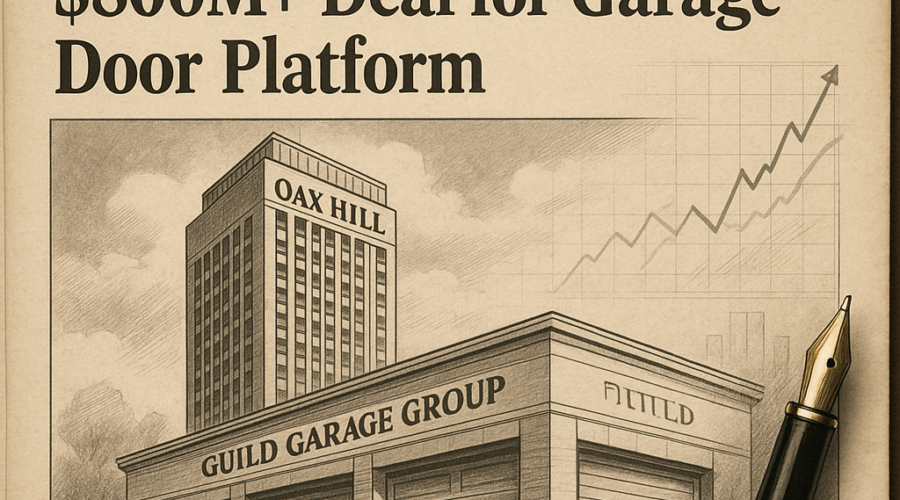
March 6, 2026 – Private equity titan Oak Hill Capital is set to acquire Guild Garage Group, an aggressive consolidator in the residential garage door repair and replacement sector, in a transaction valued at over $800 million, according to sources familiar with the matter.
Most “AI for Diligence” tools are lying to you. The truth is, they are just chatGPT wrappers. Experience what real AI for Diligence looks like, built like Claude Code, but for M&A/ PE Diligence:
💼 When Claude Code Marries Due Diligence!
The deal underscores a sustained appetite among large-cap financial sponsors for the fragmented, non-discretionary home services sector, which is prized for its resilient cash flows and high-multiple exit potential when successfully scaled.
The Aggressive Roll-Up Thesis
Guild Garage Group, a relatively nascent entity launched in 2024 by former L Catterton associates Jordan Dubin, Joe Delaney, and Sean Slazyk, has rapidly executed a classic private equity “roll-up” strategy. By its projected exit timeline, Guild has already completed close to 30 acquisitions of residential-focused garage door businesses across the U.S..
As of reports near the deal announcement, Guild is pacing over $300 million in annual revenue and generating approximately $50 million in annual EBITDA. This rapid scale-up—from launch to an eight-figure valuation in just two years—highlights the premium buyers are currently assigning to platforms that can absorb smaller, regional operators and standardize operations onto a central platform like ServiceTitan.
Key Deal Metrics & Rationale
While final terms remain confidential, an $800 million-plus valuation for a company generating around $50 million in EBITDA implies a valuation multiple in the low-to-mid teens, consistent with attractive multiples seen for resilient, tech-enabled essential services platforms in today’s market.
For Oak Hill Capital, the investment aligns with its stated thematic focus on “essential services”. The garage door repair market is characterized by:
- Non-Discretionary Demand: Repairs and replacements are often driven by component failure or necessity, insulating them from broader consumer spending volatility.
- Fragmentation: The market remains highly fragmented, offering substantial runway for the inorganic growth model Guild has perfected.
- Operational Leverage: Centralizing procurement, marketing, and back-office functions across acquired brands drives margin expansion, a key value-creation lever for PE sponsors.
Oak Hill’s Play in Essential Services Consolidation
Oak Hill Capital, which manages over $25 billion in commitments, has a history of building and exiting value in the services sector, having previously invested in platforms like VetCor Group Holdings. The firm’s systematic, theme-based approach suggests confidence in Guild’s management team to continue executing this buy-and-build mandate, potentially targeting further acquisitions or operational enhancements before a future exit.
This sector activity mirrors broader trends in the automotive aftermarket, where investors are favoring companies offering non-discretionary services, such as repair consolidators, over segments facing cyclical headwinds. The ability of companies like Guild to leverage sophisticated CRM and operational software (like ServiceTitan) further bolsters their appeal to institutional buyers looking for private equity exit strategies in essential services.
Guild’s Model: Owner Retention as a Competitive Edge
Guild Garage Group’s partnership approach differs from a traditional, sometimes abrupt, acquisition. The model is designed to retain the legacy, management teams, and employees of the acquired companies, offering founders liquidity while allowing them to retain a minority stake. This structure—often termed a “recapitalization with operational autonomy”—is crucial for incentivizing continued high performance and seamless integration, a key element in successfully navigating cross-border M&A trends 2025 stabilization periods.
The move by Oak Hill signals that institutional capital continues to view investment in well-executed residential services platforms as a hedge against market complexity and a reliable driver of superior returns, especially as the macroeconomic environment—including lingering tariff clarity and interest rate normalization—recalibrates deal-making selectivity for 2026.