
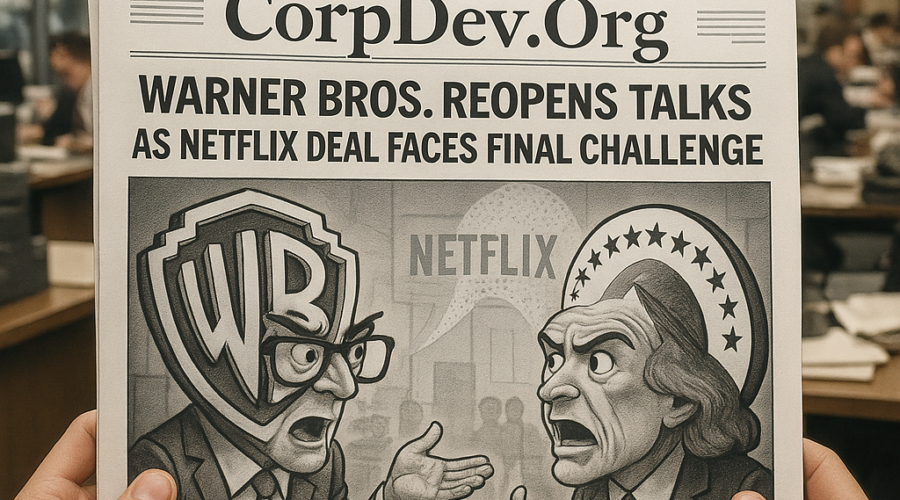
Warner Bros. Discovery (WBD) has a seven-day window to negotiate with Paramount Skydance over its $108.4 billion takeover offer, a waiver granted by Netflix. This occurs even as WBD’s board unanimously backs Netflix’s competing $83 billion all-cash bid for its streaming and studio assets. Paramount’s offer covers the entire enterprise, while the Netflix deal would spin off WBD’s linear TV assets. The negotiation window signals that WBD is leveraging Paramount’s higher-value but more complex offer to extract maximum value, potentially forcing Netflix to improve its terms before the March 20 shareholder vote.
- Target
- Warner Bros. Discovery (WBD)
- Competing Acquirer 1
- Paramount Skydance
- Offer 1 (Paramount)
- $108.4 billion ($30 per share) for the entire enterprise
- Offer 1 Financing
- $43.6B equity (Larry Ellison, RedBird Capital) and $54B debt (BofA, Citi, Apollo)
- Competing Acquirer 2
- Netflix
- Offer 2 (Netflix)
- $83 billion ($27.75 per share) for streaming and studio assets
- Offer 2 Structure
- All-cash transaction with spin-off of linear TV assets into ‘Discovery Global’
- Board Recommendation
- Unanimously recommends the Netflix merger and rejects the Paramount offer
- Key Deadline
- March 20 shareholder vote on the Netflix transaction
- Negotiation Window
- Seven-day period concluding February 23
- Termination Fee (Netflix Deal)
- $2.8 billion (Paramount has pledged to cover this fee)
- Paramount Ticking Fee
- $650 million per quarter if deal is unclosed beyond Dec. 31, 2026
null
Warner Bros. Discovery granted a seven-day negotiating window to engage with Paramount Skydance on its $108.4 billion acquisition offer, though the company’s board continues to unanimously back Netflix’s $83 billion bid for its streaming and studio assets. The waiver, granted by Netflix on Tuesday, allows WBD to address unresolved deficiencies in Paramount’s proposal before a shareholder vote on the Netflix transaction scheduled for March 20.
Most “AI for Diligence” tools are lying to you. The truth is, they are just ChatGPT wrappers. Experience what real AI for Diligence looks like, built like Claude Code, but for M&A/ PE Diligence:
💼 When Claude Code Marries Due Diligence!
The Competing Bids: Scope and Structure
The two offers differ fundamentally in scope and financing structure. Netflix’s all-cash transaction values WBD’s streaming and studio business at $83 billion, or $27.75 per share, with an enterprise value of approximately $83 billion including debt. The deal would spin off WBD’s linear television assets—including CNN and Discovery channels—into a newly created publicly traded entity called Discovery Global.
Paramount Skydance’s counteroffer seeks to acquire WBD’s entire enterprise for $108.4 billion, or $30 per share. The bid is fully financed through $43.6 billion in equity commitments from Larry Ellison and RedBird Capital Partners, combined with $54 billion in debt financing from Bank of America, Citigroup, and Apollo Global Management.
Regulatory and Timing Advantages
Paramount CEO David Ellison has positioned his offer as less vulnerable to regulatory obstacles that could delay or derail the Netflix transaction. To address timing concerns, Paramount has committed to paying WBD shareholders a “ticking fee” of 25 cents per share—approximately $650 million quarterly—for every quarter the deal remains unclosed beyond December 31, 2026. The company has also pledged to cover WBD’s $2.8 billion termination fee if the company walks away from Netflix.
Netflix, meanwhile, retains matching rights under its merger agreement, allowing it to counter any improved Paramount proposal. The company granted the waiver while emphasizing confidence in its offer’s “superior value and certainty,” characterizing Paramount’s approach as creating ongoing distraction for WBD shareholders and the broader entertainment industry.
Board Recommendation and Shareholder Dynamics
WBD’s board of directors continues to unanimously recommend the Netflix merger and unanimously recommends that shareholders reject Paramount’s offer. In a recent letter to Paramount, WBD indicated that Paramount’s revised proposal of $31 per share was not the company’s “best and final proposal,” signaling room for negotiation during the seven-day window that concludes February 23.
The special shareholder meeting to vote on the Netflix transaction is scheduled for March 20, providing a hard deadline for resolving negotiations. WBD stock rose more than 2% on Tuesday’s announcement, while Paramount Skydance shares climbed nearly 3%, reflecting investor appetite for a potential deal restructuring.
Strategic and Political Considerations
A Paramount acquisition would consolidate major media assets—including CNN, Discovery channels, and HBO Max—under the control of the Ellison family. David Ellison’s recent takeover of CBS, part of the Paramount empire, has resulted in editorial changes widely characterized as more aligned with conservative media criticism. Larry Ellison’s significant investment in TikTok’s U.S. operations, facilitated at President Donald Trump’s invitation, adds another layer of political complexity to the transaction.
Netflix’s acquisition has drawn criticism from industry observers concerned about streaming consolidation and theatrical distribution. The company has committed to providing Warner Bros. films a 45-day theatrical window to address these concerns, though critics argue the commitment may not fully resolve questions about Netflix’s historical approach to theatrical releases.
Industry Implications
The competing bids reflect broader consolidation pressures in media and entertainment, where streaming economics and content production costs have driven strategic combinations. A Netflix acquisition would create a vertically integrated streaming giant with significant studio production capabilities. A Paramount acquisition would reunite major linear television assets with streaming operations under a single corporate structure, reversing the fragmentation that followed ViacomCBS’s 2019 merger.
The outcome carries implications for media rights negotiations across sports and entertainment. Netflix currently holds significant international media rights for WWE programming, while WBD maintains minority ownership in AEW and multi-year media rights agreements. Paramount’s acquisition would consolidate these assets under a single media conglomerate with existing relationships across sports properties including UFC.
“`
Sources
https://6abc.com/post/warner-bros-reopens-takeover-talks-paramount-receiving-waiver-netflix/18612220/, https://www.postwrestling.com/2026/02/17/warner-bros-discovery-reopens-talks-with-paramount-skydance-but-still-favors-netflix-merger/, https://kuwaittimes.com/article/39962/business/warner-bros-says-reopening-talks-with-paramount-on-its-buyout-offer/