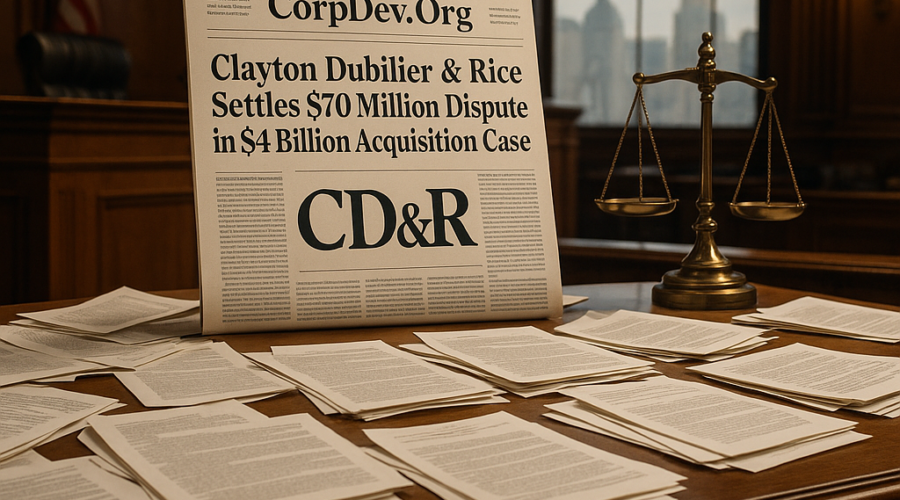
Clayton Dubilier & Rice (CD&R) has agreed to a $70 million settlement stemming from a dispute related to a $4 billion acquisition, highlighting the increasing legal and operational risks in large-scale leveraged buyouts. This settlement, representing approximately 1.75% of the transaction value, underscores common friction points like representations and warranties, earnout provisions, or post-closing adjustments. The case serves as a critical reminder for institutional investors and deal advisors that deal litigation risk is a material component of private equity return analysis, necessitating rigorous deal structuring and comprehensive insurance coverage. Even top-tier sponsors face significant post-closing liabilities that must be factored into financial planning.
- Firm Involved
- Clayton Dubilier & Rice (CD&R)
- Settlement Amount
- $70 million
- Underlying Acquisition Value
- $4 billion
- Nature of Dispute
- Likely centered on representations and warranties, earnout provisions, or post-closing adjustments
- Firm’s AUM
- Approximately $80 billion
- Firm Founded
- 1978
- Settlement Ratio to Deal Value
- Approximately 1.75%
- Market Context
- Heightened deal litigation due to valuation volatility, regulatory scrutiny, and sponsor-to-sponsor conflicts
null
Clayton Dubilier & Rice (CD&R), one of the largest independent private equity firms globally, has agreed to a $70 million settlement resolving a contentious dispute tied to a $4 billion acquisition. The settlement marks a significant resolution in a high-stakes deal litigation that underscores mounting legal and operational risks in large-scale leveraged buyouts and the increasing scrutiny of private equity transaction structures.
Most “AI for Diligence” tools are lying to you. The truth is, they are just ChatGPT wrappers. Experience what real AI for Diligence looks like, built like Claude Code, but for M&A/ PE Diligence:
💼 When Claude Code Marries Due Diligence!
Deal Background and Dispute Origins
While specific transaction details remain subject to confidentiality agreements typical in private equity settlements, the $4 billion acquisition in question represents the scale of capital deployment and complexity that characterizes CD&R’s portfolio strategy. The dispute likely centers on representations and warranties, earnout provisions, or post-closing adjustments—common friction points in large institutional acquisitions where valuation methodologies and financial performance metrics diverge between buyer and seller.
CD&R, founded in 1978 and headquartered in New York, manages approximately $80 billion in assets under management across multiple funds. The firm has built a reputation for operational value creation and long-term holding periods, distinguishing itself from shorter-duration private equity models. This settlement, however, reflects the reality that even established sponsors face litigation exposure in complex transactions.
Implications for Private Equity Deal Structures
The $70 million settlement carries broader implications for how private equity firms structure acquisitions and manage post-closing disputes. Several trends emerge:
- Representations and Warranties Insurance (RWI) Gaps: Settlements of this magnitude often indicate gaps in insurance coverage or disputes over what constitutes a covered claim. Private equity firms increasingly rely on RWI policies to mitigate tail risk, yet litigation over policy interpretation and coverage boundaries remains common.
- Earnout and Adjustment Mechanisms: Large deals frequently include earnout provisions or purchase price adjustment mechanisms tied to post-closing financial performance. Disagreements over EBITDA calculations, working capital adjustments, or revenue recognition standards frequently trigger disputes.
- Seller Financing and Holdback Escrows: In transactions where sellers retain equity or provide financing, disputes over escrow release conditions and indemnification claims are routine. The settlement amount suggests material financial exposure.
Market Context: Private Equity Litigation Trends in 2025-2026
The CD&R settlement occurs within a broader environment of heightened deal litigation. According to legal and consulting sources, private equity dispute resolution has intensified due to several factors:
- Valuation Volatility: Macroeconomic uncertainty, interest rate fluctuations, and sector-specific headwinds have created wider gaps between buyer and seller expectations regarding post-closing performance. This volatility increases the likelihood of earnout disputes and working capital adjustments.
- Regulatory Scrutiny: Enhanced antitrust enforcement and ESG-related compliance requirements have expanded the scope of representations and warranties, creating additional litigation vectors.
- Sponsor-to-Sponsor Conflicts: As secondary and continuation fund strategies proliferate, disputes between sponsors over valuation, governance, and exit timing have become more frequent.
CD&R’s Strategic Position and Track Record
Despite this settlement, CD&R maintains a strong operational and financial track record. The firm’s portfolio includes stakes in healthcare, technology, business services, and industrial sectors. Notable investments have included stakes in companies such as Bausch + Lomb, Albertsons, and various healthcare platforms. CD&R’s approach emphasizes operational improvements, management retention, and multi-year value creation rather than financial engineering.
The settlement does not materially impact CD&R’s capital raising or investor confidence, given the firm’s scale and historical returns. However, it underscores that even top-quartile sponsors face deal-related litigation and that settlement costs should be factored into post-acquisition financial planning.
Broader Lessons for Institutional Investors and Deal Advisors
The CD&R case offers several takeaways for institutional investors evaluating private equity opportunities and for deal advisors structuring transactions:
- Diligence Depth: Thorough pre-closing diligence reduces post-closing disputes. Sellers increasingly push back on broad representations, necessitating more granular financial and operational due diligence.
- Insurance Strategy: RWI policies should be carefully tailored to cover identified risks. Standard policies often exclude specific sectors, transaction types, or claim categories.
- Escrow and Holdback Sizing: Adequate escrow reserves and holdback periods provide cushion for post-closing adjustments. Underfunded escrows frequently lead to disputes when claims exceed available reserves.
- Earnout Design: Clear, objective performance metrics reduce earnout litigation. Subjective metrics or those dependent on management discretion frequently trigger disputes.
Comparable Settlements and Historical Context
Large private equity settlements are not uncommon. In recent years, disputes involving sponsors such as Apollo Global Management, Blackstone, and KKR have resulted in settlements ranging from tens of millions to over $500 million in certain cases. These settlements typically involve earnout disputes, working capital adjustments, or breach of representations and warranties claims.
The $70 million settlement in the CD&R case, while material, represents approximately 1.75% of the underlying $4 billion transaction value—a ratio consistent with typical earnout or adjustment disputes in mid-market and large-cap private equity transactions.
Looking Ahead: Deal Risk Management in 2026
As private equity firms continue to deploy capital in a higher-interest-rate environment, deal structures will likely become more complex. Sellers will demand higher earnout percentages to bridge valuation gaps, and sponsors will seek more granular adjustment mechanisms. This complexity will increase litigation risk unless transaction documents are drafted with precision and supported by robust post-closing governance frameworks.
The CD&R settlement serves as a reminder that even well-executed transactions can face post-closing disputes. Institutional investors should view deal litigation risk as a material component of private equity return analysis and ensure that sponsors have adequate reserves, insurance, and dispute resolution protocols in place.
Conclusion
Clayton Dubilier & Rice’s $70 million settlement in the $4 billion acquisition dispute reflects the operational and legal complexities inherent in large-scale private equity transactions. While the settlement does not diminish CD&R’s standing as a premier sponsor, it underscores the importance of rigorous deal structuring, comprehensive insurance coverage, and clear post-closing governance. For institutional investors and deal advisors, the case reinforces that private equity transaction risk extends well beyond closing and that effective risk mitigation requires attention to representations, warranties, earnout mechanisms, and dispute resolution frameworks.
“`
Sources