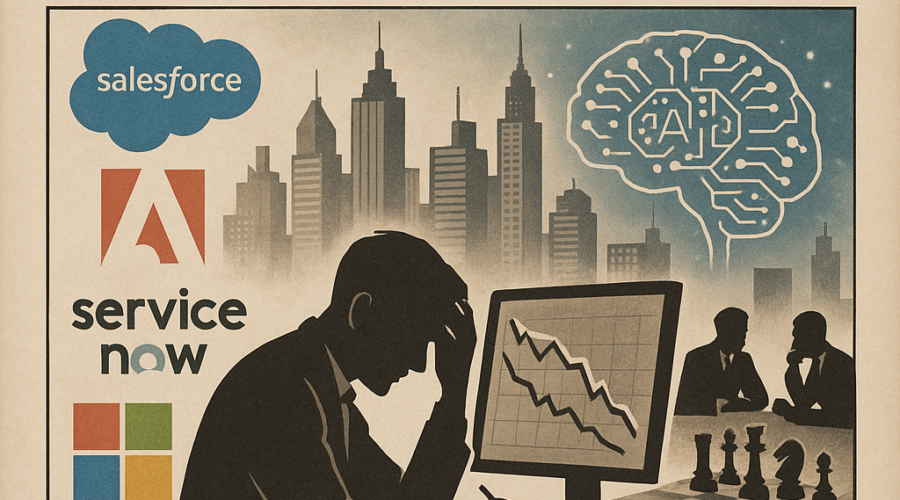
Investor panic over AI’s disruption of SaaS business models has triggered a sharp selloff in software stocks, dubbed the “SaaSpocalypse,” as agentic AI systems from Anthropic and OpenAI threaten traditional seat-based pricing and workflows.[3][6] Private equity firms, however, see opportunity in the undervalued assets, positioning for **SaaS M&A consolidation** and **private equity buyouts in AI-disrupted software** amid 2026’s valuation reset.[5][9]
Set and exceed synergy goals with benchmarks and actionable operational initiative level data from similar deals from your sector:
💼 Actionable Synergies Data from 1,000+ Deals!
AI Agents Undermine SaaS Moats
Agentic AI launches, including Anthropic’s Claude Cowork for workplace productivity and legal tasks, are pressuring SaaS incumbents by replicating functions at lower costs.[5][7] Investors fear fragmentation of toolchains and pricing power erosion, with Microsoft’s AI CEO predicting automation of most white-collar tasks within 18 months.[3][8] This has hit stocks across sectors, from DevSecOps platforms like GitLab to logistics software, as AI scales operations without headcount growth.[1][2][6]
GitLab’s early February 2026 Transcend event highlighted its pivot to agentic AI via Intelligent Orchestration and Duo Agent Platform, shifting from seat-based to usage-based pricing to counter competition from GitHub and others.[2] Projections show $1.4 billion revenue by 2028 at 21.6% annual growth, but analyst target cuts reflect execution risks in AI-led workflows.[2]
Selloff Creates Private Equity Entry Points
Despite fears, high switching costs and gross retention rates near 100% protect leading SaaS firms, with net revenue retention often exceeding 100% as customers expand usage.[5] Atlassian reports 120% net retention for cloud customers, targeting 18% revenue growth in 2026 with AI integrations and a forward P/E of 21.[5] Adobe’s Creative Cloud, bolstered by AI features in one-third of recurring revenue, trades below 12 times forward earnings.[5]
Private equity views this as a **SaaS valuation reset for PE acquisitions**, akin to post-2008 cycles where firms like KKR and Blackstone scooped undervalued software at 4-6x EBITDA multiples before AI tailwinds drove exits.[5] Current dynamics mirror 2022’s rate-hike dip, but with AI infrastructure spend rising—Nvidia-Red Hat ecosystems signal ongoing data center demand—PE can fund AI retrofits for portfolio companies.[1]
| Company | Net Retention | Fwd P/E | 2026 Rev Growth |
|---|---|---|---|
| Atlassian | 120% | 21x | 18% |
| Microsoft (Dynamics) | N/A | 24x | 17% |
| Adobe | >100% | 12x | Double-digit |
[5]
Incumbents Adapt with AI Embeddings
Survivors integrate AI rather than compete directly. Wolters Kluwer embeds GenAI and agentic AI across tax, legal, and healthcare platforms like CCH Axcess and VitalLaw, leveraging domain expertise for compliant workflows.[4] Workday, down $40 billion in value, sees cofounder Aneel Bhusri return with a $139 million investment to accelerate AI capabilities.[8]
McKinsey and Bain analyses of **AI disruption in enterprise software** emphasize hybrid models: 60% of SaaS leaders plan usage-based pricing by 2027, blending AI agents with legacy stickiness to sustain 15-20% growth. Regulatory hurdles on data centers may slow pure AI plays, favoring PE-backed SaaS with established compliance moats.[8]
PE Strategies in the SaaSpocalypse
- Distressed Buyouts: Target 8-10x revenue multiples on non-AI-exposed SaaS, retrofit with agentic tools for 2x uplift in **private equity exit strategies in SaaS**.
- Cross-Border Rollups: Consolidate fragmented verticals like legal tech, mirroring Kirkland & Ellis-advised deals in Europe amid **cross-border M&A trends 2025-2026**.
- AI Infrastructure Bets: Pair SaaS acquisitions with data center exposure, capitalizing on Anthropic’s $30 billion raise and $18 billion 2026 revenue forecast.[7]
Goldman Sachs notes PE dry powder at $2.5 trillion could drive **SaaS private equity investments 2026**, focusing on firms with 110%+ net retention. The selloff, while painful, sets up a rebound as AI proves augmentative, not apocalyptic, for enterprise software.[5][2]
Sources
https://siliconangle.com/2026/02/13/red-hat-nvidia-ecosystem-ai-infrastructure-aifactoriesdatacenters/, https://simplywall.st/stocks/us/software/nasdaq-gtlb/gitlab/news/does-gitlabs-agentic-ai-pivot-and-pricing-shift-reframe-the, https://nextdraft.com/archives/n20260213/frankensteins-laptop/, https://www.wolterskluwer.com/en/about-us/artificial-intelligence, https://www.nasdaq.com/articles/tech-sector-wall-street-shunning-right-now-all-wrong-reasons, https://managingeditor.substack.com/p/frankensteins-laptop, https://cryptorank.io/news/feed/68fbb-anthropic-raises-30b-as-ai-boom-sparks-crypto-concerns, https://fortune.com/section/tech/, https://www.aol.com/articles/tech-sector-wall-street-shunning-195200229.html, https://www.aol.com/finance/small-business-2026-economic-outlook-152300821.html