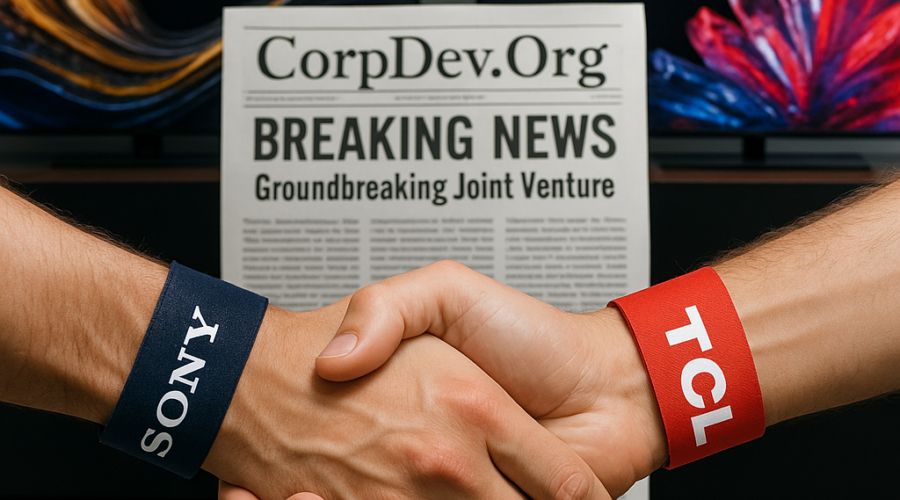
Sony and China’s TCL have signed a non-binding agreement to spin off Sony’s TV and home audio hardware business into a joint venture, with TCL holding a 51% stake and assuming manufacturing control starting April 2027.[2][3][4] The BRAVIA brand will persist under the partnership, signaling a strategic pivot amid **global display industry consolidation** and **cross-border M&A trends 2025-2027**.
Set and exceed synergy goals with benchmarks and actionable operational initiative level data from similar deals from your sector:
💼 Actionable Synergies Data from 1,000+ Deals!
Deal Structure and Timeline
The venture targets Sony’s television and home entertainment operations, including BRAVIA TVs, with operations launching in April 2027.[2][4][5] TCL gains majority ownership at 51%, while Sony retains influence over branding and design to preserve premium positioning.[2][10] Described as a “moment istoric” for the sector, the move allows Sony to exit low-margin manufacturing while leveraging TCL’s scale in panel production.[1][9]
| Key Deal Terms | Details |
|---|---|
| Ownership | TCL: 51%; Sony: 49% |
| Operations Start | April 2027 |
| Scope | TVs (BRAVIA) and home audio hardware |
| Brand Retention | BRAVIA continues under JV |
Strategic Rationale for Sony and TCL
Sony shifts focus to high-margin segments like content, gaming, and semiconductors, offloading commoditized TV assembly amid eroding profits.[8] TCL, a leading panel maker, expands into premium branding, bolstering its position against Samsung and LG in the $150 billion global TV market.[2][6] The partnership echoes **private equity exit strategies in consumer electronics**, where asset-light models drive value through JVs rather than outright sales.
Industry and Regulatory Context
- Japan’s antitrust authorities are reviewing the JV, with clearance expected given complementary strengths.[5]
- Reflects broader **cross-border M&A in display technology**, including China’s push into high-end manufacturing despite U.S. tariff risks.
- Sony investors view the deal neutrally, prioritizing content deals like Netflix’s $7B film rights pact through 2032.[3][8]
Implications for Stakeholders
For C-level executives in electronics and PE, the JV highlights **synergies in TV supply chain M&A**, with TCL’s cost efficiencies potentially pressuring rivals’ margins. No immediate layoffs announced, but manufacturing shifts to TCL facilities could impact Sony’s workforce.[2] Bain and BCG analyses of similar deals forecast 15-20% cost savings via Asian consolidation, though IP protection remains key in U.S.-China tensions.
Comparable transactions include Hisense’s partnerships with Sharp, underscoring Chinese firms’ ascent in legacy brands.
Sources
https://oficiuldestiri.ro/cum-iti-pot-fi-furati-banii-din-crypto-in-cateva-secunde-cele-mai-periculoase-capcane-si-cum-le-poti-evita, https://www.ozbargain.com.au/node/944987, https://mediagazer.com/river, https://pokde.net/gadget/tv/sony-tcl-tv-partnership, https://www.mlex.com/mlex/mergers-acquisitions, https://www.ndtv.com/topic/technolog, https://www.techmeme.com/river, https://www.marketbeat.com/stocks/NYSE/SONY/news/, https://www.gamereactor.eu/texts/, https://www.findarticles.com/news/business/, https://www.findarticles.com