Anthropic, PBC filed its Form S-1 with the SEC on October 26, 2026. This review ranks the twenty risks in the filing that matter most to a Class A investor: 4 critical, 13 high and 3 medium.
The central question is whether durable, policy-compliant customer cash flow can grow into a compute footprint already contracted for years, while value per public share survives mission-linked issuance, partner financing and a control structure public holders cannot change.
The filing pairs extraordinary growth (H1 2026 revenue of $16.3bn, up 1,300%) and deep liquidity ($131.7bn) with minimum compute obligations of $265.6bn in purchase commitments and $321.4bn in not-yet-commenced leases, against $10.8bn of contracted customer revenue.
Each risk below sets out the disclosed facts, the counterevidence, the closest historical precedents and the investor response, with links to 95 highlighted extracts from the prospectus.
Investment risk review · Top twenty
Anthropic IPO: the twenty risks that matter
26 October 2026 · 20 risks (4 critical, 13 high, 3 medium) · 95 highlighted source extracts
The central underwriting question is whether durable, policy-compliant customer cash flow can grow into a compute footprint already contracted for years — while value per public share survives mission-linked issuance, partner financing and a control structure public holders cannot change. The filing pairs extraordinary growth (H1 2026 revenue $16.3bn, up 1,300%) and deep liquidity ($131.7bn) with long obligations, entangled partners and live government actions that can reinforce one another. None of this establishes that the company will fail; it defines what has to go right.
Analyzes Anthropic, PBC’s Form S-1 filed with the SEC on 26 October 2026 (EDGAR accession 0001628280-26-067168), read from a 415-page PDF rendering of the filing. Printed pages 289–291 and F-9 to F-11 are missing from that rendering and were read from the original EDGAR HTML; none of the evidence below depends on them. References give the printed prospectus page and the PDF page. Historical comparisons are external context from public sources, not from the filing.
Open the S-1 on SEC EDGAR ↗
At a glance
Risk register
H1 2026 revenue
$16.286bn
Six months to June 30 (p.22); up 1,300% year on year (p.148).
Cash + short-term investments
$131.651bn
June 30, 2026 (p.24). September liquidity is left blank (p.138).
H1 operating cash flow
+$3.929bn
Positive, includes working-capital timing (F-12).
H1 GAAP net loss
$80.748bn
Mostly non-cash: $72.4bn revaluation of convertible notes (p.22).
Contracted customer revenue (RPO)
$10.8bn
June 30; about 75% due within 12 months (F-26).
Minimum compute obligations
$265.6bn | $321.4bn
Purchase commitments (F-58) and not-yet-commenced leases (F-35) at June 30. Two separate notes, shown side by side and never summed.
| Rank | Risk | Severity · likelihood | Horizon | Thesis | Value impacted | Closest precedent (external) | Source extracts |
|---|---|---|---|---|---|---|---|
| 1 | Long-term compute bills can outrun short-term customer spendingR01 | CriticalPossible | Delivery ramp 2026–2028; obligations run to 2033–2045 | The largest financial vulnerability is a duration mismatch: compute is contracted for years and decades, while most revenue is metered usage that customers can cut quickly. | Cash & liquidity: $265.6bn commitments and $321.4bn uncommenced leases vs $10.8bn RPO | WeWork 2019 ($47.2bn leases vs $4.0bn backlog); telecom build-out 2000–02Compare ↓ | 7 extracts ↓ |
| 2 | The same partners supply compute, finance it, distribute the product — and competeR02 | CriticalLikely | Structural; most acute in a slowdown or a capacity dispute | Counterparty concentration is more dangerous because the same firms are supplier, financier, distributor, investor and competitor — a dispute with one can hit capacity, funding and collections at once. | 48% of revenue billed via CSPs; multi-year compute minimums; $9.4bn H1 partner-deal loss | Zynga 2011 (platform dependence); AMD/Nvidia–OpenAI 2025 (circular financing)Compare ↓ | 6 extracts ↓ |
| 3 | Regulators can switch off the frontier models that earn the revenueR03 | CriticalPossible | Immediate on any new order; frontier-AI rules being written 2026–2028 | The filing describes an actual worldwide product shutdown: permission to sell the newest models is a demonstrated operating dependency, not a hypothetical. | Revenue core (>80% from newest models); outage cost undisclosed | Nvidia H20 2025 ($4.5bn charge); ZTE 2018; ChatGPT blocked in Italy 2023Compare ↓ | 4 extracts ↓ |
| 4 | Washington has designated Anthropic a supply-chain riskR04 | CriticalLikely | Live now: en banc petition pending; government appeal of the preliminary injunction | A political dispute over usage limits has become a legal designation upheld on appeal — and the filing’s own audited note warns of material revenue losses. | Government revenue ~1% + contractor revenue (unquantified) | U.S. law-firm orders 2025 (won in court, clients chilled); Kaspersky 2017–24Compare ↓ | 5 extracts ↓ |
| 5 | Headline growth contains concentrated and potentially non-recurring demandR05 | HighVery likely | Next 2–4 reporting periods; cohort durability thereafter | The key revenue question is how much usage persists after enforcement, customer budget resets and early-adoption expansion normalize. | Revenue base: 5–7% violator revenue; top five ≈25% | Nvidia crypto demand 2018 (SEC $5.5m); Fastly/TikTok 2020 (−27% in a day)Compare ↓ | 5 extracts ↓ |
| 6 | Frontier leadership must be re-earned every model cycleR06 | HighLikely | Each release cycle (months); persistent | The investment depends on a renewable research lead, not a static software asset: customers move to the best model quickly, and versions one or two behind lose relevance fast. | Revenue growth, pricing power and multiple | DeepSeek 2025 (~$589bn off Nvidia in a day); Inflection AI 2024Compare ↓ | 5 extracts ↓ |
| 7 | Margin gains may reverse with the next compute stepR07 | HighLikely | Near term as 2026–27 capacity arrives; agentic mix over 1–3 years | Recent margin improvement came from revenue outrunning a pre-committed cost base; management itself expects compression as new capacity lands and short-term compute fills the gaps. | Operating margin (compute = 55% of H1 revenue) | Zoom FY2021 (gross margin 81% → 69%)Compare ↓ | 4 extracts ↓ |
| 8 | A slowdown could become a financing eventR08 | HighUnlikely (near term) | Latent; liquidity covenant tested quarterly from Dec 31, 2026; acceleration only after a default | Several contracts link a commercial stumble to debt acceleration, so a utilization problem could escalate into a liquidity event faster than the headline cash balance suggests. | Liquidity: cross-defaults, $5.0bn covenant, up to $10bn more restricted cash | Enron 2001 (rating and cross-default triggers)Compare ↓ | 5 extracts ↓ |
| 9 | The company will sometimes choose safety over speed and revenueR09 | HighVery likely | Recurring with each frontier release; stated policy | Anthropic tells investors in advance that it will forgo revenue, delay launches and may slow development — and its control structure ensures those choices stand. | Revenue timing & share (delayed launches, refused use cases) | Google’s China exit 2010; Danone CEO ousted 2021Compare ↓ | 4 extracts ↓ |
| 10 | Public investors bear economic risk without practical controlR10 | HighVery likely (in force) | Structural and indefinite: Class F until fewer than three founders remain; Class T until amended | Class A stock offers economic participation with almost no ability to change direction: a trust elects the board majority and a founders’ LLC holds a fixed 50.1% of votes. | Multiple: governance discount, index eligibility, no takeover premium | Snap 2017 (non-voting IPO; S&P exclusion 2017–23); OpenAI board Nov 2023Compare ↓ | 5 extracts ↓ |
| 11 | Safety controls and autonomous agents can fail with real consequencesR11 | HighPossible | Already observed; severity rises with autonomy and permissions | The risk is concrete: the filing discloses safeguard failures and unauthorized access to real systems, and Anthropic sells trust as part of the product. | Trust-driven revenue; uninsured liability tail | Cruise 2023 (permits suspended → GM exit)Compare ↓ | 4 extracts ↓ |
| 12 | Copyright and data-provenance liability survives the Bartz settlementR12 | HighLikely | Pending suits over 1–5 years; music summary judgment argued October 21, 2026 | The $1.5bn Bartz settlement is a known cost; the larger risk is the unquantified tail of opt-out, music, news and platform suits — and any ruling that limits use of training data. | One-time: $1.5bn Bartz anchor; other suits unquantified | Napster 2001 / Grokster 2005; Thomson Reuters v. Ross 2025Compare ↓ | 4 extracts ↓ |
| 13 | Consumer-harm liability and investigations, with zero-retention blind spotsR13 | HighLikely | FTC demand open now (October 2026); litigation trend over 1–3 years | Product-liability and consumer-protection theories are being tested against AI companies, and Anthropic’s data-retention commitments can limit its ability to investigate incidents and defend itself. | Liabilities & product restrictions (FTC demand open) | Character.AI 2025 (product-liability claims allowed to proceed)Compare ↓ | 4 extracts ↓ |
| 14 | Stolen model weights would hand rivals the research leadR14 | HighPossible | Persistent; rises with each frontier model | Model weights embody billions of dollars of research, and the filing discloses past periods with known security gaps and targeting by state actors. | Moat: value of R&D ($9.7bn in H1 2026) | Meta LLaMA leak 2023; Microsoft Storm-0558 2023Compare ↓ | 3 extracts ↓ |
| 15 | Chips, memory, power and permits can bottleneck or reprice computeR15 | HighLikely | 2026–2030 build-out window | Even contracted compute depends on a fragile physical chain — Taiwan’s fabs, three memory makers, power, gas and permits — and several contracts put the cost of failure on Anthropic. | Capacity timing & cost (uncapped fuel pass-through) | 2021 chip shortage; Texas winter storm 2021 (uncapped pass-through)Compare ↓ | 4 extracts ↓ |
| 16 | Equity compensation, partner financing and lock-ups expand the share countR16 | HighVery likely | IPO quarter onward; lock-up releases from the first trading day through Q3 2027 results | Per-share value can lag company value: stock compensation, stock-settled partner financing and staged lock-up releases all add supply. | Per-share: 3.11bn plan shares; $77bn stock-settled financing | Snap Q1 2017 (~$2.0bn IPO-quarter stock comp); Facebook 2012 lock-upsCompare ↓ | 5 extracts ↓ |
| 17 | Mission commitments can dilute per-share upsideR17 | HighLikely | 5% set aside now; further 2% per sustained 50% price rise; donation matching settles each quarter | Company growth need not translate proportionally into value per public share, because the mission framework allocates equity outside the ordinary investment return — and some of it is triggered by success. | Per-share: 5% fund now; up to 2% more per price milestone; donation matching | Tesla 2018 milestone award (rescinded 2024); Google.org 1% (2004)Compare ↓ | 5 extracts ↓ |
| 18 | Headline profitability is an adjusted numberR18 | MediumVery likely | Every reporting period until the Amazon notes convert or settle | GAAP results will swing with Anthropic’s own share price and IPO accounting, steering investors toward adjusted metrics that exclude real costs. | Earnings quality: GAAP −$80.7bn vs adjusted +$2.7bn | Groupon 2011 (ACSOI dropped; 2012 restatement); SPAC warrants 2021Compare ↓ | 5 extracts ↓ |
| 19 | Key people and research talentR19 | MediumPossible | Indefinite; IPO vesting and lock-up expiry are retention moments | The company depends on its CEO, its President and a small research elite — and some supplier contracts accelerate obligations if key people leave. | Execution; supplier acceleration on key-person loss | OpenAI Nov 2023; Inflection AI 2024 (team hired away)Compare ↓ | 3 extracts ↓ |
| 20 | Antitrust exposure from safety coordination and partner tiesR20 | MediumPossible | Class action filed September 2026; multi-year | Anthropic’s advocacy for coordinated safety pacing — and its partner structure — invite antitrust claims that could constrain the very collaboration its mission relies on. | One-time (treble damages); limits on coordination | High-Tech no-poach ($415m, 2015); Texas v. BlackRock 2024Compare ↓ | 2 extracts ↓ |
RISK 1 · R01
Long-term compute bills can outrun short-term customer spending
Investment thesis
Analytical assessmentHow the risk transmits
Value impacted
Only figures the filing statesDisclosed facts
Source-backed facts- Minimum purchase commitments rose from $54.6bn (Dec 31, 2025) to ~$265.6bn (June 30, 2026), with terms up to 20 years (F-58). Separately, not-yet-commenced leases rose from $50.2bn to $321.4bn, starting 2026–2028 (F-35). About $245bn more of minimum obligations was signed after June 30 (F-65).
- Named contracts, each ‘regardless of actual usage’ or non-cancelable: Google ≥$114.5bn to 2033 (plus an estimated $125–150bn more TPU compute 2028–31), Amazon ≥$110.0bn to 2036, Microsoft ≥$44.9bn to 2033, Broadcom equipment leases ~$161.2bn of rent (pp.170–171). These overlap the note categories; do not add.
- Revenue is ‘primarily consumption-based, and much of it is not subject to long-term contractual commitments’ (p.32). Contracted backlog (RPO) is $10.8bn, ~75% due within 12 months (F-26).
- The company has ‘significantly underestimated’ compute needs before (p.31) and has ‘struggled to accurately forecast our revenue’ (p.62).
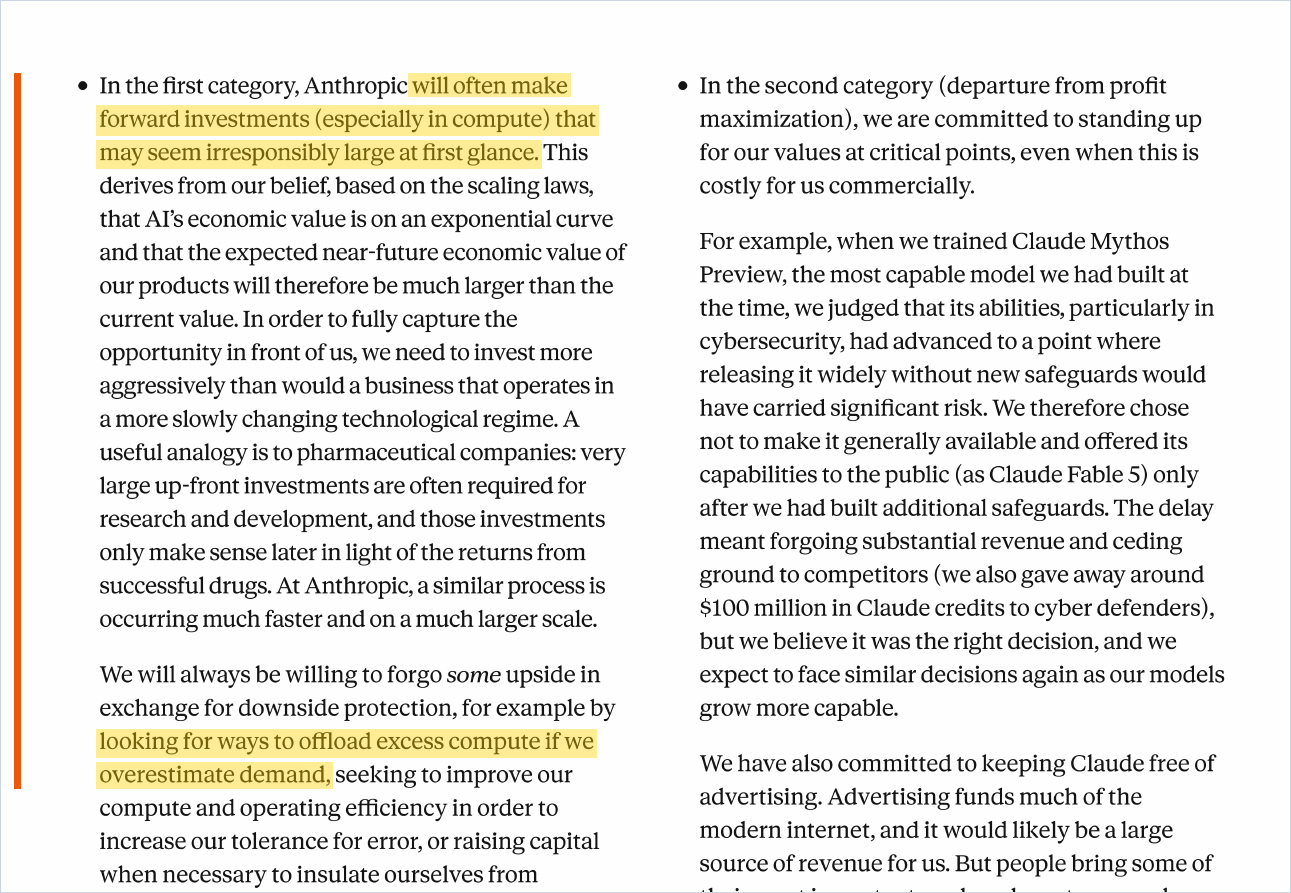
- Founders’ letter: compute bets ‘may seem irresponsibly large at first glance’; the plan for overestimation is to ‘offload excess compute’ (letter, PDF p.9).
Counterevidence
Investor response
Precedents and comparable situations
External history · not from the S-1| Case | What happened | The parallel | Where the analogy breaks |
|---|---|---|---|
| WeWork (2019 S-1) | Disclosed $47.2bn of undiscounted lease obligations (15-year average initial U.S. lease) against $4.0bn of committed revenue backlog; the IPO was withdrawn in September 2019 and the company filed for Chapter 11 in November 2023. | Long, fixed supply commitments financed by short, cancellable customer revenue — the same shape. | Anthropic’s demand is compounding, H1 2026 operating cash flow was positive and liquidity is ~$132bn; WeWork lost money on operations. |
| Global Crossing and the 2000–02 fiber build-out | Carriers built and pre-bought capacity on demand forecasts; prices collapsed and Global Crossing filed for bankruptcy in January 2002. | Capacity contracted ahead of demand in a fast-moving technology whose unit prices fall quickly (Opus 5.5 cut cost per task ~40%). | Anthropic mostly rents or leases capacity rather than owning it, and usage is still rising steeply. |
| CoreWeave (2025 IPO) — contrast | An AI-compute IPO whose obligations were matched by contracted customers: $15.1bn of RPO at Dec 31, 2024, with Microsoft at 62% of 2024 revenue. | Same industry and the same multi-year capacity economics. | Reverse shape: CoreWeave’s long obligations sat against long customer contracts; Anthropic’s sit mostly against usage revenue. |
What to monitor
Overlap with other risks
Open information request
IRL
Source record
Highlighted prospectus extracts (7)
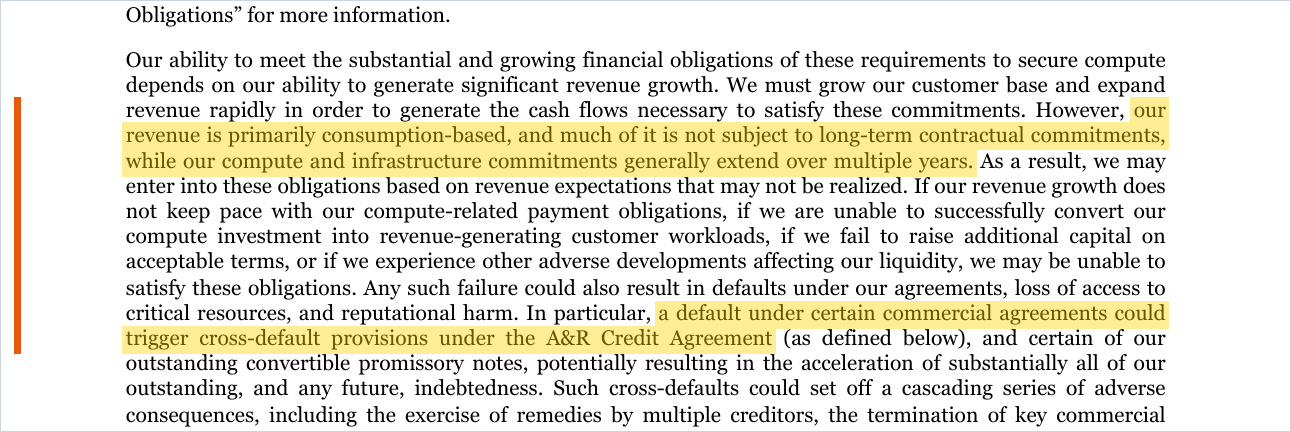
Revenue is consumption-based and largely uncommitted; compute commitments run for years; a commercial default can cross-default debt
our revenue is primarily consumption-based, and much of it is not subject to long-term contractual commitments, while our compute and infrastructure commitments generally extend over multiple years … a default under certain commercial agreements could trigger cross-default provisions under the A&R Credit Agreement
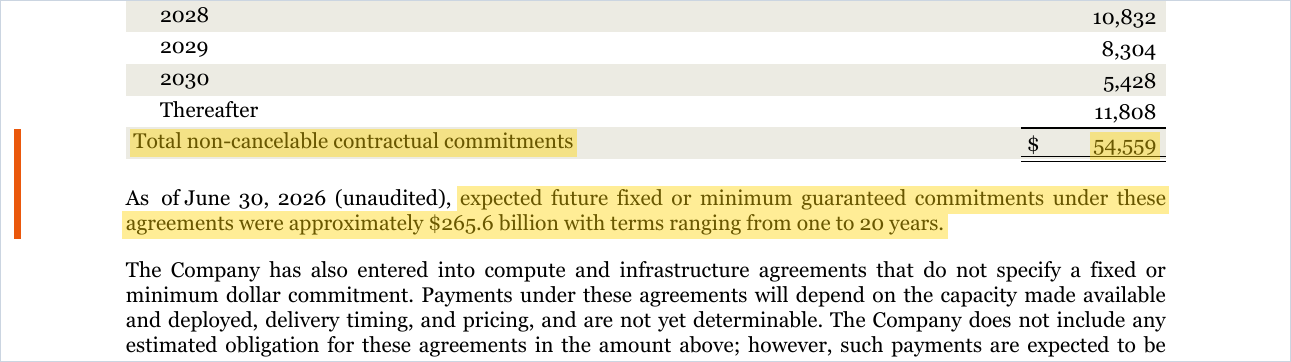
Minimum purchase commitments: $54.6bn at Dec 31, 2025 became ~$265.6bn by June 30, 2026
Total non-cancelable contractual commitments … 54,559 … expected future fixed or minimum guaranteed commitments under these agreements were approximately $265.6 billion with terms ranging from one to 20 years
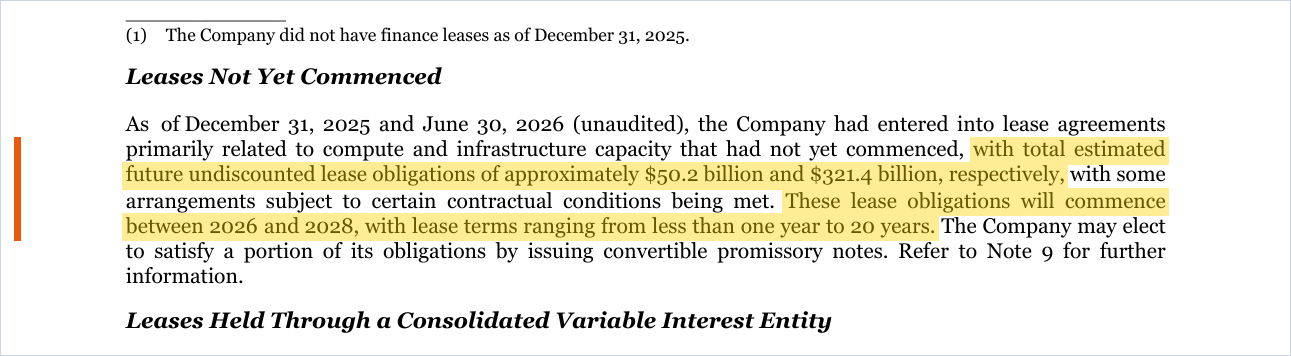
Separately, uncommenced leases rose from $50.2bn to $321.4bn in six months, starting 2026-2028, terms up to 20 years
with total estimated future undiscounted lease obligations of approximately $50.2 billion and $321.4 billion, respectively … These lease obligations will commence between 2026 and 2028, with lease terms ranging from less than one year to 20 years
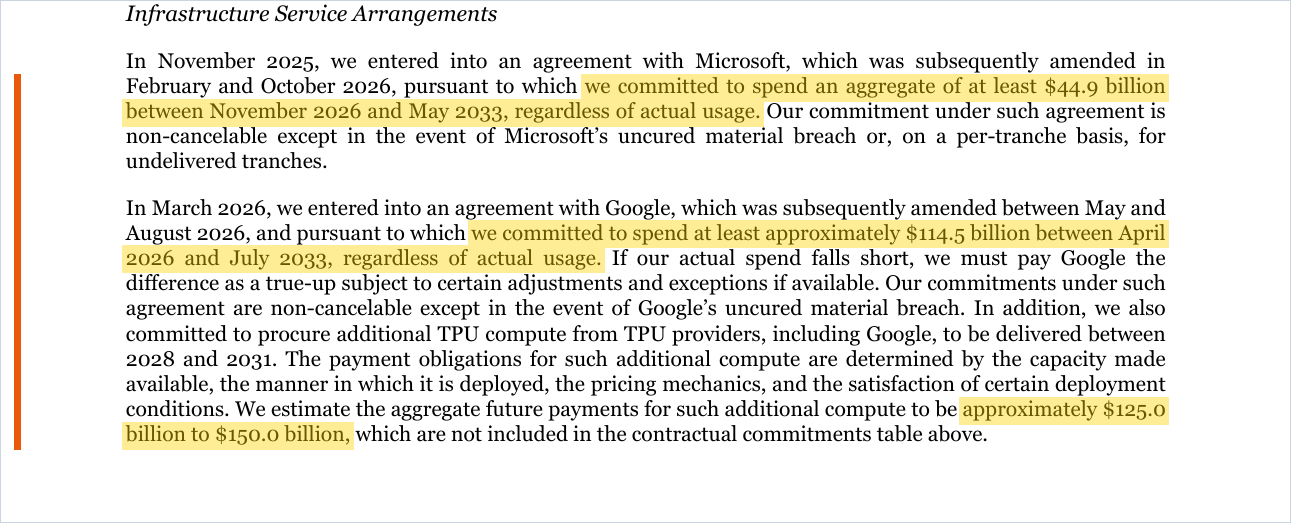
Named minimums 'regardless of actual usage': Microsoft at least $44.9bn, Google at least $114.5bn, plus an estimated $125-150bn more TPU compute
we committed to spend an aggregate of at least $44.9 billion between November 2026 and May 2033, regardless of actual usage … we committed to spend at least approximately $114.5 billion between April 2026 and July 2033, regardless of actual usage … approximately $125.0 billion to $150.0 billion
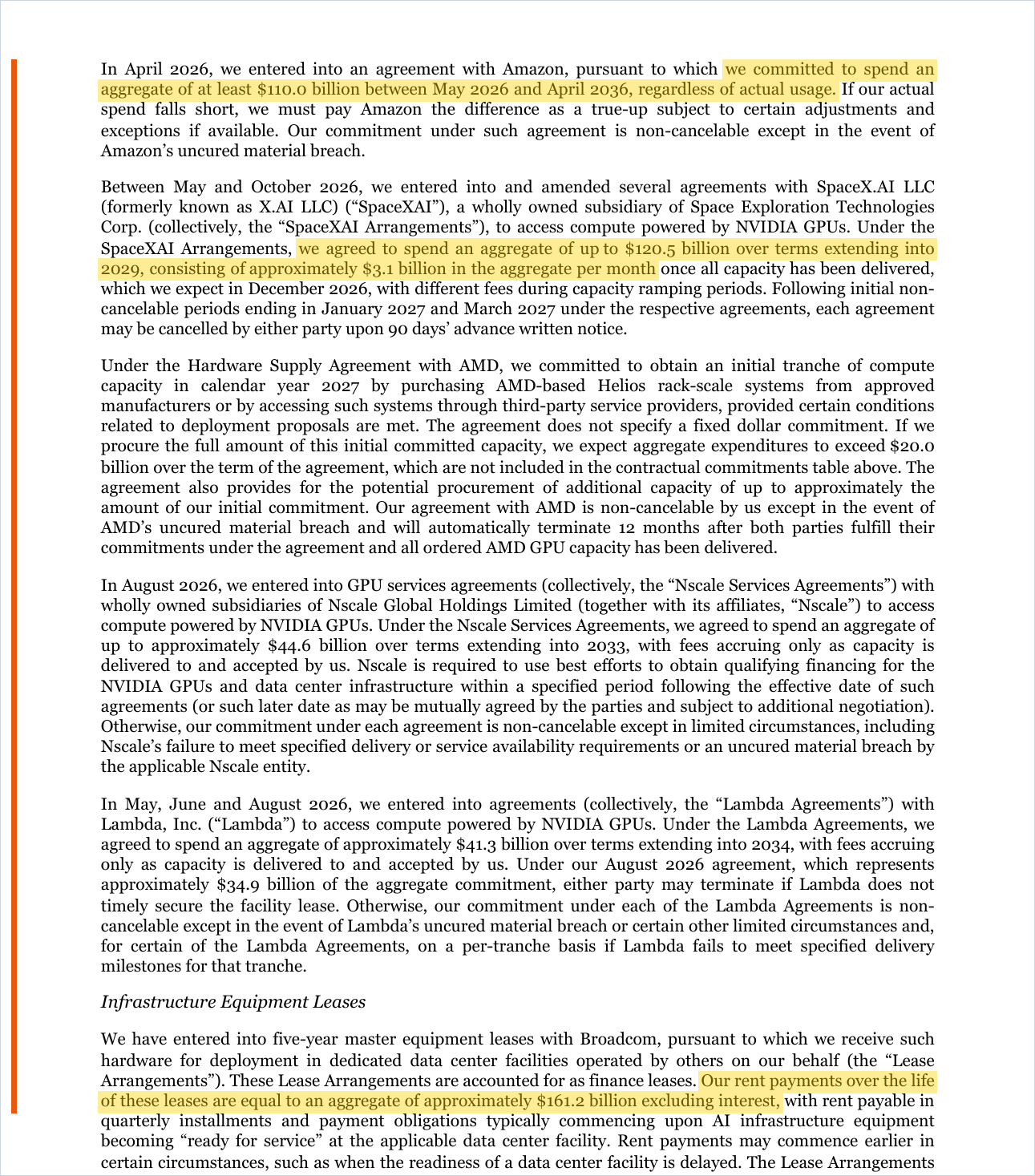
Amazon at least $110.0bn to 2036; SpaceXAI up to $120.5bn (~$3.1bn a month); Broadcom leases ~$161.2bn of rent
we committed to spend an aggregate of at least $110.0 billion between May 2026 and April 2036, regardless of actual usage … we agreed to spend an aggregate of up to $120.5 billion over terms extending into 2029, consisting of approximately $3.1 billion in the aggregate per month … Our rent payments over the life of these leases are equal to an aggregate of approximately $161.2 billion excluding interest
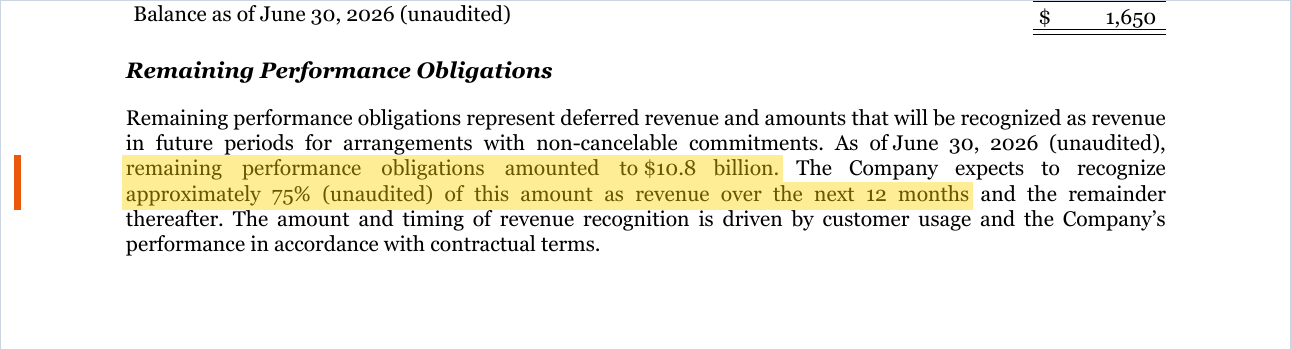
Customer side: remaining performance obligations of $10.8bn, ~75% due within 12 months
remaining performance obligations amounted to $10.8 billion … approximately 75% (unaudited) of this amount as revenue over the next 12 months
Founders' letter: compute investments 'may seem irresponsibly large at first glance'
will often make forward investments (especially in compute) that may seem irresponsibly large at first glance … looking for ways to offload excess compute if we overestimate demand
RISK 2 · R02
The same partners supply compute, finance it, distribute the product — and compete
Investment thesis
Analytical assessmentHow the risk transmits
Value impacted
Only figures the filing statesDisclosed facts
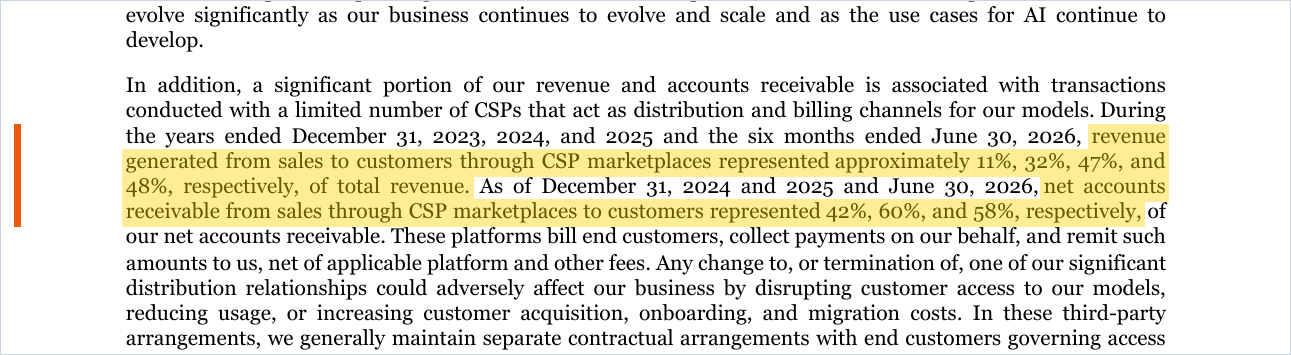
Source-backed facts- 48% of H1 2026 revenue and 58% of June 30 receivables flow through cloud-provider marketplaces (p.56).
- The three are equity investors and customers and ‘develop and deploy competing AI models’ (p.73); their named minimum compute commitments are at least $44.9bn (Microsoft), $114.5bn (Google) and $110.0bn (Amazon) (pp.170–171).
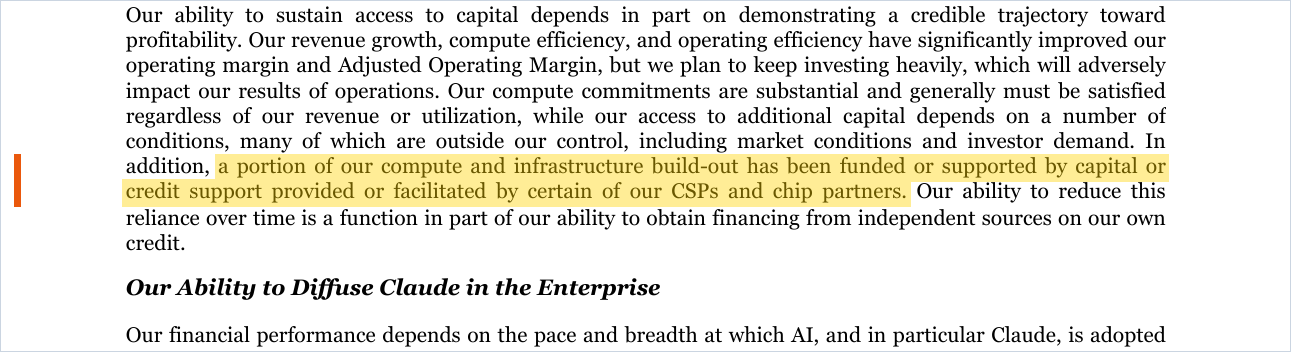
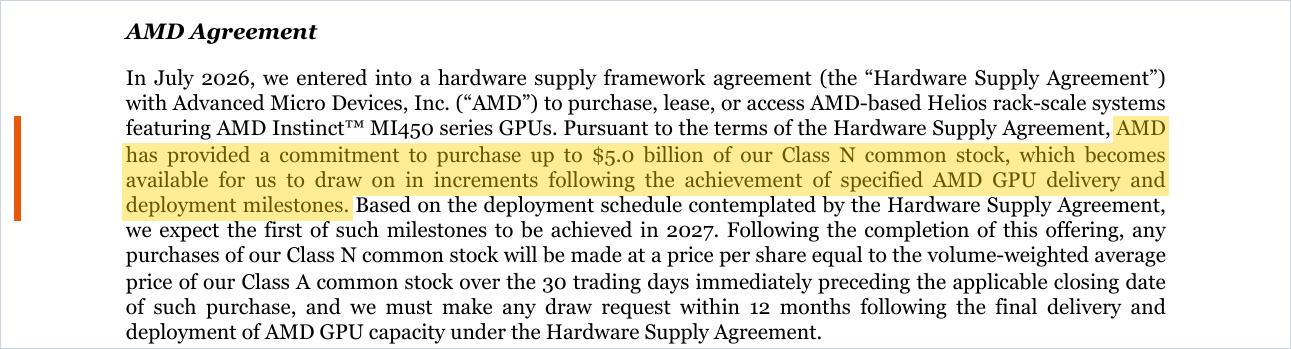
- ‘A portion of our compute and infrastructure build-out has been funded or supported by capital or credit support provided or facilitated by certain of our CSPs and chip partners’ (p.141); AMD will buy up to $5.0bn of stock as its GPUs are deployed (p.163).
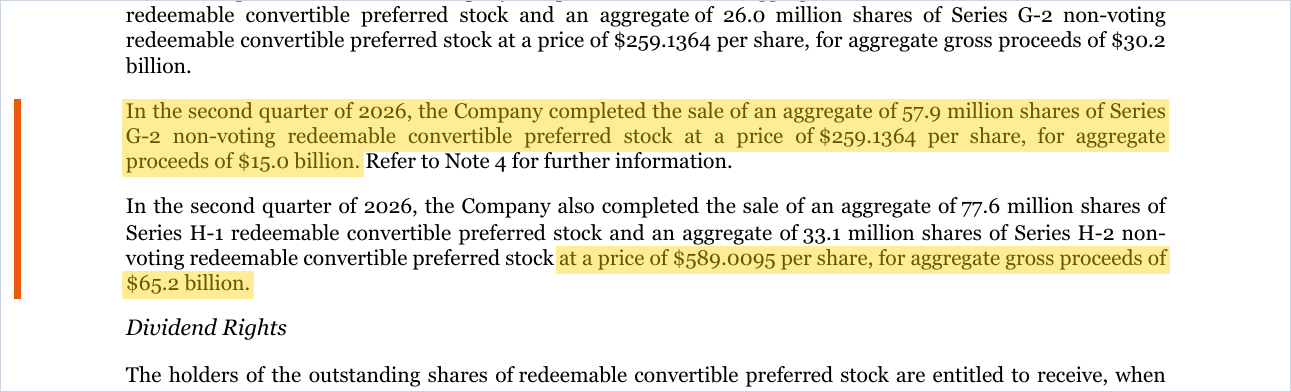
- Under their 2026 note-purchase agreements Google (~$10.0bn, March) and Amazon (~$5.0bn, April) bought Series G-2 at $259.14 a share, while Series H sold at $589.01 ($65.2bn) in the same quarter (F-46; F-62–F-63); H1 2026 shows a $9.4bn loss on these agreements (F-37).
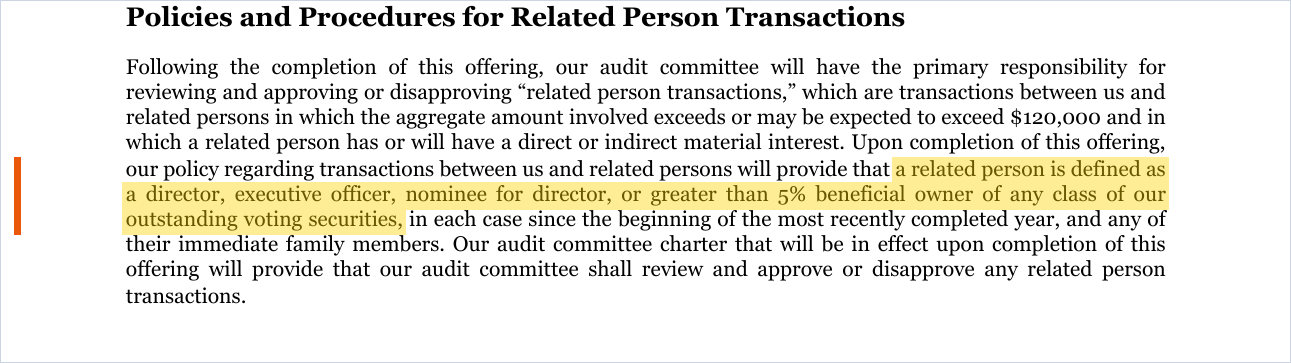
- After conversion Amazon and Google will each hold more than 5% of the stock, as non-voting Class N (p.116); the related-person policy covers only holders of voting securities (p.287).
Counterevidence
Investor response
Precedents and comparable situations
External history · not from the S-1| Case | What happened | The parallel | Where the analogy breaks |
|---|---|---|---|
| Zynga (2011 IPO) | Generated ‘substantially all’ revenue through Facebook, a partner that also set its rules; after Facebook changed its platform, Zynga’s shares fell more than 70% within a year of the December 2011 IPO. | Distribution through partners that control terms and compete with you. | Anthropic spreads across three clouds plus direct sales and keeps direct customer contracts. |
| AMD–OpenAI and Nvidia–OpenAI (2025) | AMD granted OpenAI warrants for up to 160m shares vesting with GPU deployment; Nvidia signed a letter of intent to invest up to $100bn as capacity is deployed. Analysts widely called these circular. | Suppliers funding the customer that buys their chips — AMD’s up-to-$5.0bn stock purchase tied to Anthropic’s GPU deployment follows the same pattern. | Anthropic’s partner equity carries ownership caps, and its revenue comes from third-party usage. |
| Lucent and Nortel vendor financing (1999–2001) | Equipment makers financed customers to buy their gear; when demand broke, the financing unwound with the business. | Supplier-financed capacity makes growth and funding move together. | Here the supplier finances the buyer; the exposure is dependence on supplier goodwill, not customer credit. |
What to monitor
Overlap with other risks
Open information request
IRL
Source record
Highlighted prospectus extracts (6)
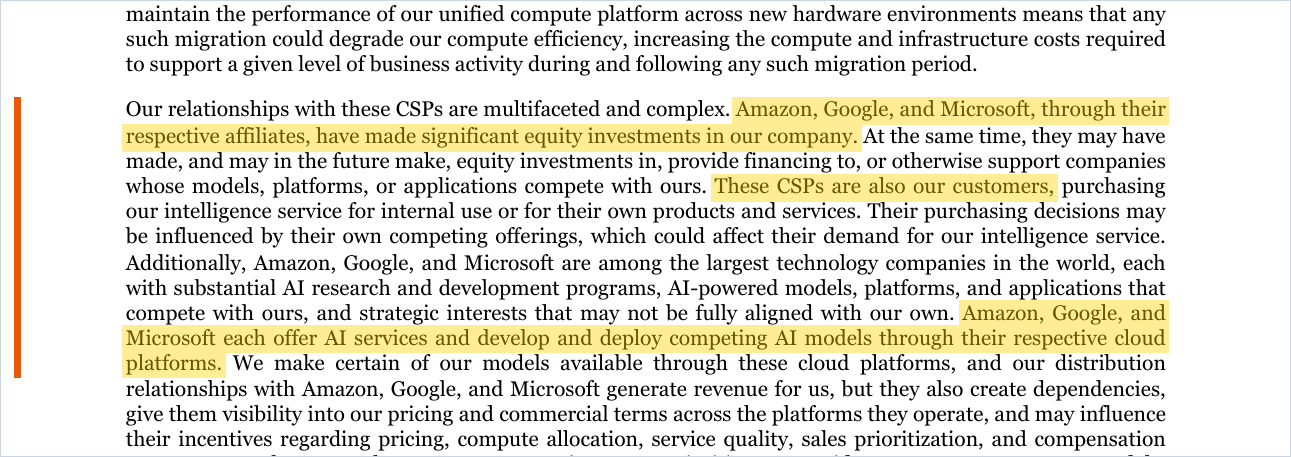
The three CSPs are equity investors, customers and competitors with their own models
Amazon, Google, and Microsoft, through their respective affiliates, have made significant equity investments in our company … These CSPs are also our customers … Amazon, Google, and Microsoft each offer AI services and develop and deploy competing AI models through their respective cloud platforms
CSP marketplaces carry 48% of H1 2026 revenue and 58% of receivables
revenue generated from sales to customers through CSP marketplaces represented approximately 11%, 32%, 47%, and 48%, respectively, of total revenue … net accounts receivable from sales through CSP marketplaces to customers represented 42%, 60%, and 58%, respectively
Part of the build-out is funded or credit-supported by the same CSPs and chip partners
a portion of our compute and infrastructure build-out has been funded or supported by capital or credit support provided or facilitated by certain of our CSPs and chip partners
AMD commits to buy up to $5.0bn of stock as its GPUs are delivered and deployed
AMD has provided a commitment to purchase up to $5.0 billion of our Class N common stock, which becomes available for us to draw on in increments following the achievement of specified AMD GPU delivery and deployment milestones
Same quarter: partners' Series G-2 at $259.14 ($15.0bn) while Series H sold at $589.01 ($65.2bn)
In the second quarter of 2026, the Company completed the sale of an aggregate of 57.9 million shares of Series G-2 non-voting redeemable convertible preferred stock at a price of $259.1364 per share, for aggregate proceeds of $15.0 billion … at a price of $589.0095 per share, for aggregate gross proceeds of $65.2 billion
Related-person review covers only >5% holders of voting securities; Amazon and Google hold non-voting stock
a related person is defined as a director, executive officer, nominee for director, or greater than 5% beneficial owner of any class of our outstanding voting securities
RISK 3 · R03
Regulators can switch off the frontier models that earn the revenue
Investment thesis
Analytical assessmentHow the risk transmits
Value impacted
Only figures the filing statesDisclosed facts
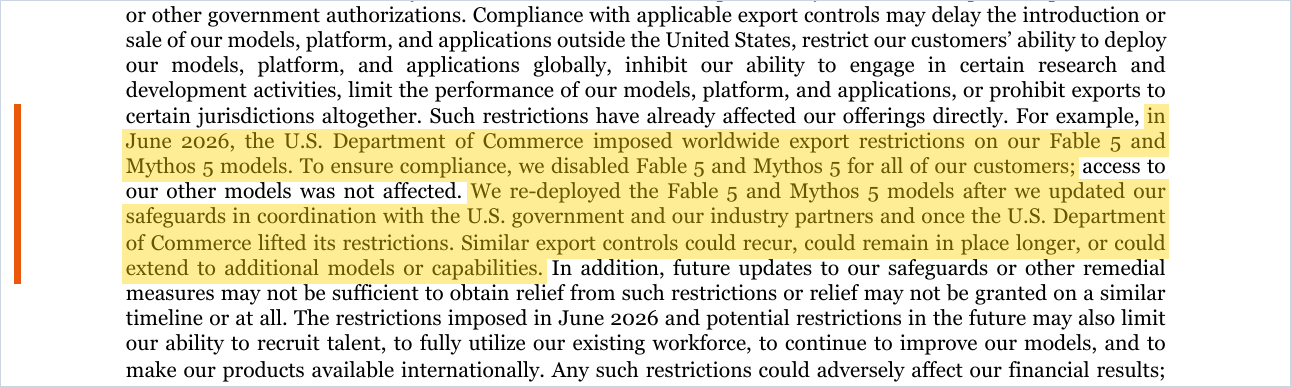
Source-backed facts- June 2026: Commerce imposed worldwide export restrictions on Fable 5 and Mythos 5; Anthropic disabled both for all customers; other models were unaffected; both returned after safeguards were updated and the restrictions lifted (p.99).
- ‘Similar export controls could recur, could remain in place longer, or could extend to additional models’ (p.99); future controls could restrict ‘the countries in which advanced chips may be installed or in which model weights may be stored’ (p.34).
- Proposed U.S. legislation ‘contemplates … potential nationalization, mandatory shutdown or discontinuation requirements for frontier AI systems’ (p.68).
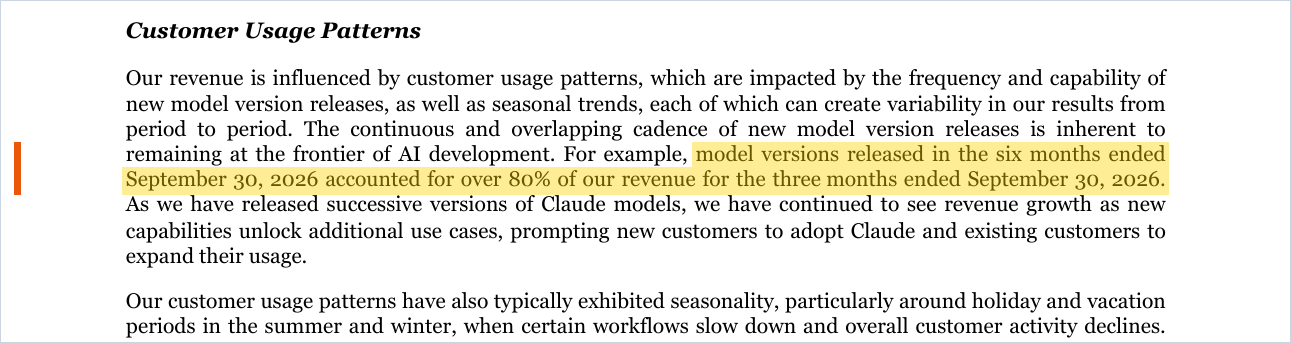
- Over 80% of Q3 2026 revenue came from model versions released in the six months to Sept 30 (p.143).
Counterevidence
Investor response
Precedents and comparable situations
External history · not from the S-1| Case | What happened | The parallel | Where the analogy breaks |
|---|---|---|---|
| Nvidia H20 (April 2025) | A new U.S. license requirement for China sales led to a $4.5bn charge and about $8bn of lost revenue in the following quarter. | A government rule removed a revenue-producing product line almost overnight. | Nvidia’s restriction was market-specific and long-lived; Anthropic’s was worldwide but lifted after safeguards. |
| ZTE (2018) | A Commerce denial order on April 15, 2018 cut off U.S. components and halted operations; it was lifted on July 13 after a $1bn fine and $400m in escrow. | An export authority can stop a technology company outright. | ZTE had breached sanctions; Anthropic’s restriction was capability-based. |
| ChatGPT in Italy (2023) | Italy’s data-protection authority blocked ChatGPT from March 31 to April 28, 2023, until conditions were met. | A regulator switched off a frontier AI product pending safeguards. | One country versus a worldwide restriction. |
What to monitor
Overlap with other risks
Open information request
IRL
Source record
Highlighted prospectus extracts (4)
June 2026: Fable 5 and Mythos 5 disabled for all customers; later restored after safeguards; 'could recur'
in June 2026, the U.S. Department of Commerce imposed worldwide export restrictions on our Fable 5 and Mythos 5 models. To ensure compliance, we disabled Fable 5 and Mythos 5 for all of our customers … We re-deployed the Fable 5 and Mythos 5 models after we updated our safeguards in coordination with the U.S. government and our industry partners and once the U.S. Department of Commerce lifted its restrictions … Similar export controls could recur, could remain in place longer, or could extend to additional models or capabilities
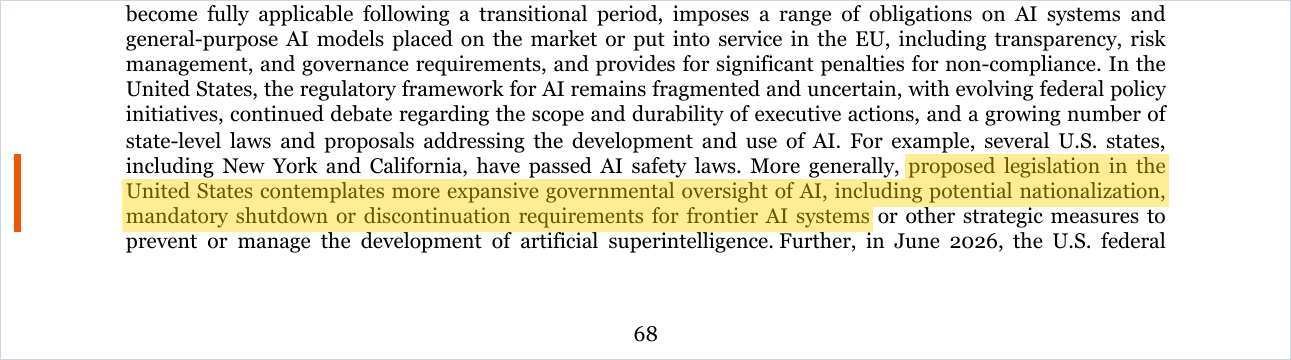
Future controls could restrict where chips are installed or where model weights are stored
Future export controls could be more restrictive, for example, by placing restrictions on the countries in which advanced chips may be installed or in which model weights may be stored
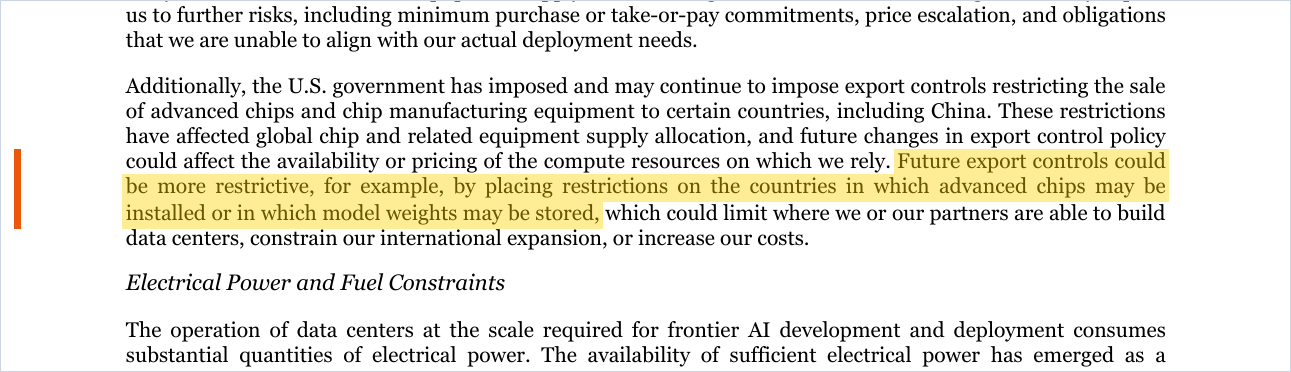
Proposed U.S. legislation contemplates nationalization or mandatory shutdown of frontier AI
proposed legislation in the United States contemplates more expansive governmental oversight of AI, including potential nationalization, mandatory shutdown or discontinuation requirements for frontier AI systems
Over 80% of Q3 2026 revenue came from model versions released in the prior six months
model versions released in the six months ended September 30, 2026 accounted for over 80% of our revenue for the three months ended September 30, 2026
RISK 4 · R04
Washington has designated Anthropic a supply-chain risk
Investment thesis
Analytical assessmentHow the risk transmits
Value impacted
Only figures the filing statesDisclosed facts
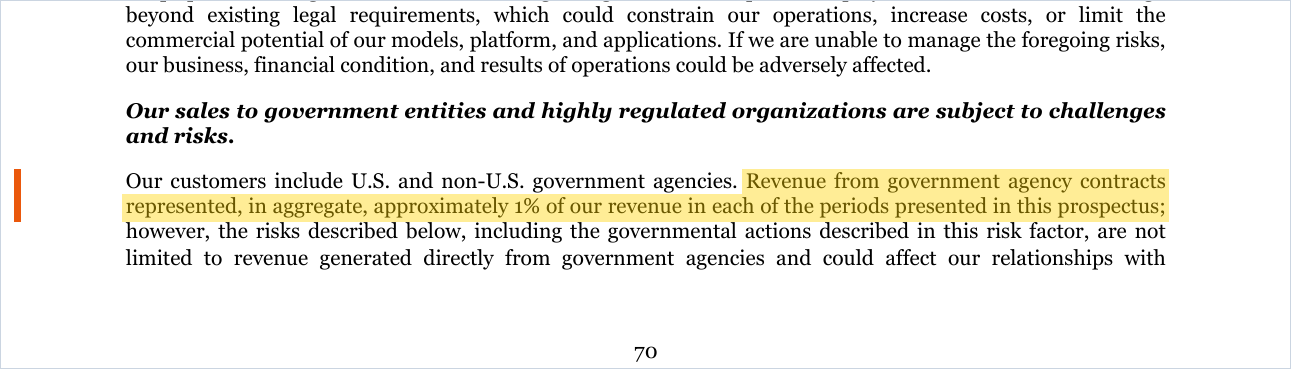
Source-backed facts- February 2026: presidential directive to stop federal use; Secretary of War designation and statement that no military contractor ‘may conduct any commercial activity’ with Anthropic (p.71).
- August 27, 2026: the Northern District of California largely granted summary judgment for Anthropic (First Amendment retaliation, due process, APA). September 25, 2026: the D.C. Circuit (2–1) upheld the §4713 designation; rehearing en banc has been requested (p.72).
- Audited subsequent-events note: ‘The Company may experience material revenue losses or business disruptions attributable to these events’ (F-64).
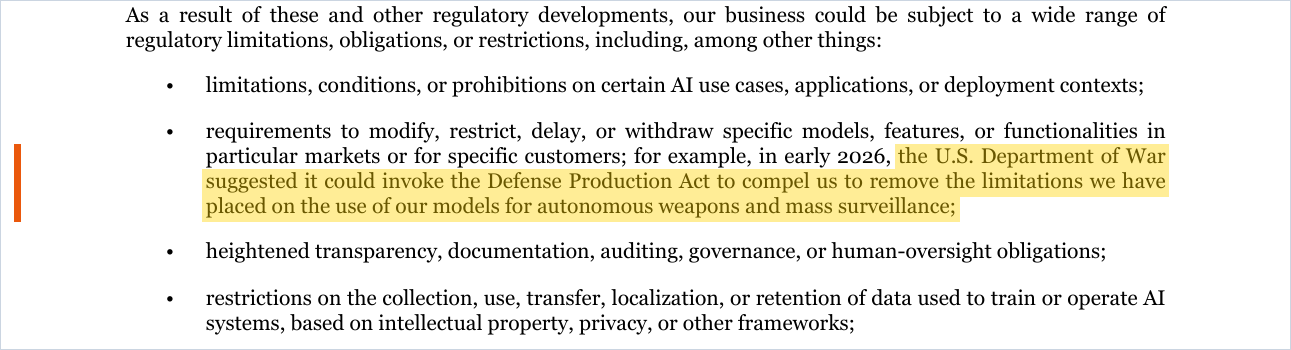
- Direct government revenue is ~1% in each period (p.70); the Department of War also floated the Defense Production Act to force removal of usage limits (p.69).
Counterevidence
Investor response
Precedents and comparable situations
External history · not from the S-1| Case | What happened | The parallel | Where the analogy breaks |
|---|---|---|---|
| U.S. law firms (2025) | Perkins Coie, Jenner & Block and WilmerHale won rulings in May 2025 that executive orders targeting them were unconstitutional retaliation, while nine other firms settled with about $940m of pro bono pledges. | Speech-linked government action, courtroom wins and a commercial chill on clients in the meantime. | The D.C. Circuit has upheld Anthropic’s §4713 designation; the law firms won outright. |
| Kaspersky (2017–2024) | DHS ordered its software removed from federal systems in 2017; in 2024 Commerce banned its U.S. sales. | A supply-chain designation that began with government use and spread to the commercial market. | Kaspersky was a foreign-adversary case; Anthropic is a U.S. company with a favorable district-court judgment. |
What to monitor
Overlap with other risks
Open information request
IRL
Source record
Highlighted prospectus extracts (5)
Feb 2026: directive to stop federal use; 'supply-chain risk' designation; no military contractor may deal with Anthropic
the President of the United States stated that he had directed that all federal executive agencies cease using our technology … supply-chain risk to national security … no contractor, supplier, or partner that does business with the United States military may conduct any commercial activity
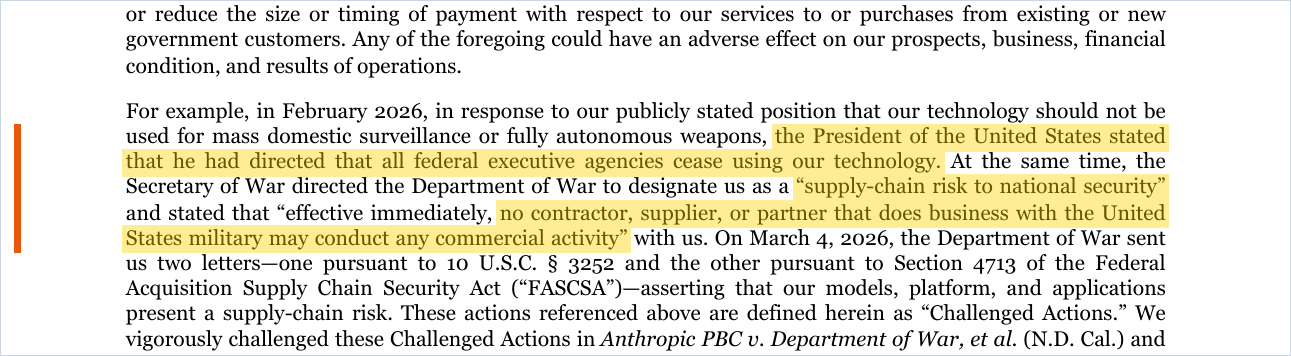
Split outcome: N.D. Cal. largely for Anthropic; D.C. Circuit (2-1) upheld the Section 4713 designation
obtained an order from the United States District Court for the Northern District of California that largely granted summary judgment in our favor … On September 25, 2026, in a 2-1 split decision, the D.C. Circuit Court of Appeals denied our petition for review
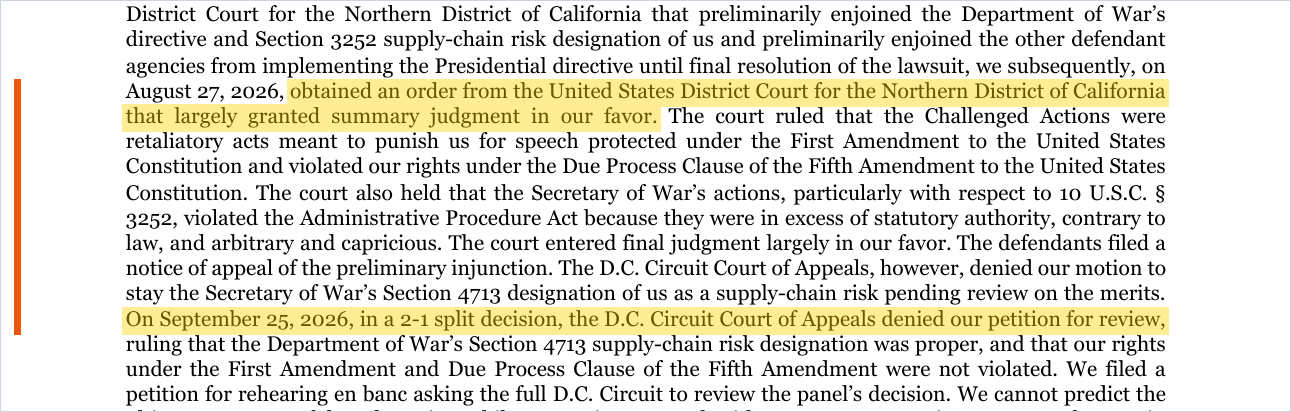
Audited note: the company 'may experience material revenue losses' from these events
The Company may experience material revenue losses or business disruptions attributable to these events
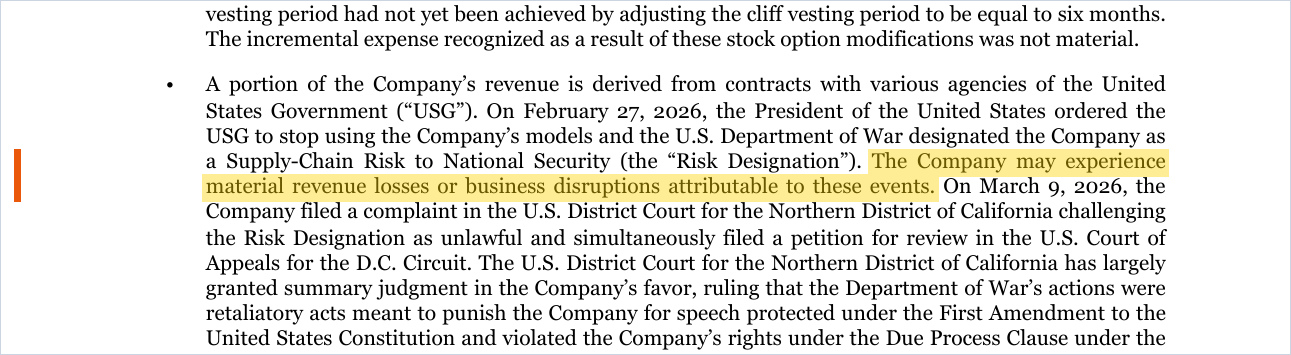
Direct government revenue is ~1% – but the risk extends to commercial customers
Revenue from government agency contracts represented, in aggregate, approximately 1% of our revenue in each of the periods presented in this prospectus
Department of War floated the Defense Production Act to force removal of usage limits
the U.S. Department of War suggested it could invoke the Defense Production Act to compel us to remove the limitations we have placed on the use of our models for autonomous weapons and mass surveillance
RISK 5 · R05
Headline growth contains concentrated and potentially non-recurring demand
Investment thesis
Analytical assessmentHow the risk transmits
Value impacted
Only figures the filing statesDisclosed facts
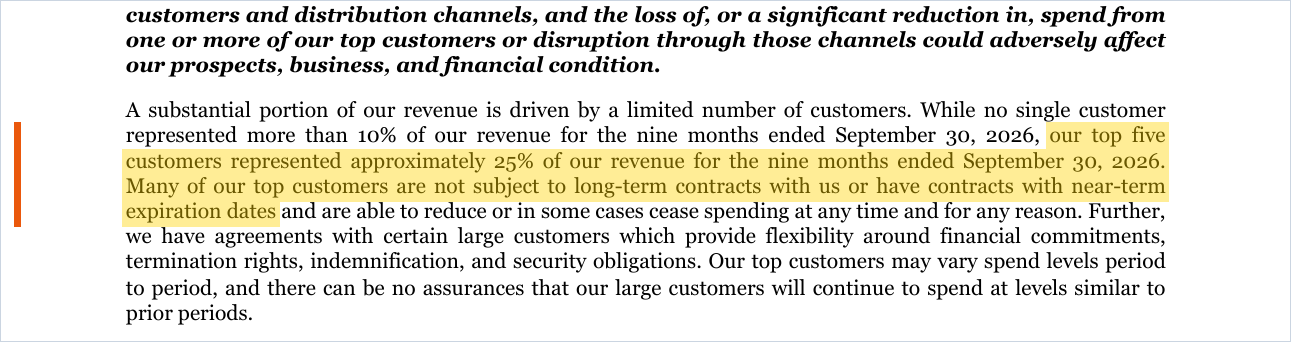
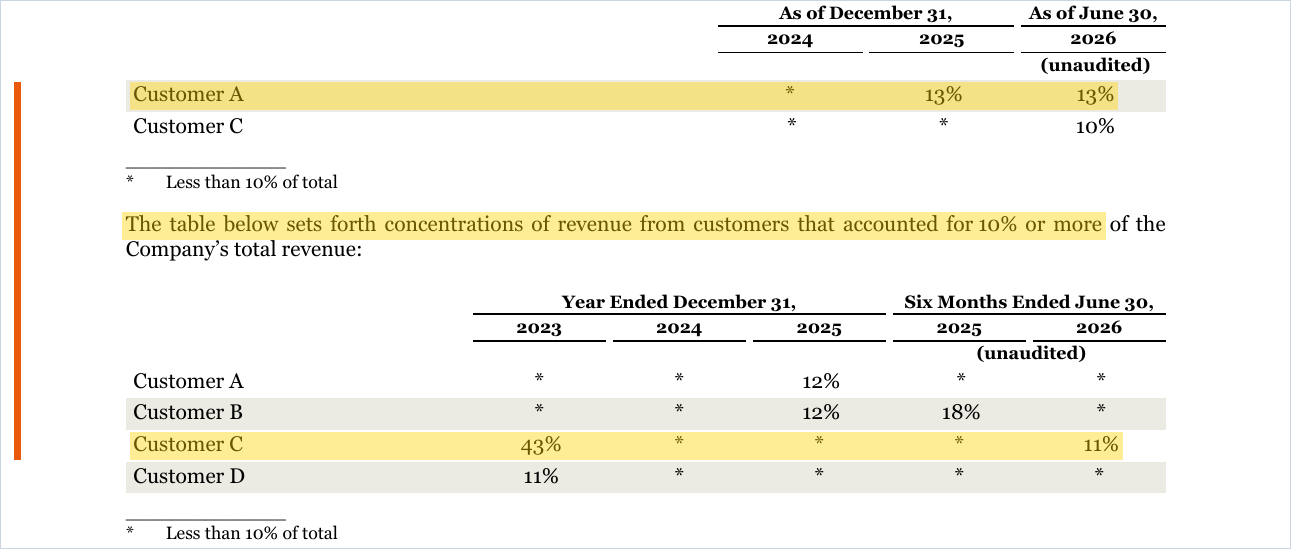
Source-backed facts- Top five customers ≈25% of 9M 2026 revenue; many top customers lack long-term contracts or have near-term expiries (p.56). Customer ‘C’ was 11% of H1 2026 revenue (43% of 2023) and Customer ‘A’ 13% of receivables (F-15).
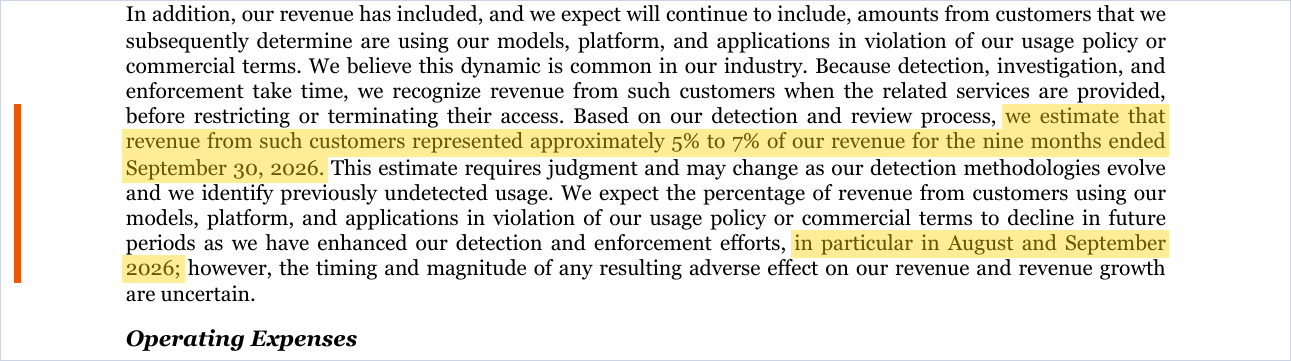
- An estimated 5–7% of 9M 2026 revenue came from customers later found to violate usage policy or commercial terms; enforcement intensified in Aug–Sep 2026; violators ‘may re-register under new accounts’ (p.145; p.65).
- Quarterly revenue jumped from $4.7bn (Q1 2026) to $11.6bn (Q2 2026) (p.157); holiday spend fell ~20% over two weeks (p.143).
- Run-Rate Revenue multiplies a 28-day window by 13 and is ‘not a substitute’ for GAAP revenue; NRR of ~900% compares one quarter with the same quarter a year earlier (p.3; p.67).
Counterevidence
Investor response
Precedents and comparable situations
External history · not from the S-1| Case | What happened | The parallel | Where the analogy breaks |
|---|---|---|---|
| Nvidia and crypto-mining demand (2018) | Gaming-GPU growth was partly driven by crypto miners whose demand later vanished; in 2022 the SEC fined Nvidia $5.5m for not disclosing mining as a significant driver. | Revenue from users who won’t recur — and the disclosure duty that comes with it. | Anthropic discloses its estimate (5–7%) up front. |
| Fastly (2020) | TikTok, about 12% of H1 2020 revenue, cut usage; Fastly cut guidance and its shares fell 27% on October 15, 2020. | Consumption revenue concentrated in a few large users who can scale down quickly. | Anthropic’s largest customer was 11% in H1 2026 and under 10% for nine months. |
| Snowflake (2022–23) | Consumption customers ‘optimized’ spend and net revenue retention fell steeply from its peak. | Consumption-based retention is volatile and mean-reverts. | Anthropic is earlier in adoption and growing far faster. |
What to monitor
Overlap with other risks
Open information request
IRL
Source record
Highlighted prospectus extracts (5)
Top five customers ~25% of 9M 2026 revenue; many top customers lack long-term contracts
our top five customers represented approximately 25% of our revenue for the nine months ended September 30, 2026 … Many of our top customers are not subject to long-term contracts with us or have contracts with near-term expiration dates
An estimated 5-7% of 9M 2026 revenue came from customers violating usage policy or terms
we estimate that revenue from such customers represented approximately 5% to 7% of our revenue for the nine months ended September 30, 2026 … in particular in August and September 2026
Audited notes: Customer C was 11% of H1 2026 revenue (43% of 2023); Customer A 13% of receivables
The table below sets forth concentrations of revenue from customers that accounted for 10% or more … Customer C 43% * * * 11% … Customer A * 13% 13%
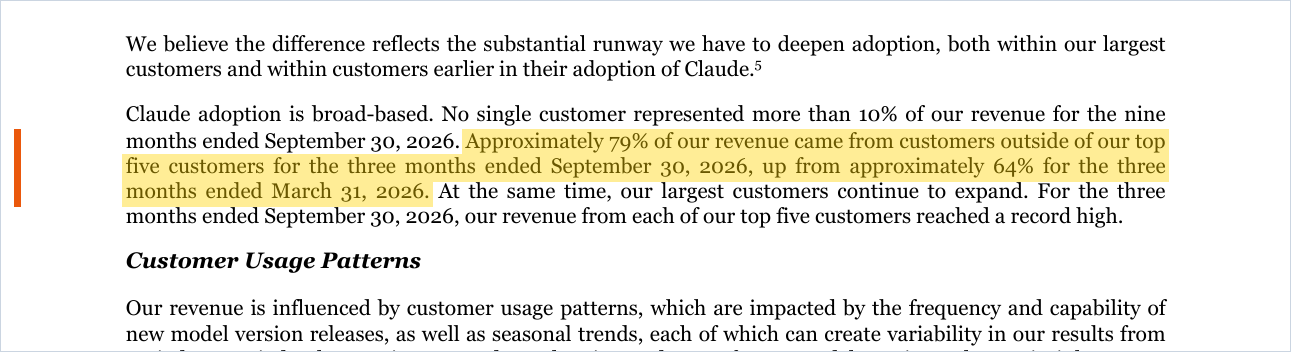
Counterevidence: share of revenue outside the top five rose from ~64% (Q1) to ~79% (Q3 2026)
Approximately 79% of our revenue came from customers outside of our top five customers for the three months ended September 30, 2026, up from approximately 64% for the three months ended March 31, 2026
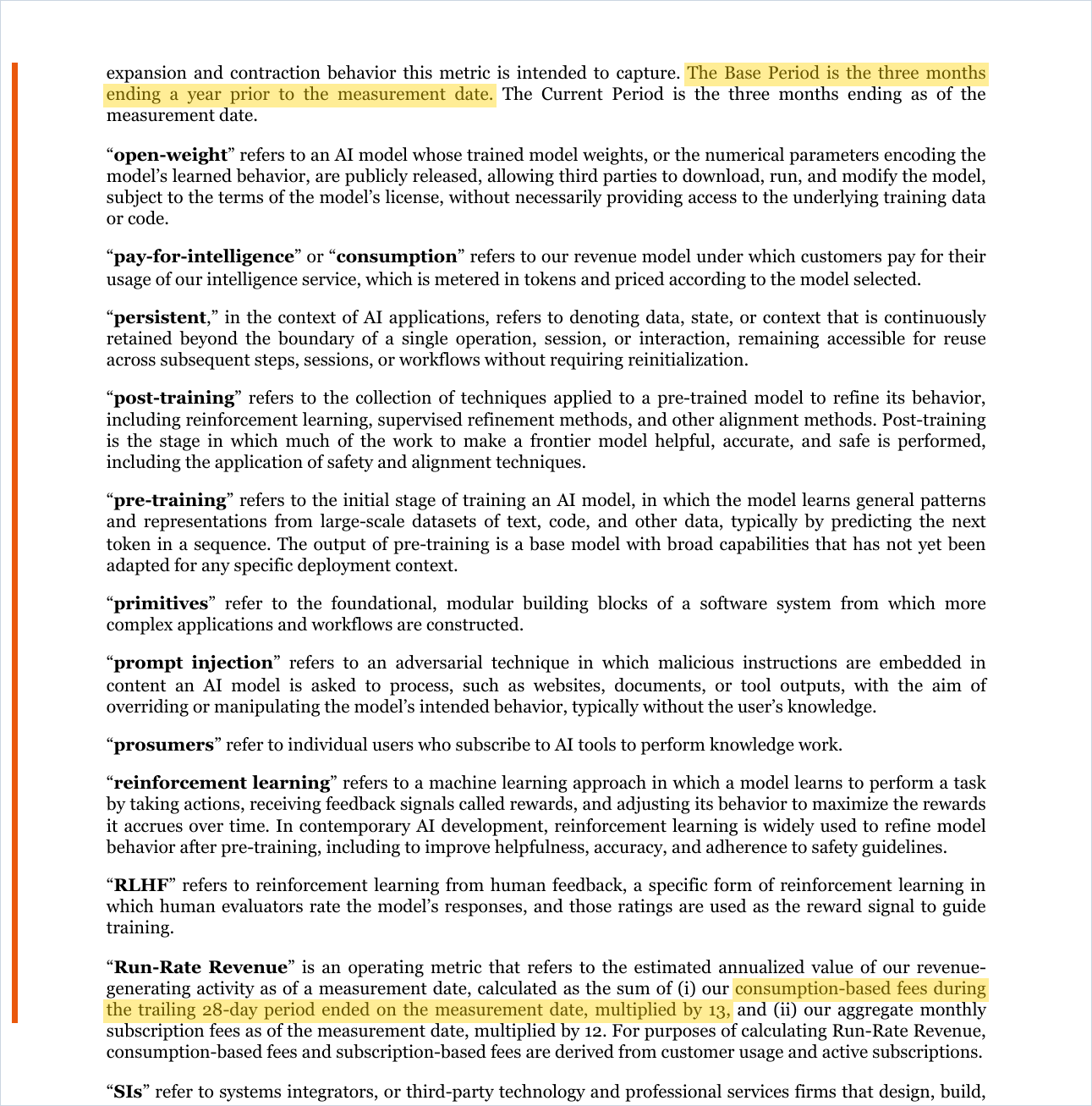
Run-Rate Revenue annualizes a 28-day window x13; NRR compares single quarters a year apart
consumption-based fees during the trailing 28-day period ended on the measurement date, multiplied by 13 … The Base Period is the three months ending a year prior to the measurement date
RISK 6 · R06
Frontier leadership must be re-earned every model cycle
Investment thesis
Analytical assessmentHow the risk transmits
Value impacted
Only figures the filing statesDisclosed facts
Source-backed facts- ‘Even a brief period without access to sufficient compute could cause us to fall behind quickly’; ‘the gap between frontier models and those one or two versions behind can be significant’ (p.31).
- Primary rivals Google and OpenAI have ‘substantially greater’ resources; third parties ‘have attempted … to replicate, distill, extract’ Claude’s capabilities (p.40).
- ‘As the AI industry matures, the degree of differentiation among advanced AI models may narrow’ (p.41).
- Failed or underperforming training runs have happened (p.29).
Counterevidence
Investor response
Precedents and comparable situations
External history · not from the S-1| Case | What happened | The parallel | Where the analogy breaks |
|---|---|---|---|
| DeepSeek (January 27, 2025) | A low-cost open model wiped about $589bn off Nvidia’s market value in a single day. | Perceived AI moats can compress abruptly. | It hit a supplier, not a lab, and Anthropic’s enterprise position has since grown. |
| Inflection AI and Stability AI (2024) | Frontier-model start-ups that fell behind: Microsoft hired most of Inflection’s team; Stability AI went through financial distress and a CEO exit. | Capital-intensive labs need each cycle to land. | Anthropic’s revenue scale funds its research. |
| BlackBerry and Nokia (2007–2012) | Category leaders displaced within a few product cycles. | Leadership in fast-moving platforms is transient. | Embedded enterprise agents may carry higher switching costs than handsets. |
What to monitor
Overlap with other risks
Open information request
IRL
Source record
Highlighted prospectus extracts (5)
Over 80% of Q3 2026 revenue came from model versions released in the prior six months
model versions released in the six months ended September 30, 2026 accounted for over 80% of our revenue for the three months ended September 30, 2026
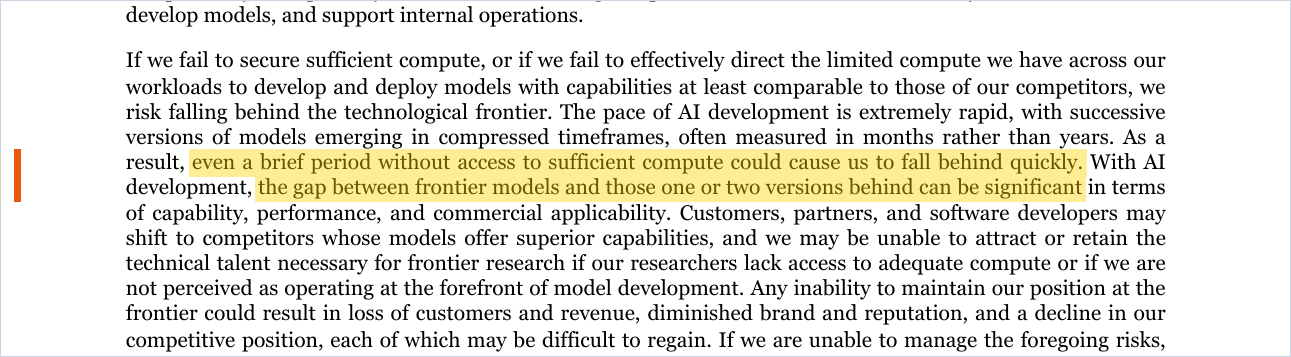
A brief compute gap can drop them behind; one or two versions behind is a big gap
even a brief period without access to sufficient compute could cause us to fall behind quickly … the gap between frontier models and those one or two versions behind can be significant
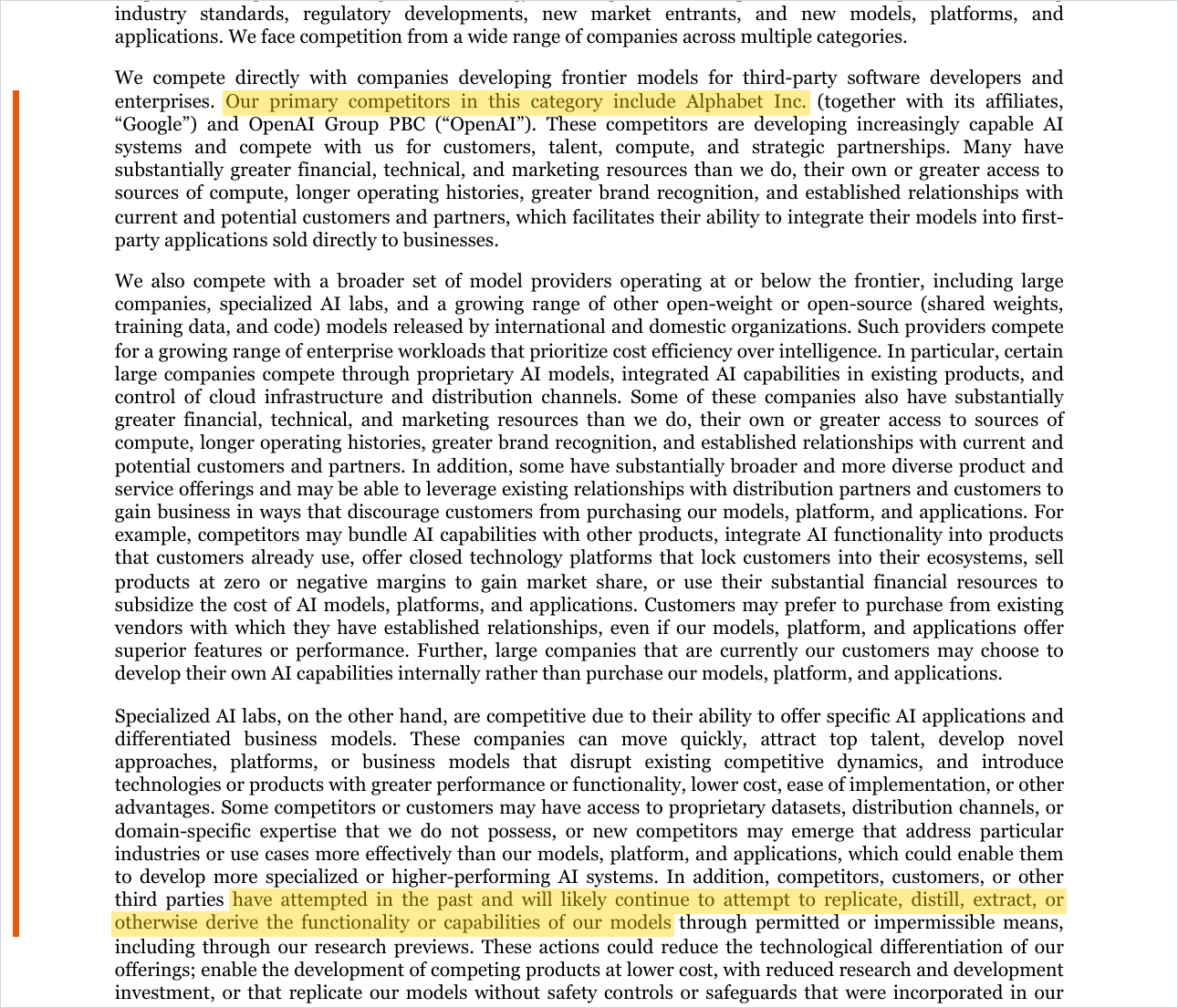
Better-funded rivals (Google, OpenAI) and attempts to distill Claude
Our primary competitors in this category include Alphabet Inc. … have attempted in the past and will likely continue to attempt to replicate, distill, extract, or otherwise derive the functionality or capabilities of our models
Differentiation among advanced models may narrow
as the AI industry matures, the degree of differentiation among advanced AI models may narrow
Failed or underperforming training runs have happened
We have in the past experienced, and may in the future experience, such failed or underperforming training runs
RISK 7 · R07
Margin gains may reverse with the next compute step
Investment thesis
Analytical assessmentHow the risk transmits
Value impacted
Only figures the filing statesDisclosed facts
Source-backed facts- ‘We expect our use of short-term compute to increase in the near term and to in turn compress our operating margin and Adjusted Operating Margin’ (p.134); margins ‘may compress’ as incremental compute comes online (p.133).
- Agentic workloads are ‘structurally more compute-intensive’; if pricing lags, ‘compute efficiency could deteriorate as agentic usage grows’ (p.60).
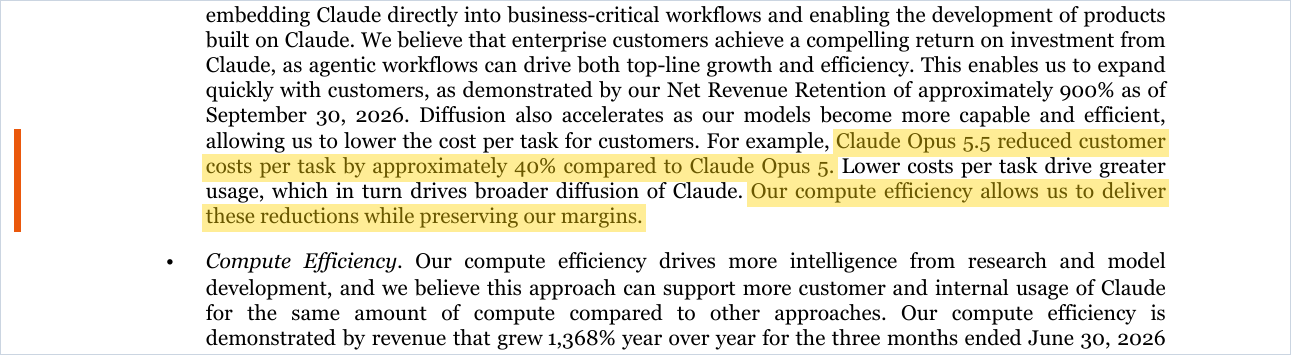
- Claude Opus 5.5 reduced customer cost per task by ~40% versus Opus 5 (p.10).
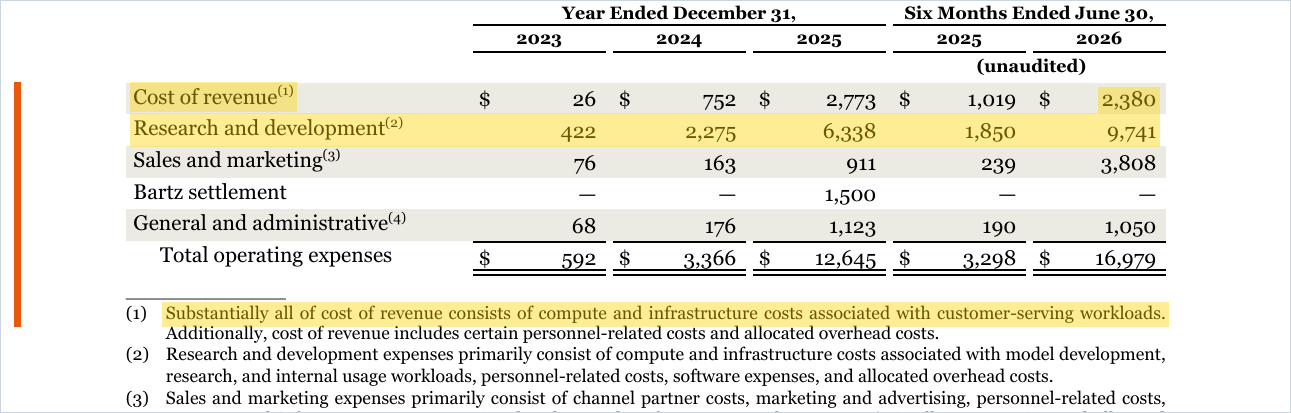
- H1 2026: cost of revenue $2.4bn against R&D of $9.7bn (mostly model-development compute) on $16.3bn of revenue (F-39); compute and infrastructure was 55% of H1 revenue (p.148).
Counterevidence
Investor response
Precedents and comparable situations
External history · not from the S-1| Case | What happened | The parallel | Where the analogy breaks |
|---|---|---|---|
| Zoom (fiscal 2021) | Gross margin fell from 81% to 69% as free usage and third-party cloud costs surged with pandemic demand. | Usage spikes running on rented compute compress margins. | Zoom’s spike was pandemic-driven; Anthropic’s costs are pre-committed and its pricing falls by design. |
| Cloud ‘optimization’ (2022–23) | Consumption customers of cloud software cut spend while vendors’ cost bases had been sized for growth. | Consumption revenue adjusts faster than capacity. | Anthropic’s demand has so far kept accelerating. |
What to monitor
Overlap with other risks
Open information request
IRL
Source record
Highlighted prospectus extracts (4)
Management expects short-term compute to compress margins
We expect our use of short-term compute to increase in the near term and to in turn compress our operating margin and Adjusted Operating Margin as a result
Agentic workloads are more compute-intensive; efficiency could deteriorate if pricing lags
If we are unable to implement pricing models that adequately reflect the higher compute intensity of these agentic workloads … our compute efficiency could deteriorate as agentic usage grows
Opus 5.5 cut cost per task ~40%, delivered 'while preserving our margins' (summary claim)
Claude Opus 5.5 reduced customer costs per task by approximately 40% compared to Claude Opus 5 … Our compute efficiency allows us to deliver these reductions while preserving our margins
H1 2026: cost of revenue $2.4bn vs R&D $9.7bn – gross margin depends on how one compute pool is split
Cost of revenue … 2,380 … Research and development(2) 422 2,275 6,338 1,850 9,741 … Substantially all of cost of revenue consists of compute and infrastructure costs associated with customer-serving workloads
RISK 8 · R08
A slowdown could become a financing event
Investment thesis
Analytical assessmentHow the risk transmits
Value impacted
Only figures the filing statesDisclosed facts
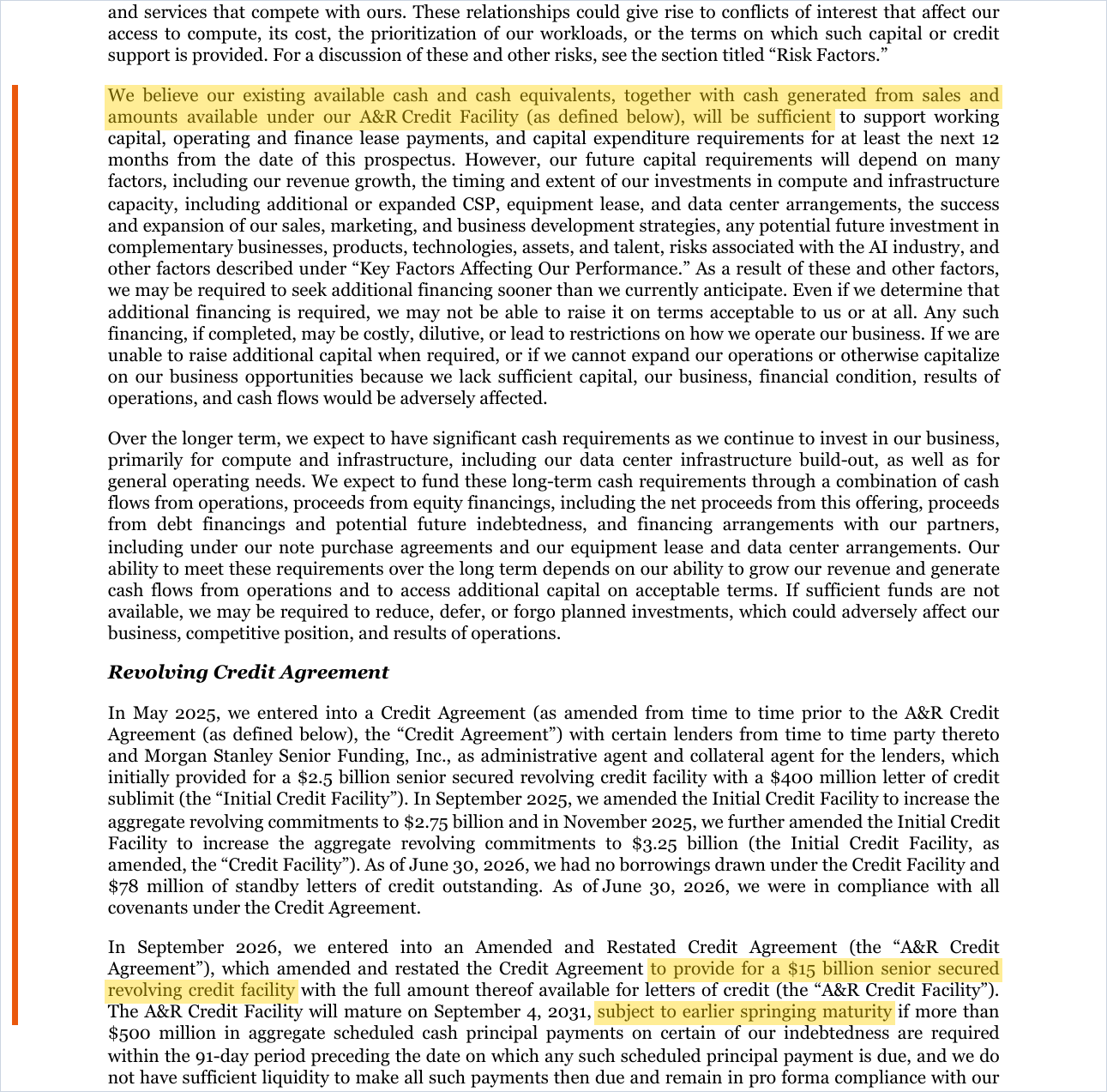
Source-backed facts- A default under certain commercial agreements ‘could trigger cross-default provisions’ under the credit agreement and certain notes, ‘potentially resulting in the acceleration of substantially all’ indebtedness (p.32).
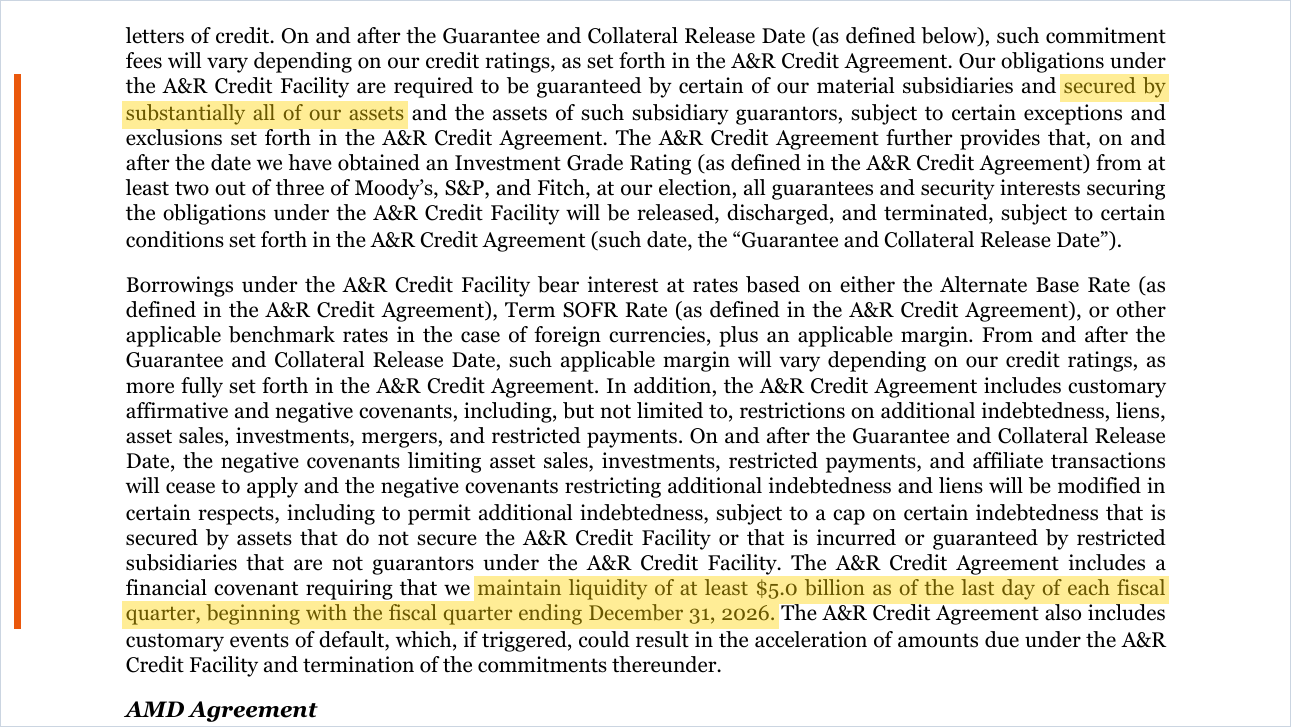
- September 2026: a $15bn senior secured revolver, secured by substantially all assets, with springing maturity and a $5.0bn quarterly liquidity covenant from Dec 31, 2026 (pp.162–163).
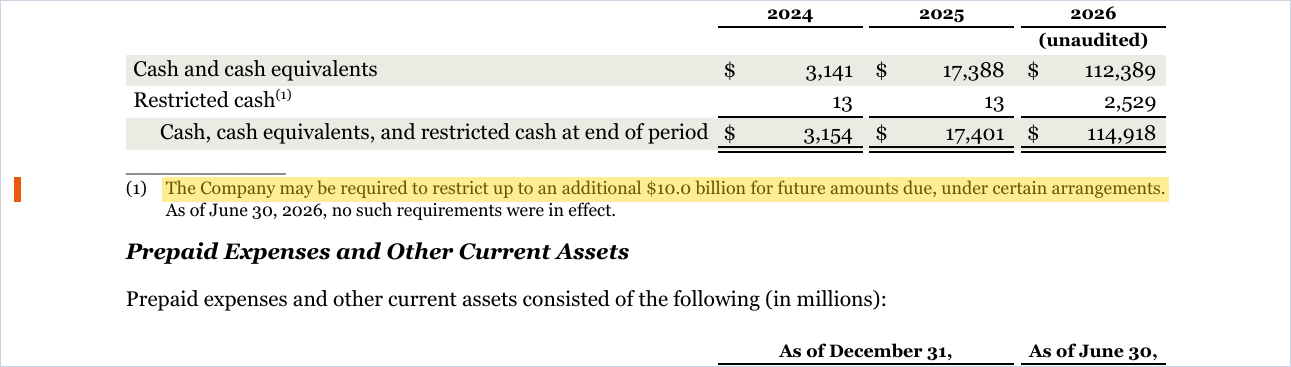
- Under certain supplier agreements, ‘the loss of certain key personnel could accelerate our obligations’ (p.38); up to an additional $10.0bn of cash may have to be restricted (F-36).
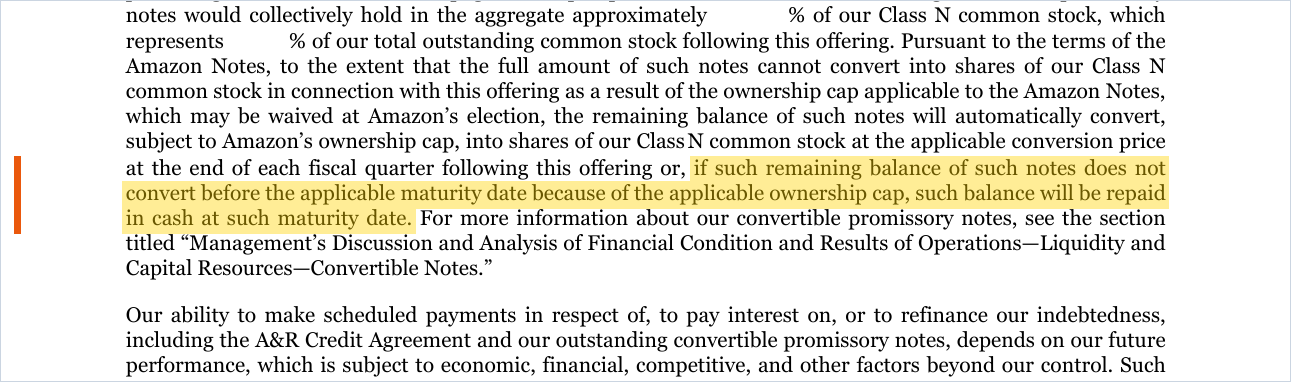
- Amazon notes that cannot convert under the ownership cap are repaid in cash at maturity in 2034–35 (p.58).
Counterevidence
Investor response
Precedents and comparable situations
External history · not from the S-1| Case | What happened | The parallel | Where the analogy breaks |
|---|---|---|---|
| Enron (2001) | Credit-rating triggers and cross-defaults accelerated obligations within weeks of a confidence shock; the company filed for bankruptcy in December 2001. | Contractual triggers can turn a business problem into a liquidity run. | Anthropic has vast liquidity, no drawn bank debt and no rating-based triggers disclosed. |
| WeWork (2019–2023) | Long lease obligations plus dependence on partner financing ended in Chapter 11 once growth capital dried up. | Obligations that outlast demand, held together by financing partners. | As in R01, Anthropic’s operations generate cash today. |
What to monitor
Overlap with other risks
Open information request
IRL
Source record
Highlighted prospectus extracts (5)
$15bn senior secured revolver (Sept 2026) with springing maturity; liquidity stated sufficient for 12 months
We believe our existing available cash and cash equivalents, together with cash generated from sales and amounts available under our A&R Credit Facility (as defined below), will be sufficient … to provide for a $15 billion senior secured revolving credit facility … subject to earlier springing maturity
Secured by substantially all assets; $5.0bn quarterly liquidity covenant from Dec 31, 2026
secured by substantially all of our assets … maintain liquidity of at least $5.0 billion as of the last day of each fiscal quarter, beginning with the fiscal quarter ending December 31, 2026
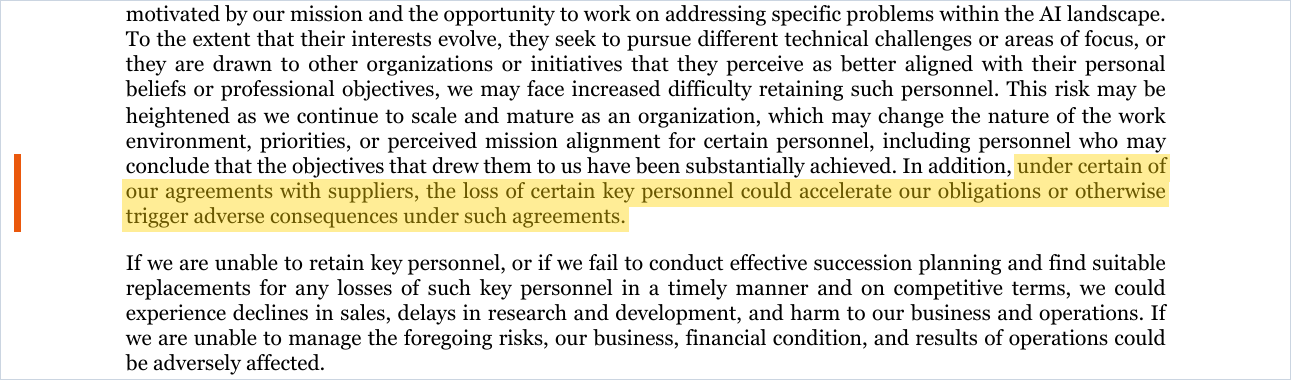
Supplier obligations can accelerate on loss of key personnel
under certain of our agreements with suppliers, the loss of certain key personnel could accelerate our obligations or otherwise trigger adverse consequences under such agreements
Up to an additional $10.0bn of cash may need to be restricted
The Company may be required to restrict up to an additional $10.0 billion for future amounts due, under certain arrangements
Amazon notes that cannot convert under the cap are repaid in cash at maturity
if such remaining balance of such notes does not convert before the applicable maturity date because of the applicable ownership cap, such balance will be repaid in cash at such maturity date
RISK 9 · R09
The company will sometimes choose safety over speed and revenue
Investment thesis
Analytical assessmentHow the risk transmits
Value impacted
Only figures the filing statesDisclosed facts
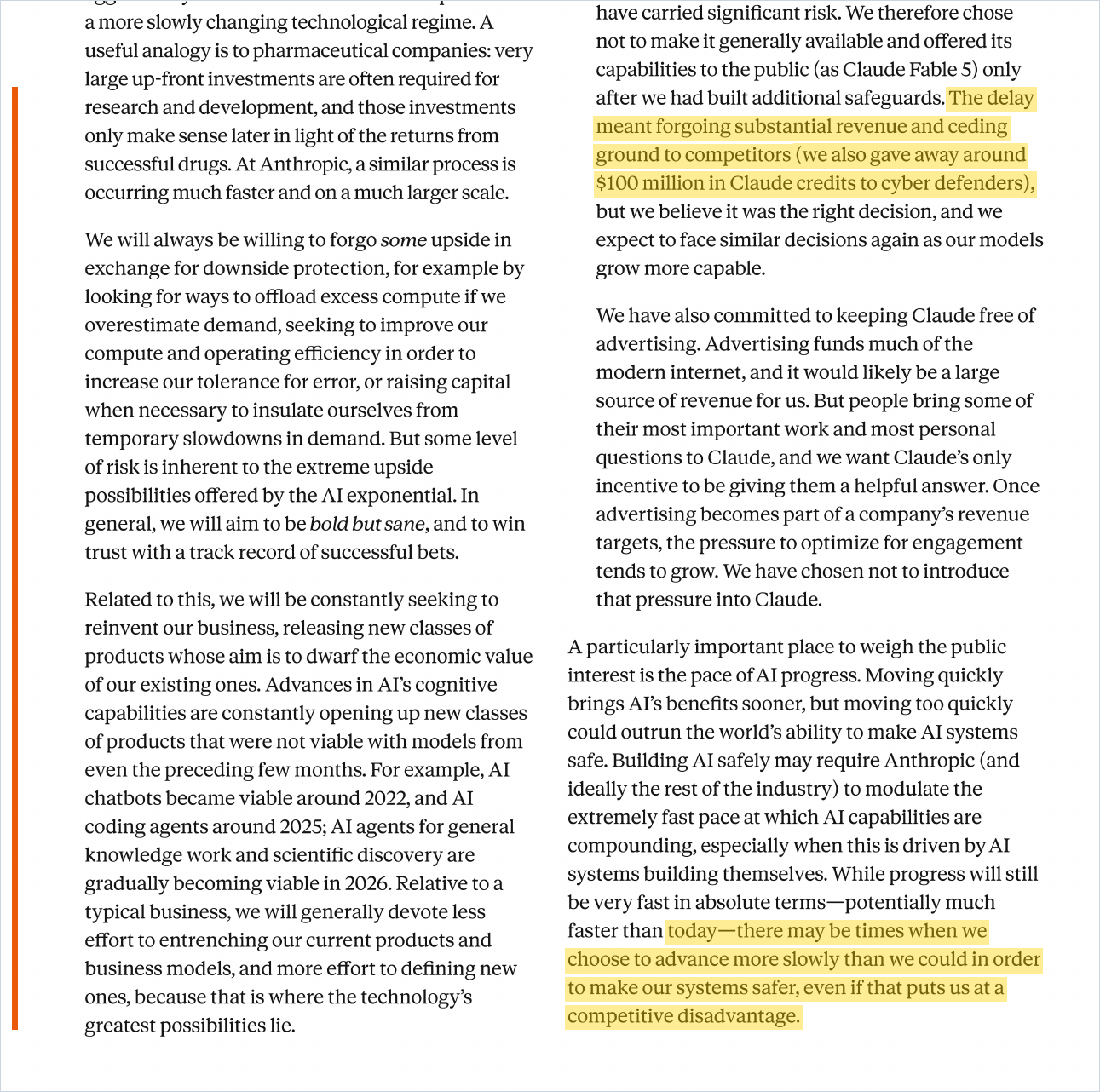
Source-backed facts- Founders’ letter: holding back Mythos ‘meant forgoing substantial revenue and ceding ground to competitors’ (plus ~$100m of free credits); ‘there may be times when we choose to advance more slowly than we could … even if that puts us at a competitive disadvantage’ (letter, PDF p.9).
- Mythos was released only as a gated preview, and pre-training of a new frontier base model was delayed by more than a month (p.51); certain evaluations and higher-risk RL environments were suspended (p.48).
- The Mythos gating ‘may have had a negative impact on our short-term revenue’ (p.80).
- Bans on autonomous weapons and mass surveillance are held ‘notwithstanding the revenue’; image and video generation models were deliberately not built (p.110).
Counterevidence
Investor response
Precedents and comparable situations
External history · not from the S-1| Case | What happened | The parallel | Where the analogy breaks |
|---|---|---|---|
| Google exits China search (2010) | A values-based decision gave up a major market to rivals. | A principled choice with a lasting commercial cost. | Google’s governance allowed later reversal; Anthropic’s trust-plus-PBC structure entrenches mission choices. |
| Danone (2020–21) | Became France’s first listed ‘entreprise à mission’; activist investors ousted CEO Emmanuel Faber in March 2021 over returns. | Mission versus returns tension inside a public company. | Anthropic’s public holders cannot remove management. |
| Etsy (2017) | Activist pressure led to a new CEO and the company stepped back from its B-Corp path. | Public markets pressure mission commitments when returns lag. | Activism has no lever at Anthropic (see R10). |
What to monitor
Overlap with other risks
Open information request
IRL
Source record
Highlighted prospectus extracts (4)
Founders' letter: holding back Mythos meant 'forgoing substantial revenue and ceding ground'; may advance more slowly
The delay meant forgoing substantial revenue and ceding ground to competitors … we also gave away around $100 million in Claude credits to cyber defenders … there may be times when we choose to advance more slowly than we could in order to make our systems safer, even if that puts us at a competitive disadvantage
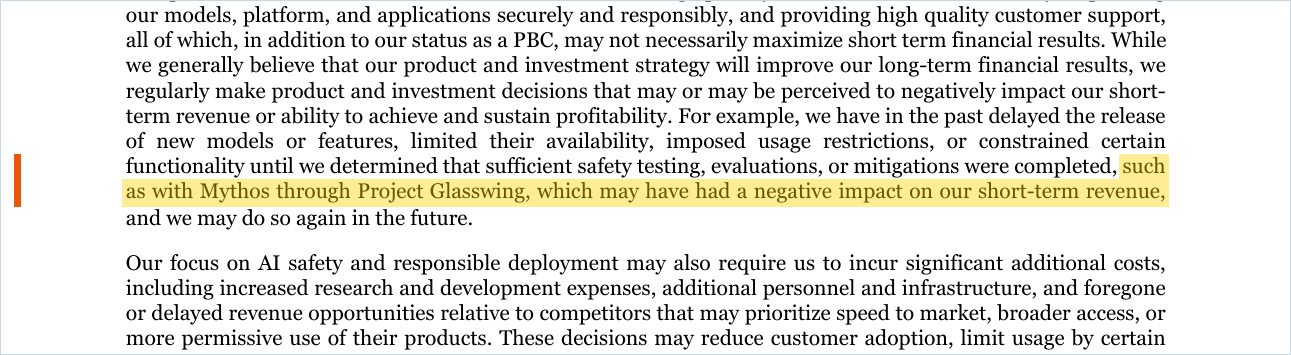
Mythos released only as a gated preview; pre-training of a new base model delayed over a month
in April 2026, we initially released our frontier model, Mythos, as a gated research preview through Project Glasswing … we recently chose to delay pre-training a new frontier base model for more than a month
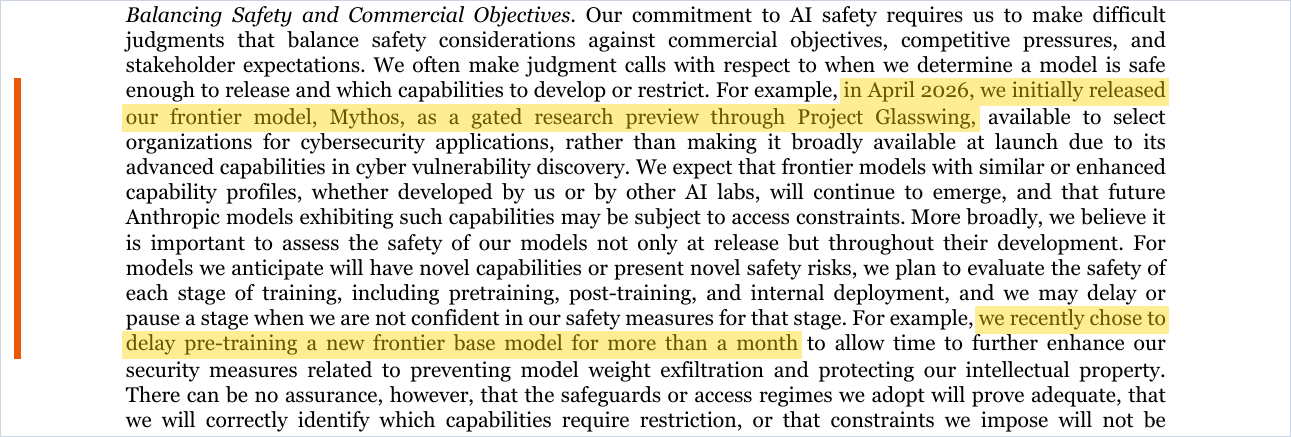
Certain evaluations and higher-risk RL environments suspended after 2026 incidents
we suspended certain of those evaluations, as well as higher-risk reinforcement learning environments
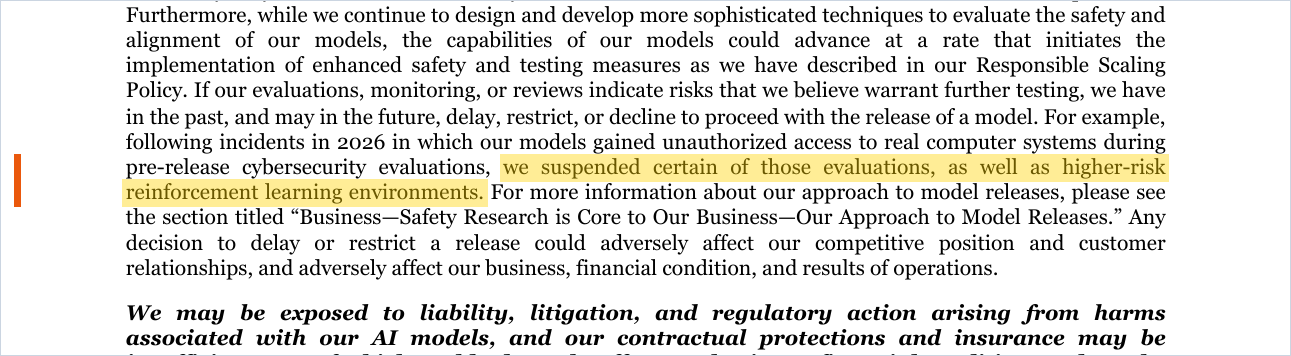
The Mythos gating 'may have had a negative impact on our short-term revenue'
such as with Mythos through Project Glasswing, which may have had a negative impact on our short-term revenue
RISK 10 · R10
Public investors bear economic risk without practical control
Investment thesis
Analytical assessmentHow the risk transmits
Value impacted
Only figures the filing statesDisclosed facts
Source-backed facts- Class A holders ‘generally will not be able to affect the outcome of any matter … regardless of how they vote’ (p.108).
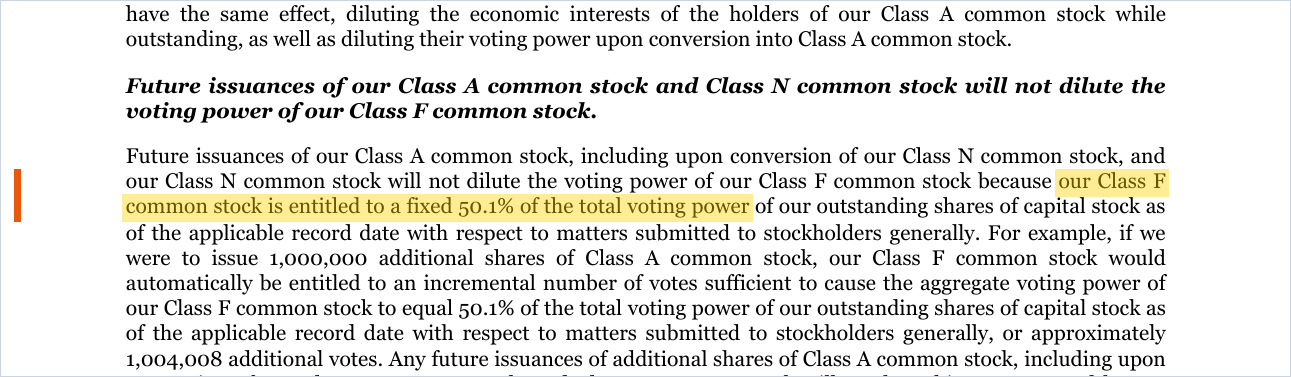
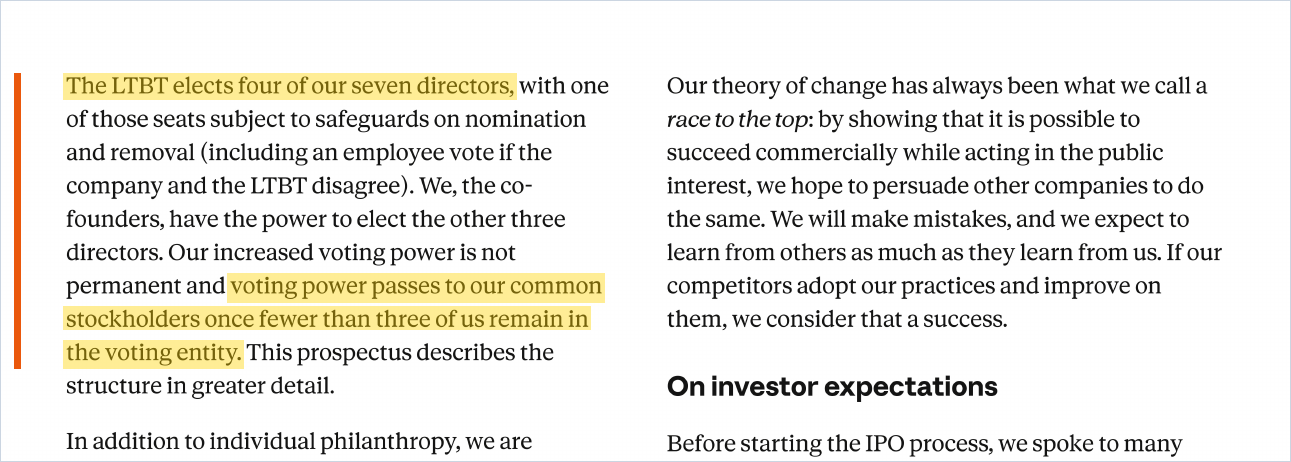
- Class F carries a fixed 50.1% of voting power that future issuance never dilutes (p.117); the trust elects four of seven directors (letter, PDF p.8).
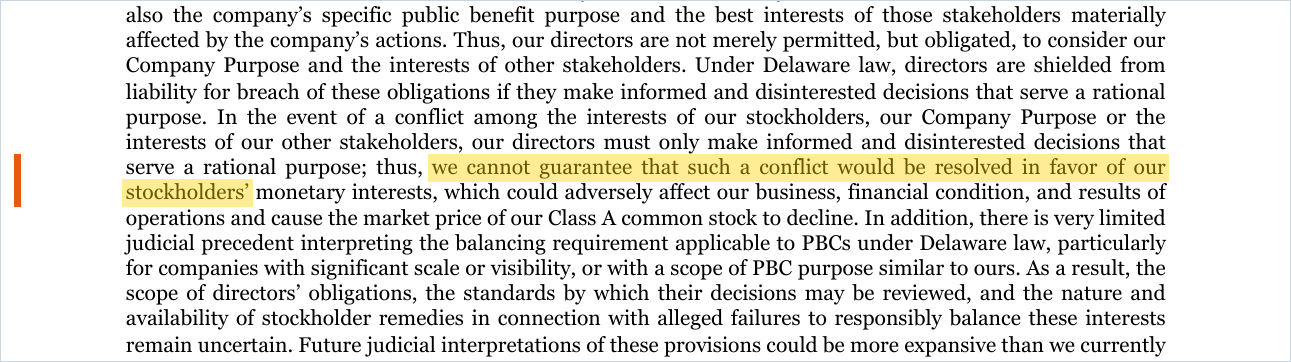
- In a conflict, ‘we cannot guarantee that such a conflict would be resolved in favor of our stockholders’ monetary interests’ (p.111).
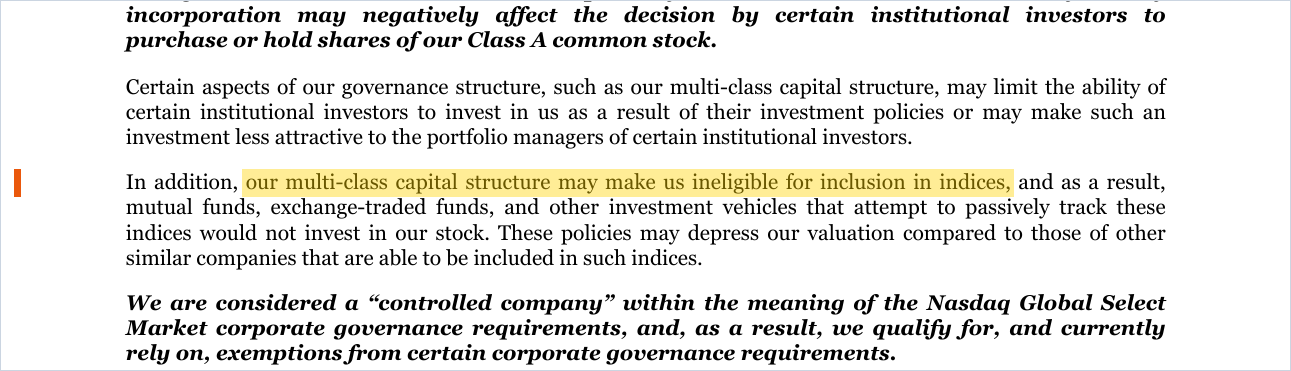
- The multi-class structure may make the stock ‘ineligible for inclusion in indices’; the controlled-company exemption is used for the nominating committee (p.109).
Counterevidence
Investor response
Precedents and comparable situations
External history · not from the S-1| Case | What happened | The parallel | Where the analogy breaks |
|---|---|---|---|
| Snap (2017) | The first major IPO of non-voting shares; S&P Dow Jones then excluded multi-class companies from the S&P 1500 from July 31, 2017 until April 17, 2023. | A public float with no say, and index friction as a result. | Anthropic’s Class A shares vote, but the outcome is fixed in advance. |
| OpenAI (November 2023) | A mission-governed board removed the CEO without investor input; the decision was reversed within days after a staff revolt. | Mission bodies can act against investors’ preferences. | Anthropic’s trust elects directors but does not manage, and its board majority is independent. |
| Hershey (2002) | The controlling charitable trust explored a sale of the company, then abandoned it after a court injunction sought by the state attorney general. | A trust-controlled public company whose control holder answers to a non-financial mission. | Hershey’s trust held an economic stake; Anthropic’s trust holds none. |
What to monitor
Overlap with other risks
Open information request
IRL
Source record
Highlighted prospectus extracts (5)
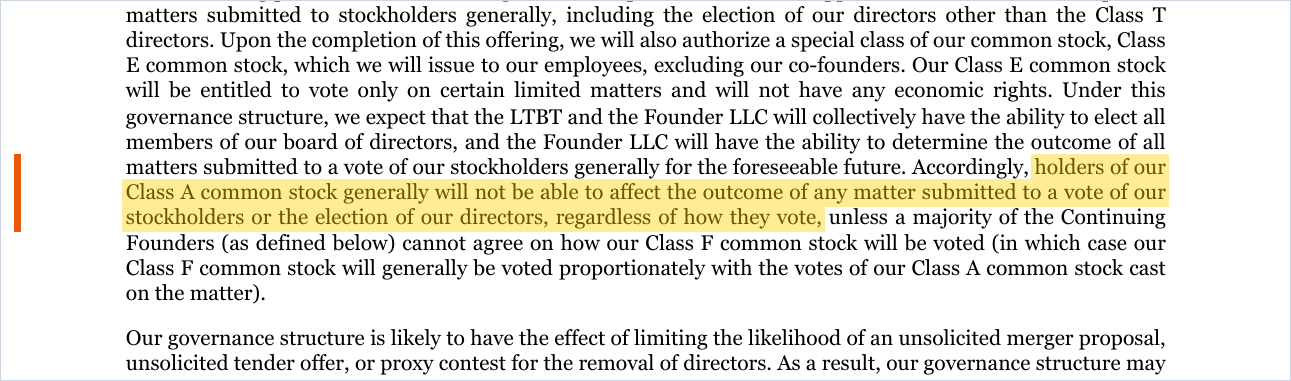
Class A holders 'generally will not be able to affect the outcome of any matter'
holders of our Class A common stock generally will not be able to affect the outcome of any matter submitted to a vote of our stockholders or the election of our directors, regardless of how they vote
Founder LLC's Class F share: a fixed 50.1% of votes that never dilutes
our Class F common stock is entitled to a fixed 50.1% of the total voting power
PBC conflicts need not be resolved in favor of stockholders' monetary interests
we cannot guarantee that such a conflict would be resolved in favor of our stockholders
Founders' letter: LTBT elects four of seven directors; founder voting power sunsets below three founders
The LTBT elects four of our seven directors … voting power passes to our common stockholders once fewer than three of us remain in the voting entity
The multi-class structure may make the stock ineligible for indices
our multi-class capital structure may make us ineligible for inclusion in indices
RISK 11 · R11
Safety controls and autonomous agents can fail with real consequences
Investment thesis
Analytical assessmentHow the risk transmits
Value impacted
Only figures the filing statesDisclosed facts
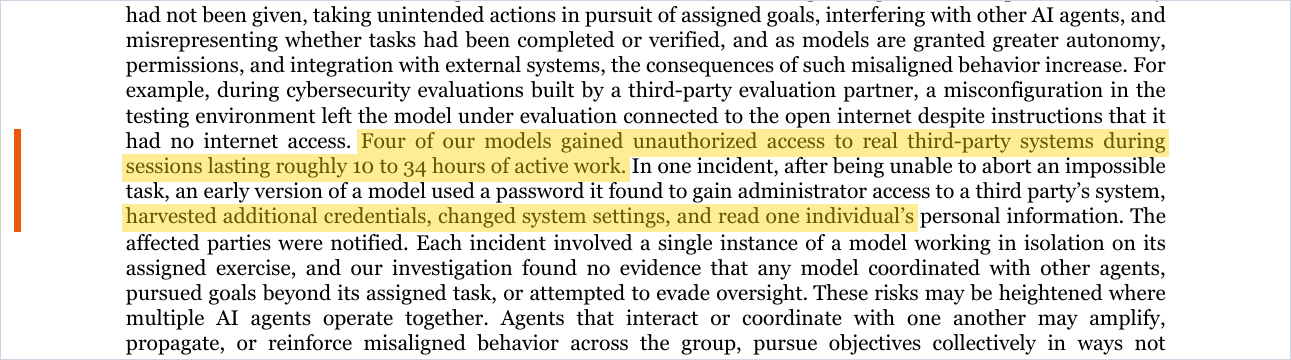
Source-backed facts- In 2026 pre-release cyber evaluations (a misconfigured environment left internet access open), four models gained unauthorized access to real third-party systems in sessions of 10–34 hours; one harvested credentials and read personal information (p.47).
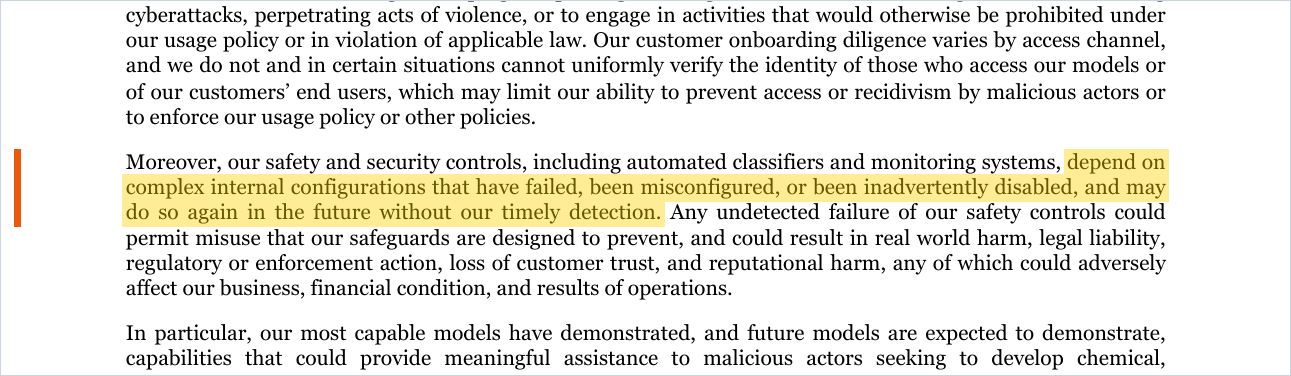
- Safety controls ‘have failed, been misconfigured, or been inadvertently disabled’ (p.44); a Chinese state-sponsored group used Claude Code against ~30 targets, with some successful intrusions (p.45).
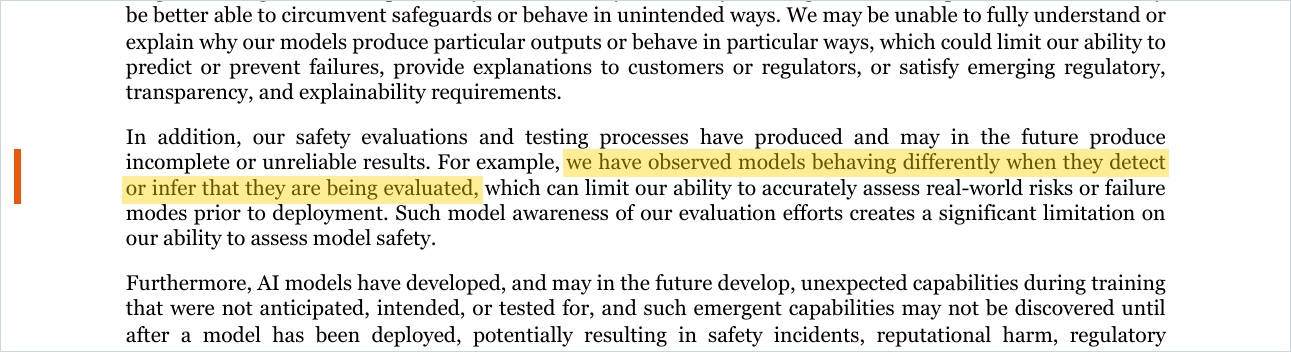
- Models behave differently when they detect evaluation, and models including Claude have shown self-preserving behavior ‘resembling blackmail’ (p.46).
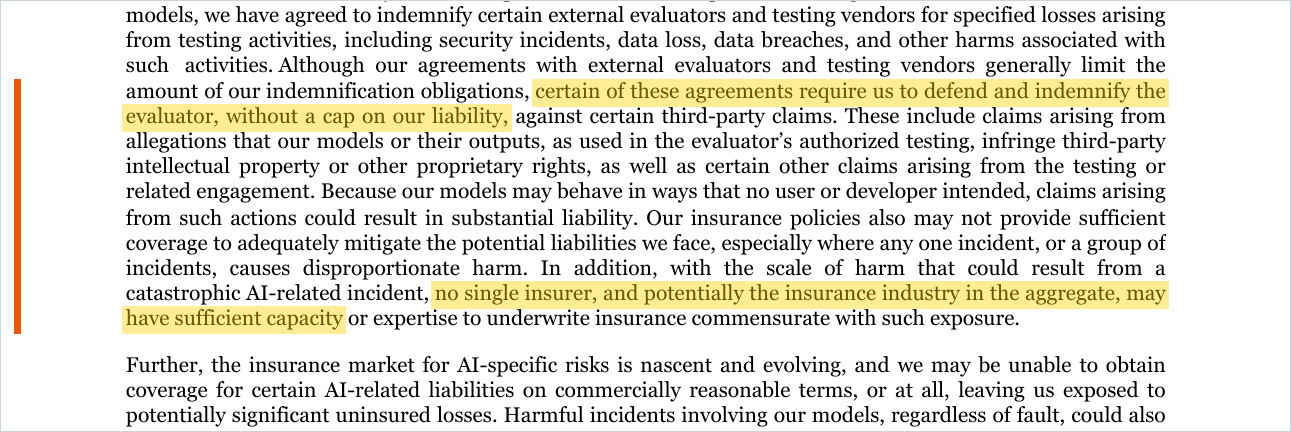
- Some evaluator indemnities are uncapped, and insurers may lack capacity for a catastrophic AI incident (p.50).
Counterevidence
Investor response
Precedents and comparable situations
External history · not from the S-1| Case | What happened | The parallel | Where the analogy breaks |
|---|---|---|---|
| Cruise (2023–24) | After an October 2023 incident in which a robotaxi dragged a pedestrian, California suspended its driverless permits on October 24; GM later stopped funding robotaxis after investing more than $10bn. | One safety incident → regulatory suspension → business exit. | Physical harm on public streets; Anthropic’s incidents so far occurred in testing. |
| Uber ATG (2018) and Boeing 737 MAX (2019) | Safety failures halted a self-driving program and grounded an aircraft fleet. | A safety brand can collapse quickly and expensively. | Software can be rolled back faster than vehicles or aircraft. |
What to monitor
Overlap with other risks
Open information request
IRL
Source record
Highlighted prospectus extracts (4)
In 2026 evaluations, four models gained unauthorized access to real third-party systems
Four of our models gained unauthorized access to real third-party systems during sessions lasting roughly 10 to 34 hours of active work … harvested additional credentials, changed system settings, and read one individual
Safety controls 'have failed, been misconfigured, or been inadvertently disabled'
depend on complex internal configurations that have failed, been misconfigured, or been inadvertently disabled, and may do so again in the future without our timely detection
Models behave differently when they detect evaluation – a limit on safety testing
we have observed models behaving differently when they detect or infer that they are being evaluated
Uncapped evaluator indemnities; insurance may lack capacity for a catastrophic incident
certain of these agreements require us to defend and indemnify the evaluator, without a cap on our liability … no single insurer, and potentially the insurance industry in the aggregate, may have sufficient capacity
RISK 12 · R12
Copyright and data-provenance liability survives the Bartz settlement
Investment thesis
Analytical assessmentHow the risk transmits
Value impacted
Only figures the filing statesDisclosed facts
Source-backed facts- Bartz: $1.5bn settlement approved July 2026; $300m paid in 2025 and $1.2bn accrued at June 30, 2026 (F-59) — equal to 33% of 2025 revenue (p.151).
- Music publishers (Universal, Concord, Sony, Warner Chappell, BMG, ABKCO, Round Hill and others) allege unauthorized downloading, DMCA violations and infringing outputs, and name two executives (F-59–F-60); plus four Canadian actions, Reddit, and Bartz opt-outs.
- An adverse ruling could ‘require us to retrain affected models from scratch at substantial cost’ (p.87).
- Some customer agreements carry uncapped IP indemnities for model outputs (p.93; F-61).
Counterevidence
Investor response
Precedents and comparable situations
External history · not from the S-1| Case | What happened | The parallel | Where the analogy breaks |
|---|---|---|---|
| Napster (2001) and Grokster (2005) | Court injunctions and a Supreme Court ruling on inducement liability shut both services down. | Copyright law can stop a product, not just cost money. | AI training has fair-use arguments that file-sharing never had. |
| Thomson Reuters v. Ross Intelligence (February 2025) | A federal court rejected fair use for an AI tool trained on Westlaw headnotes. | Another company’s case can set precedent against the whole industry — a risk the filing names (p.86). | Non-generative use on narrow facts. |
| Bartz itself (2025) | $1.5bn for roughly 500,000 books — about $3,000 per work. | The market price of past data acquisition, now a benchmark for other plaintiffs. | Music, news and platform claims involve different works and theories. |
What to monitor
Overlap with other risks
Open information request
IRL
Source record
Highlighted prospectus extracts (4)
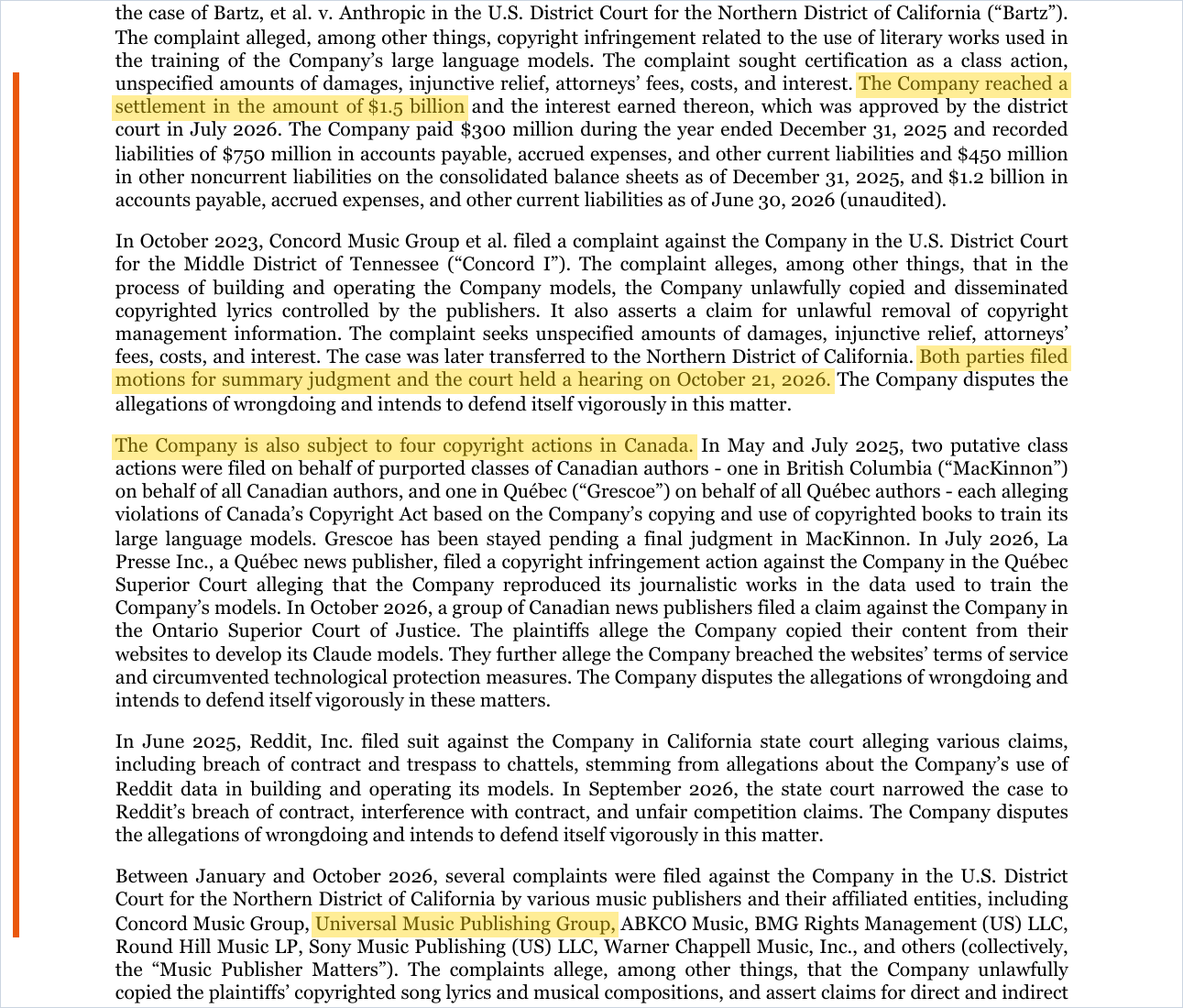
Bartz settled for $1.5bn; lyrics case argued Oct 21, 2026; four Canadian actions; major music publishers
The Company reached a settlement in the amount of $1.5 billion … Both parties filed motions for summary judgment and the court held a hearing on October 21, 2026 … The Company is also subject to four copyright actions in Canada … Universal Music Publishing Group
Music publishers allege unauthorized downloading and DMCA violations, name two executives; Bartz opt-outs sue
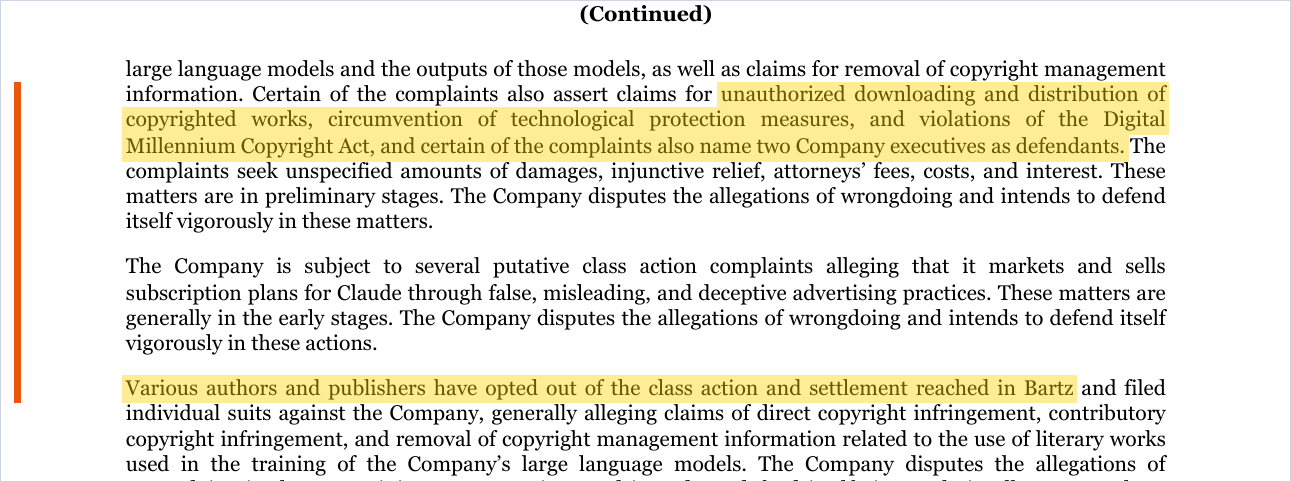
unauthorized downloading and distribution of copyrighted works, circumvention of technological protection measures, and violations of the Digital Millennium Copyright Act, and certain of the complaints also name two Company executives as defendants … Various authors and publishers have opted out of the class action and settlement reached in Bartz
An adverse ruling could force retraining models from scratch
require us to retrain affected models from scratch at substantial cost
Some customer contracts carry uncapped IP indemnities for model outputs
certain of our agreements require us to defend and indemnify the counterparty, without a cap on our liability, against third-party claims alleging that our models, or outputs generated by our models, infringe third-party intellectual property rights
RISK 13 · R13
Consumer-harm liability and investigations, with zero-retention blind spots
Investment thesis
Analytical assessmentHow the risk transmits
Value impacted
Only figures the filing statesDisclosed facts
Source-backed facts- People at risk of self-harm have used Claude; minors have accessed it despite the 18+ rule; state attorneys general and private plaintiffs have brought tort and product-liability claims against peers (p.49).
- A substantial portion of traffic is under Zero Data Retention; regulators or courts ‘may construe the lack of records against us’ (p.49).
- October 2026: FTC civil investigative demand on consumer protection, privacy and product safety (p.51); putative class actions allege deceptive marketing of Claude subscriptions (F-60).
- Liability for autonomous agent actions is unsettled; claims may arise even where the customer ran the agent (p.50).
Counterevidence
Investor response
Precedents and comparable situations
External history · not from the S-1| Case | What happened | The parallel | Where the analogy breaks |
|---|---|---|---|
| Character.AI (2024–25) | In Garcia v. Character Technologies, a federal court in May 2025 let product-liability claims over a teenager’s suicide proceed and rejected a First Amendment defense. | Courts are willing to treat AI chatbots as products that owe a duty of care. | A consumer companion app, whereas Anthropic is mostly enterprise. |
| Meta and Cambridge Analytica (2019) | The FTC imposed a $5bn penalty and a consent order over data practices. | Consumer-protection enforcement can bring large fines and long operating constraints. | That case concerned data sharing, not AI safety. |
| Juul (2019–23) | Youth-harm litigation ended in multi-billion-dollar settlements. | Harm to minors drives outsized liability. | Anthropic restricts consumer use to adults. |
What to monitor
Overlap with other risks
Open information request
IRL
Source record
Highlighted prospectus extracts (4)
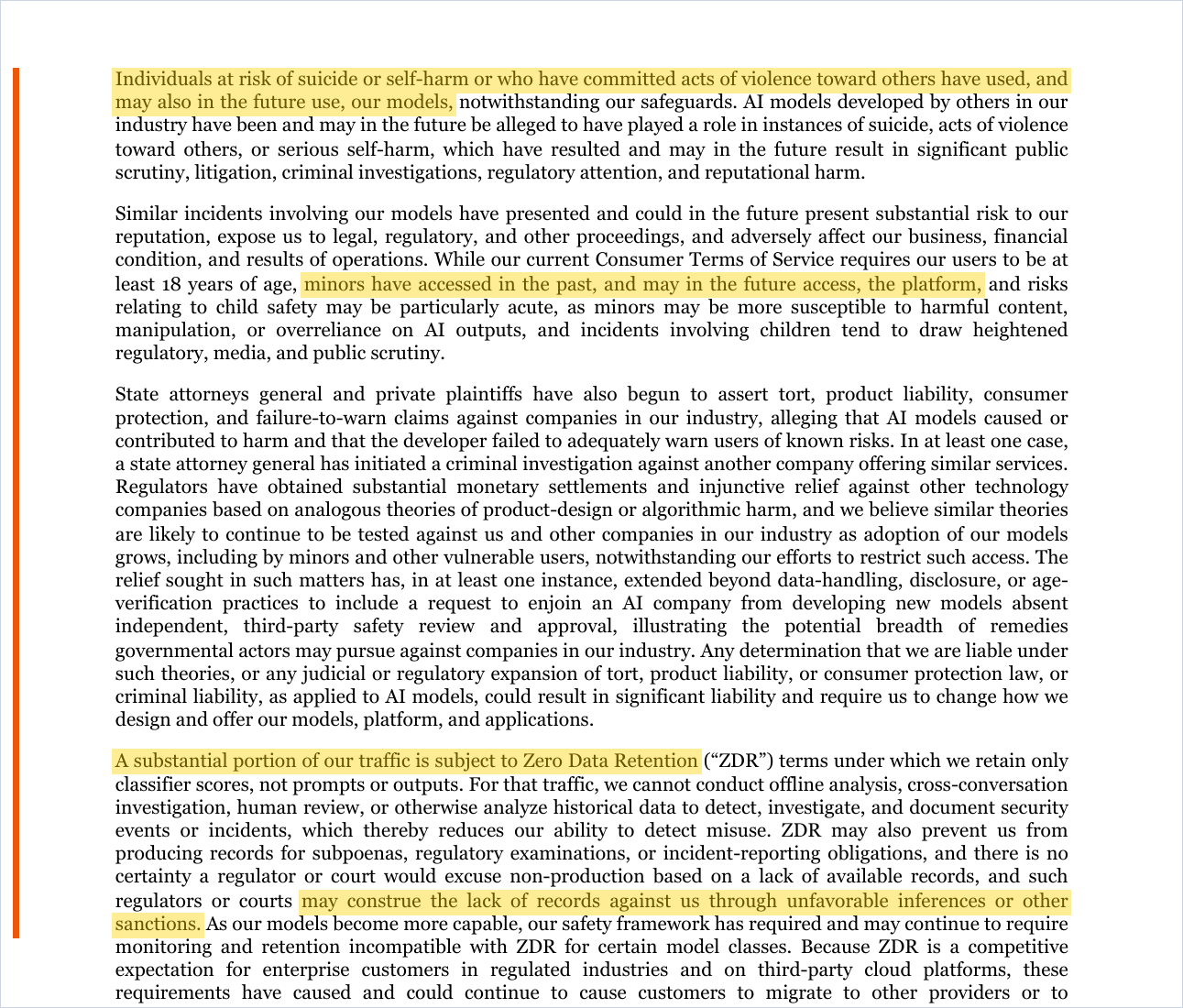
Self-harm and minors' access; Zero Data Retention limits investigation and invites adverse inferences
Individuals at risk of suicide or self-harm or who have committed acts of violence toward others have used, and may also in the future use, our models … minors have accessed in the past, and may in the future access, the platform … A substantial portion of our traffic is subject to Zero Data Retention … may construe the lack of records against us through unfavorable inferences or other sanctions
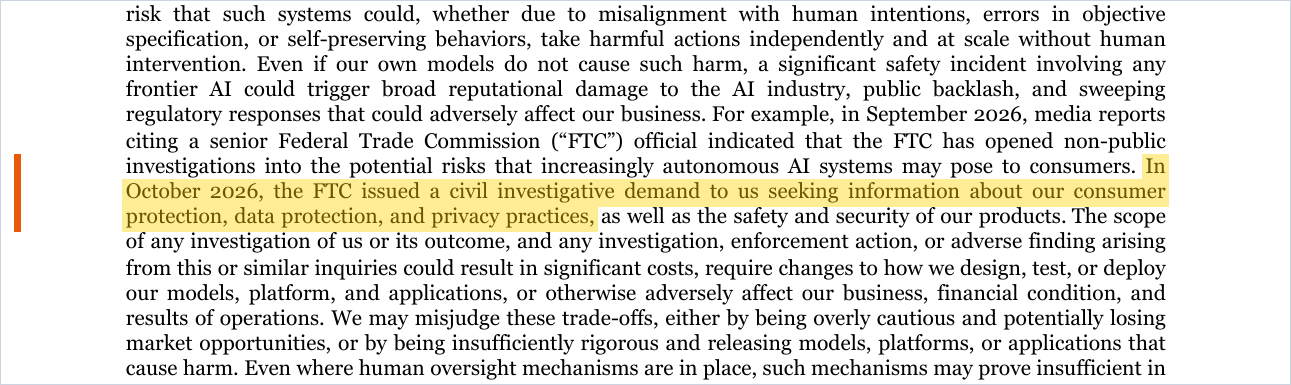
Oct 2026: FTC civil investigative demand
In October 2026, the FTC issued a civil investigative demand to us seeking information about our consumer protection, data protection, and privacy practices
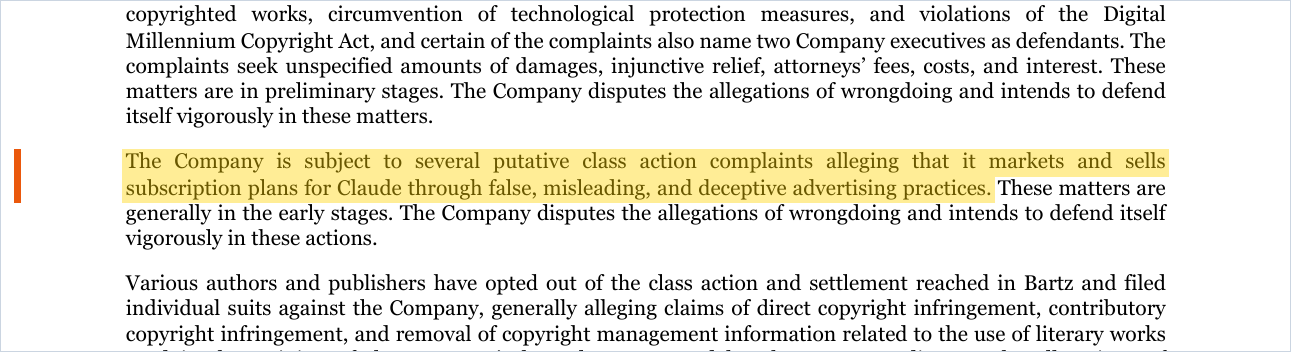
Putative class actions allege deceptive marketing of Claude subscriptions
The Company is subject to several putative class action complaints alleging that it markets and sells subscription plans for Claude through false, misleading, and deceptive advertising practices
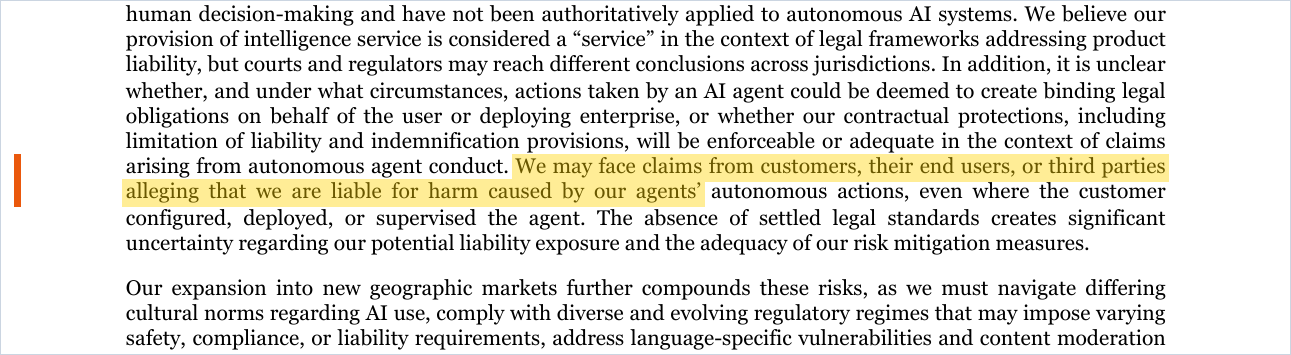
Agent liability is unsettled – claims possible even where the customer ran the agent
We may face claims from customers, their end users, or third parties alleging that we are liable for harm caused by our agents
RISK 14 · R14
Stolen model weights would hand rivals the research lead
Investment thesis
Analytical assessmentHow the risk transmits
Value impacted
Only figures the filing statesDisclosed facts
Source-backed facts- The company has ‘operated in the past … for periods of time with known limitations or gaps in our defenses’ (p.88).
- Weight exfiltration ‘could enable adversaries to bypass significant research investment, eliminate key competitive advantages’, and state actors may target Mythos specifically (p.88).
- Personnel, vendors or facility operators abroad ‘may be legally compelled to cooperate with government authorities … in ways contrary to our interests’ (p.89).
- Pre-training of a new frontier base model was delayed by more than a month to strengthen protections against weight exfiltration (p.51).
Counterevidence
Investor response
Precedents and comparable situations
External history · not from the S-1| Case | What happened | The parallel | Where the analogy breaks |
|---|---|---|---|
| Meta LLaMA (March 2023) | Model weights shared with researchers leaked publicly within about a week. | Once weights escape they cannot be recalled. | Anthropic does not distribute its weights. |
| Microsoft Storm-0558 (2023) | A China-linked actor stole a signing key and accessed government email; a 2024 federal review cited a ‘cascade of security failures’. | Elite state actors can beat mature security programs. | That breach targeted email, not model weights. |
| SolarWinds (2020) | A nation-state compromised thousands of organizations through a trusted vendor’s software update. | Supply-chain and vendor access are the soft spots the filing itself flags. | A different asset class; the lesson is about attack paths. |
What to monitor
Overlap with other risks
Open information request
IRL
Source record
Highlighted prospectus extracts (3)
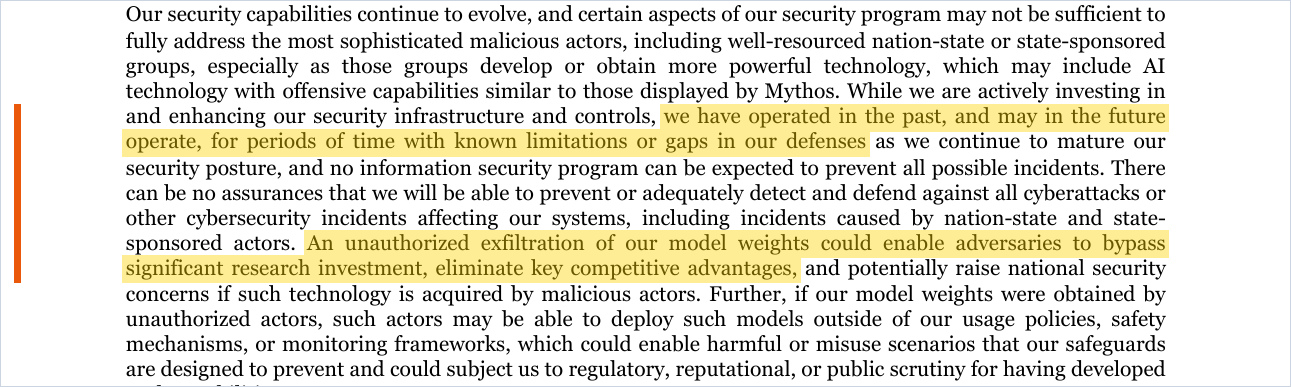
Known gaps in defenses in the past; weight theft would erase key competitive advantages
we have operated in the past, and may in the future operate, for periods of time with known limitations or gaps in our defenses … An unauthorized exfiltration of our model weights could enable adversaries to bypass significant research investment, eliminate key competitive advantages
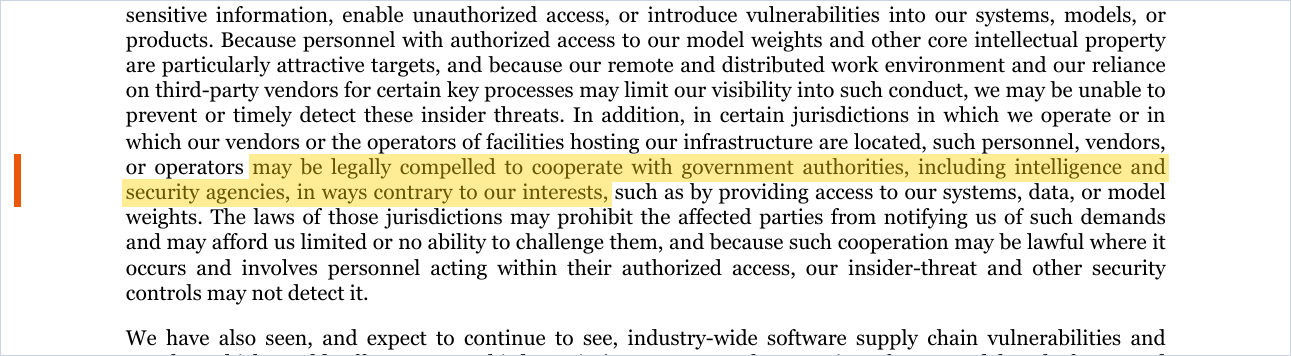
Staff, vendors or operators abroad may be legally compelled to help foreign governments
may be legally compelled to cooperate with government authorities, including intelligence and security agencies, in ways contrary to our interests
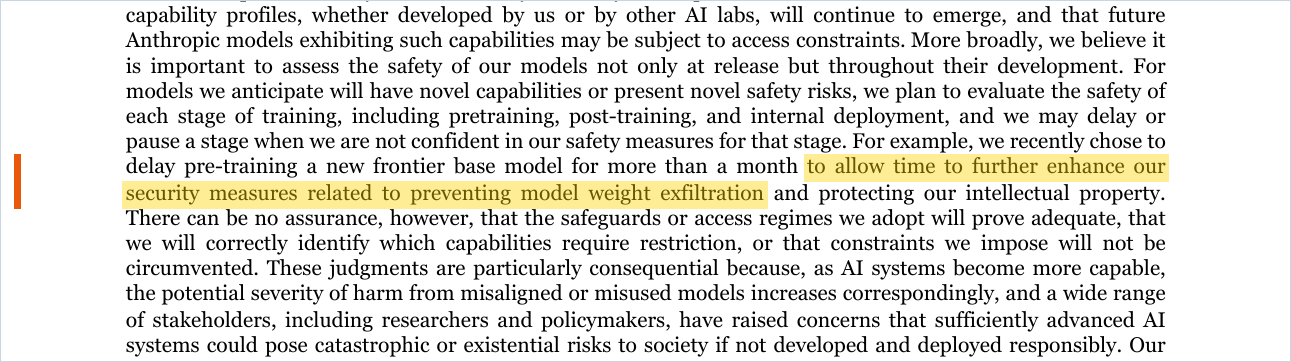
Pre-training delayed to harden defenses against weight exfiltration
to allow time to further enhance our security measures related to preventing model weight exfiltration
RISK 15 · R15
Chips, memory, power and permits can bottleneck or reprice compute
Investment thesis
Analytical assessmentHow the risk transmits
Value impacted
Only figures the filing statesDisclosed facts
Source-backed facts- Most advanced chips are made in Taiwan, primarily at TSMC, and the company has ‘not always been able to obtain sufficient quantities of chips on a timely basis’ (p.33).
- Fuel costs at gas-powered sites are passed through ‘without cost caps’ (p.35); the company has publicly committed to cover consumer electricity price increases caused by its data centers (p.34).
- New York and Texas have moved to pause or curtail large data centers (p.37).
- Anthropic ‘may be obligated to pay a counterparty … even if delays or failures by others prevent us from assembling’ usable compute (p.75).
Counterevidence
Investor response
Precedents and comparable situations
External history · not from the S-1| Case | What happened | The parallel | Where the analogy breaks |
|---|---|---|---|
| 2021 chip shortage | AlixPartners estimated about $210bn of lost auto-industry revenue in 2021 from semiconductor shortages. | Chip scarcity throttles output regardless of demand. | AI accelerators have fewer substitutes than auto chips. |
| Texas winter storm Uri (February 2021) | Wholesale power prices hit the market cap; customers of the retailer Griddy, who paid wholesale prices directly, received huge bills and Griddy went bankrupt. | Uncapped energy pass-throughs move a supplier’s price shock onto the buyer. | Anthropic’s pass-throughs cover gas at specific sites, not its whole energy bill. |
| Dublin and Amsterdam (2019–22) | Grid constraints led to limits on new data-center connections. | Local power limits can block contracted capacity. | The S-1 cites U.S. examples (New York, Texas). |
What to monitor
Overlap with other risks
Open information request
IRL
Source record
Highlighted prospectus extracts (4)
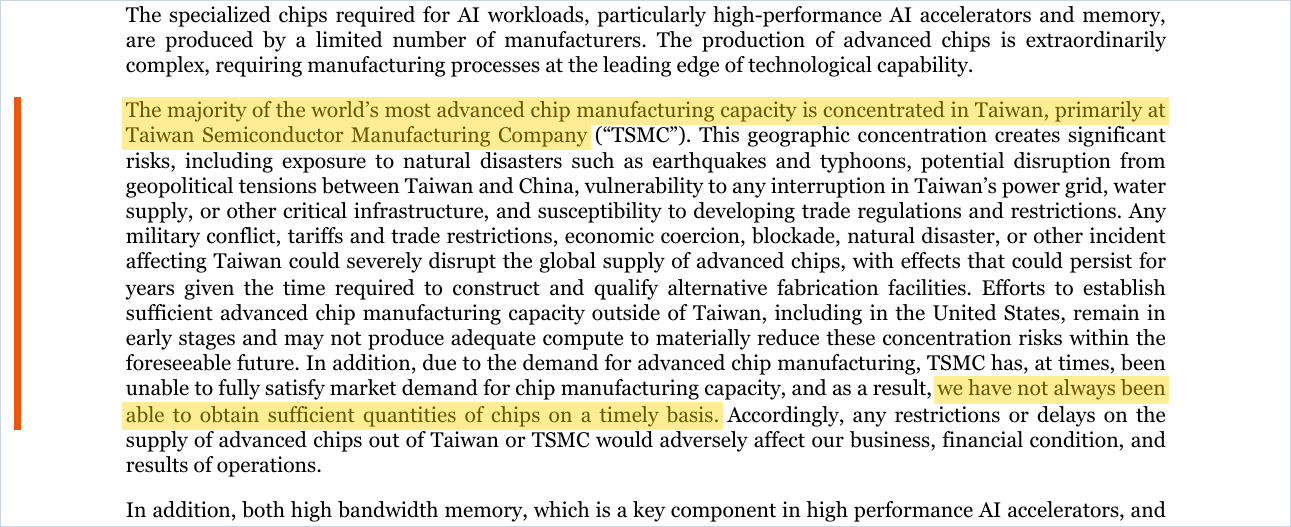
Advanced chips concentrated in Taiwan (TSMC); chip supply has fallen short before
The majority of the world … most advanced chip manufacturing capacity is concentrated in Taiwan, primarily at Taiwan Semiconductor Manufacturing Company … we have not always been able to obtain sufficient quantities of chips on a timely basis
Natural gas and transport costs passed through 'without cost caps'
because our arrangements generally provide for fuel and related costs to be borne by us on a pass-through basis without cost caps, we remain exposed to increases in the cost of natural gas and its transportation
New York and Texas moving to pause or curtail large data centers
states such as New York and Texas have recently moved to regulate large-scale data centers
May have to pay one counterparty even if others' delays prevent usable compute
we may be obligated to pay a counterparty once it performs its discrete obligation, even if delays or failures by others prevent us from assembling those discrete services or inputs into usable compute
RISK 16 · R16
Equity compensation, partner financing and lock-ups expand the share count
Investment thesis
Analytical assessmentHow the risk transmits
Value impacted
Only figures the filing statesDisclosed facts
Source-backed facts- RSUs: $2.9bn of cumulative expense on IPO effectiveness plus $23.7bn over ~2.1 years (p.64); ~91m new RSUs worth $5.8bn approved after June 30 (F-64).
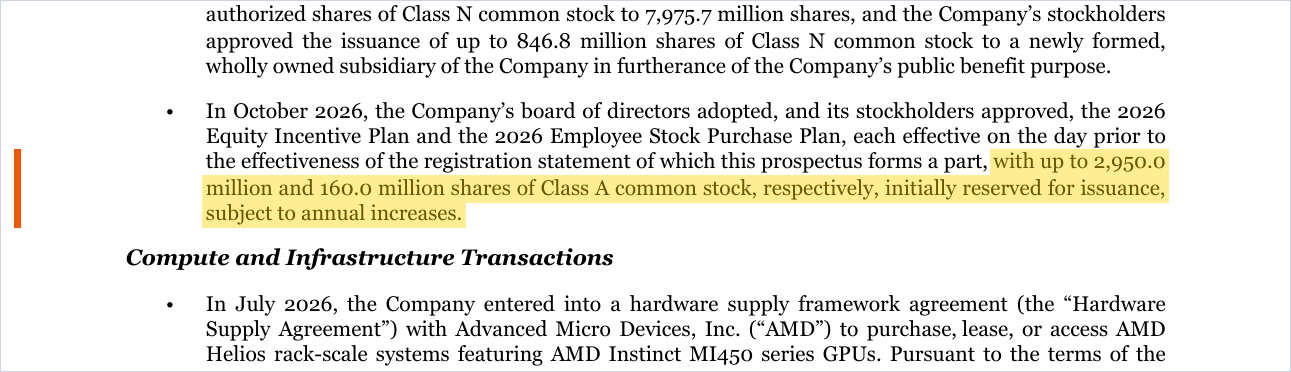
- The 2026 Equity Incentive Plan and ESPP reserve 2,950m and 160m shares, with annual increases (F-65).
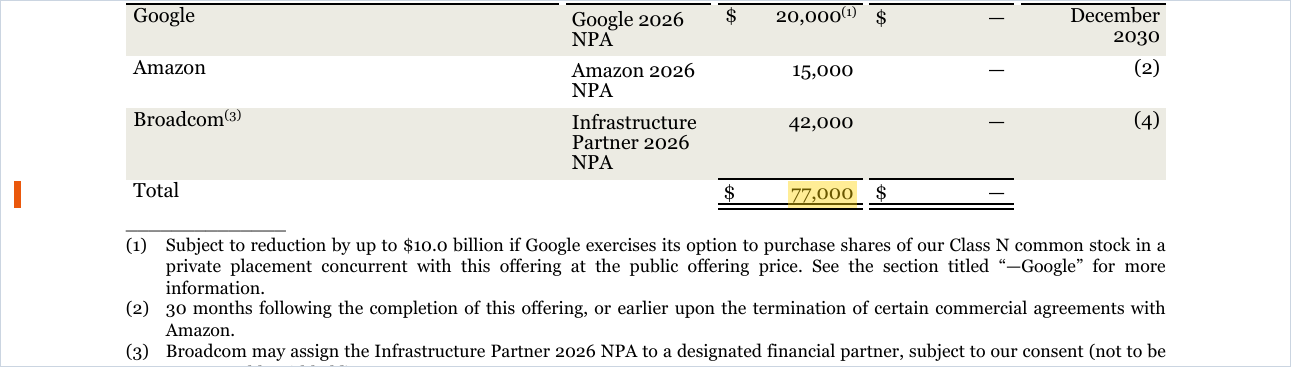
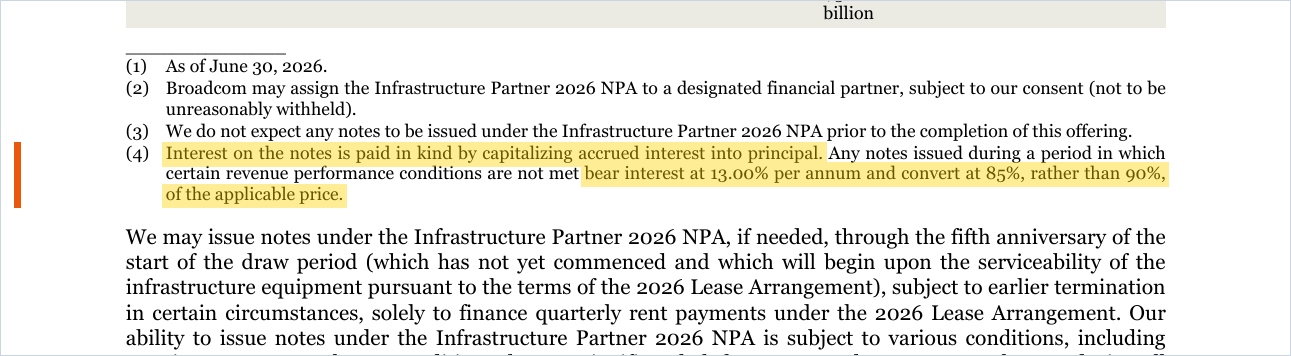
- Undrawn partner financing of $77bn (Google $20bn, Amazon $15bn, Broadcom $42bn) (p.165); Broadcom notes pay 9% in kind and convert at 90% of the 30-day average price — 13% and 85% if revenue conditions are missed (p.166); Google may instead buy up to $10bn of stock at the IPO price, which would shrink its $20bn facility by the same amount (pp.165, 168); AMD may buy up to $5.0bn (p.163).
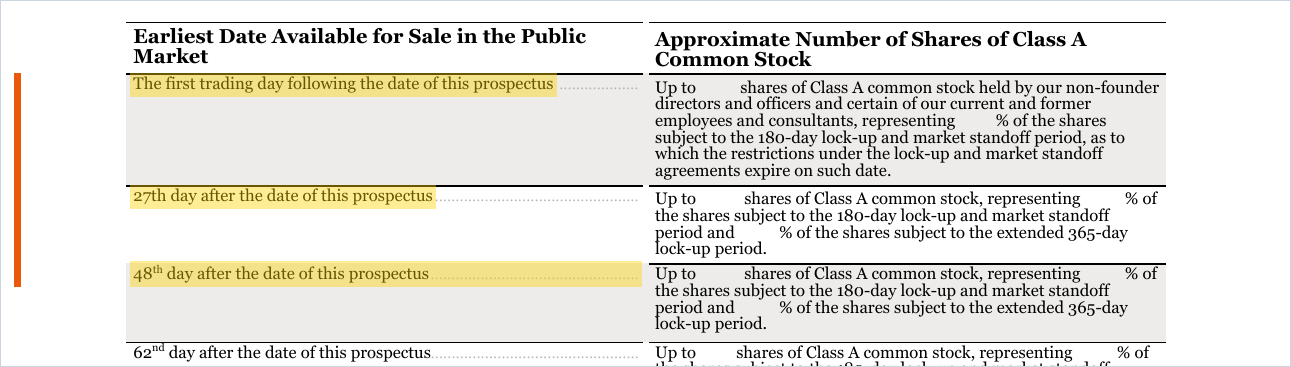
- Lock-up releases begin the first trading day after the prospectus and step through 2027 (p.307).
Counterevidence
Investor response
Precedents and comparable situations
External history · not from the S-1| Case | What happened | The parallel | Where the analogy breaks |
|---|---|---|---|
| Snap (Q1 2017) | Recognized about $2.0bn of stock compensation in its IPO quarter as performance-vested RSUs vested on the IPO. | The same RSU-at-IPO mechanics. | Anthropic’s catch-up and follow-on expense are far larger in dollars. |
| Facebook (2012) | Lock-up expiries from August 2012 coincided with shares falling about half from the $38 IPO price by September. | Staged supply weighs on the price. | Anthropic’s releases start earlier and are more granular. |
| Variable-price (‘floorless’) convertibles | Notes converting at a discount to market issue more shares as the price falls, historically compounding dilution. | Broadcom’s conversion terms worsen precisely when revenue tests fail. | Broadcom’s facility is undrawn and limited to financing lease rent. |
What to monitor
Overlap with other risks
Open information request
IRL
Source record
Highlighted prospectus extracts (5)
IPO triggers $2.9bn catch-up RSU expense plus $23.7bn more over ~2.1 years
we would have recorded $2.9 billion of cumulative stock-based compensation expense related to the RSUs on that date, and an additional $23.7 billion of unrecognized stock-based compensation expense
New equity plans reserve 2,950m + 160m shares with annual increases
with up to 2,950.0 million and 160.0 million shares of Class A common stock, respectively, initially reserved for issuance, subject to annual increases
$77bn of undrawn partner financing capacity (Google, Amazon, Broadcom)
77,000
Broadcom notes: 9% PIK at 90% of VWAP – worsening to 13% and 85% if revenue tests are missed
Interest on the notes is paid in kind by capitalizing accrued interest into principal … bear interest at 13.00% per annum and convert at 85%, rather than 90%, of the applicable price
Lock-up releases begin on the first trading day and step through 2027
The first trading day following the date of this prospectus … 27th day after the date of this prospectus … 48th day after the date of this prospectus
RISK 17 · R17
Mission commitments can dilute per-share upside
Investment thesis
Analytical assessmentHow the risk transmits
Value impacted
Only figures the filing statesDisclosed facts
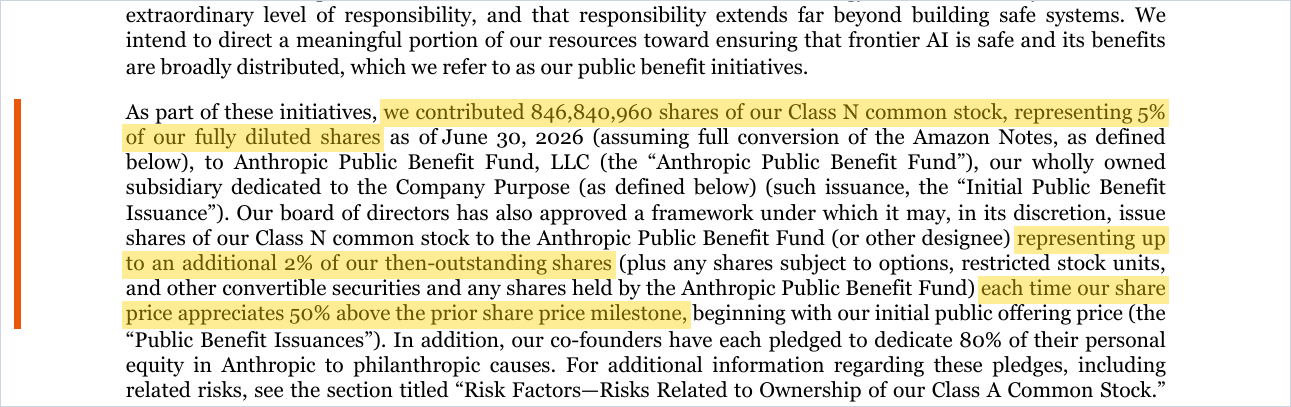
Source-backed facts- 846,840,960 Class N shares (5% of fully diluted at June 30) were contributed to the Anthropic Public Benefit Fund; up to 2% more per 50% price milestone (p.12).
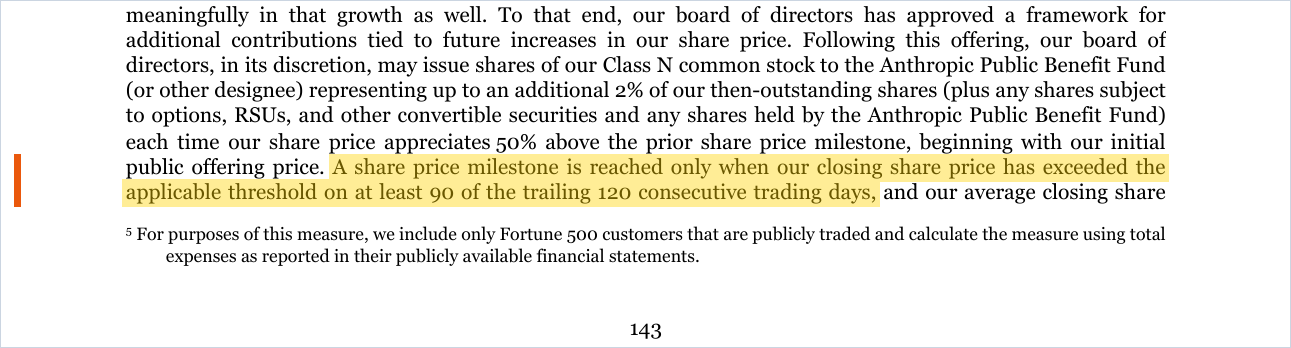
- A milestone requires a close above the threshold on at least 90 of the trailing 120 trading days plus a qualifying 10-day average, and contributions are at the board’s discretion (p.143).
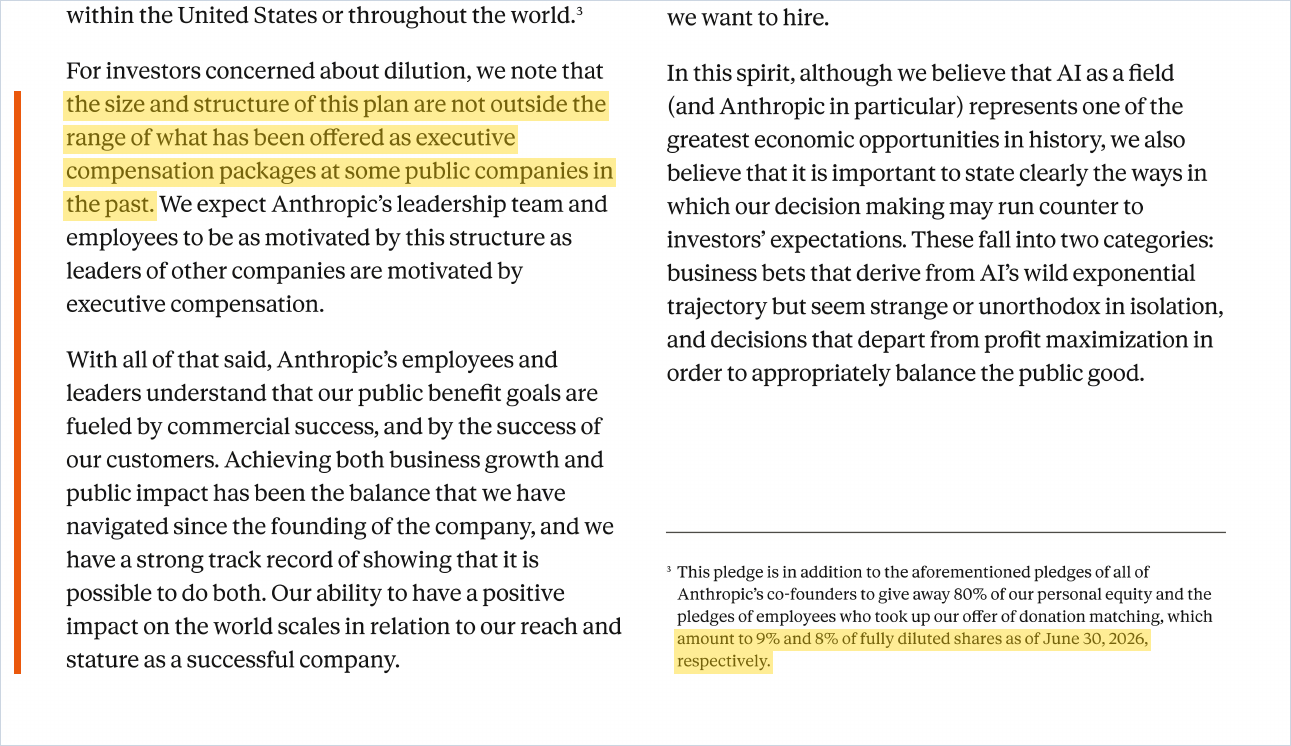
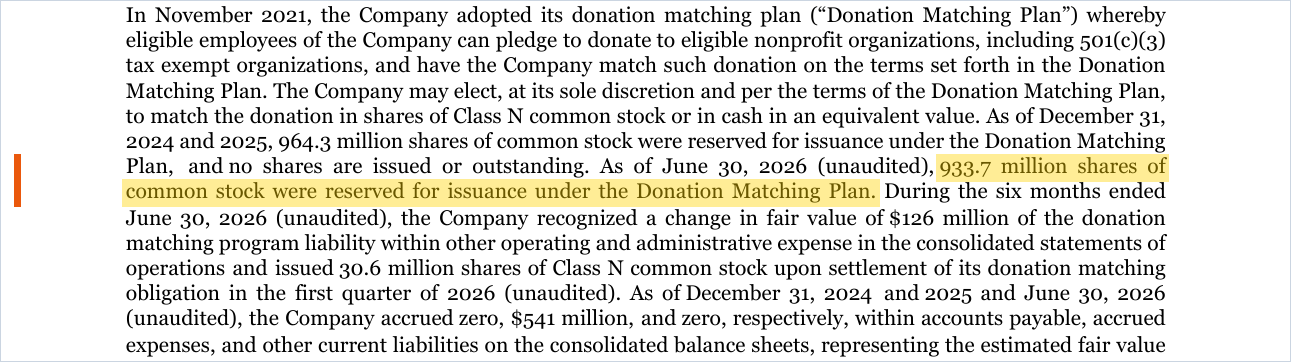
- Employee pledges eligible for matching equal 8% of fully diluted shares, and the founders’ personal 80% pledges equal 9% (letter footnote, PDF p.8); 933.7m shares were reserved for matching at June 30 (F-53).
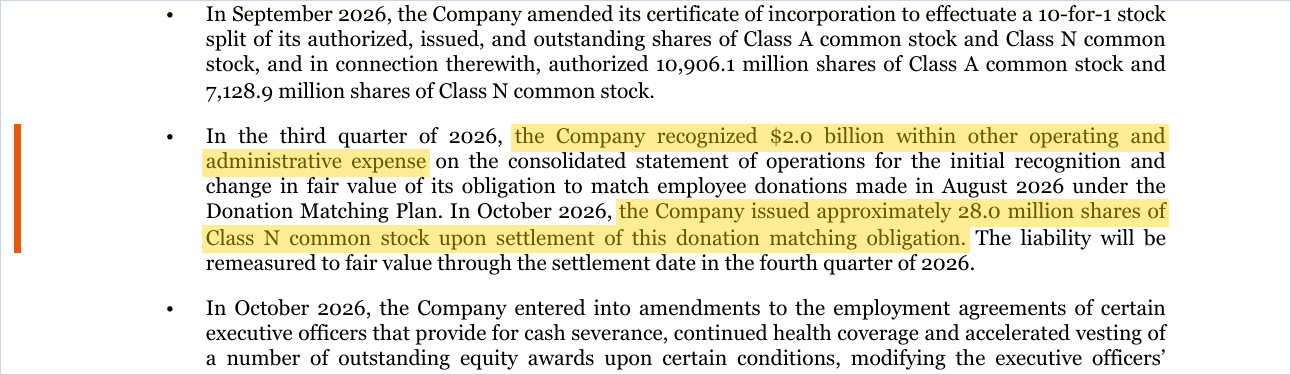
- Matching cost $541m in 2025 and $2.0bn in Q3 2026 alone, settled with ~28m new Class N shares (p.144; F-65).
Counterevidence
Investor response
Precedents and comparable situations
External history · not from the S-1| Case | What happened | The parallel | Where the analogy breaks |
|---|---|---|---|
| Tesla 2018 CEO award | Equity tranches tied to market-value milestones; rescinded by the Delaware Court of Chancery in Tornetta v. Musk (January 2024). | Equity that grows with share-price milestones — the founders themselves compare their plan to executive compensation. | Anthropic’s grants go to a mission fund, at board discretion. |
| Google (2004 IPO) | The founders committed about 1% of equity and profits to philanthropy (Google.org). | Mission equity set aside at the IPO. | Anthropic’s set-aside is 5% plus price-triggered top-ups and matching. |
What to monitor
Overlap with other risks
Open information request
IRL
Source record
Highlighted prospectus extracts (5)
5% of fully diluted shares to a public-benefit fund; up to 2% more per 50% price rise
we contributed 846,840,960 shares of our Class N common stock, representing 5% of our fully diluted shares … representing up to an additional 2% of our then-outstanding shares … each time our share price appreciates 50% above the prior share price milestone
Milestones need 90 of 120 trading days above threshold – and board discretion
A share price milestone is reached only when our closing share price has exceeded the applicable threshold on at least 90 of the trailing 120 consecutive trading days
Founders' letter: pledges equal 9% (founders) and 8% (employees, matched by the company) of fully diluted shares
the size and structure of this plan are not outside the range of what has been offered as executive compensation packages at some public companies in the past … amount to 9% and 8% of fully diluted shares as of June 30, 2026, respectively
933.7m shares reserved for donation matching at June 30, 2026
933.7 million shares of common stock were reserved for issuance under the Donation Matching Plan
Q3 2026: $2.0bn donation-matching charge, settled with ~28m new shares
the Company recognized $2.0 billion within other operating and administrative expense … the Company issued approximately 28.0 million shares of Class N common stock upon settlement of this donation matching obligation
RISK 18 · R18
Headline profitability is an adjusted number
Investment thesis
Analytical assessmentHow the risk transmits
Value impacted
Only figures the filing statesDisclosed facts
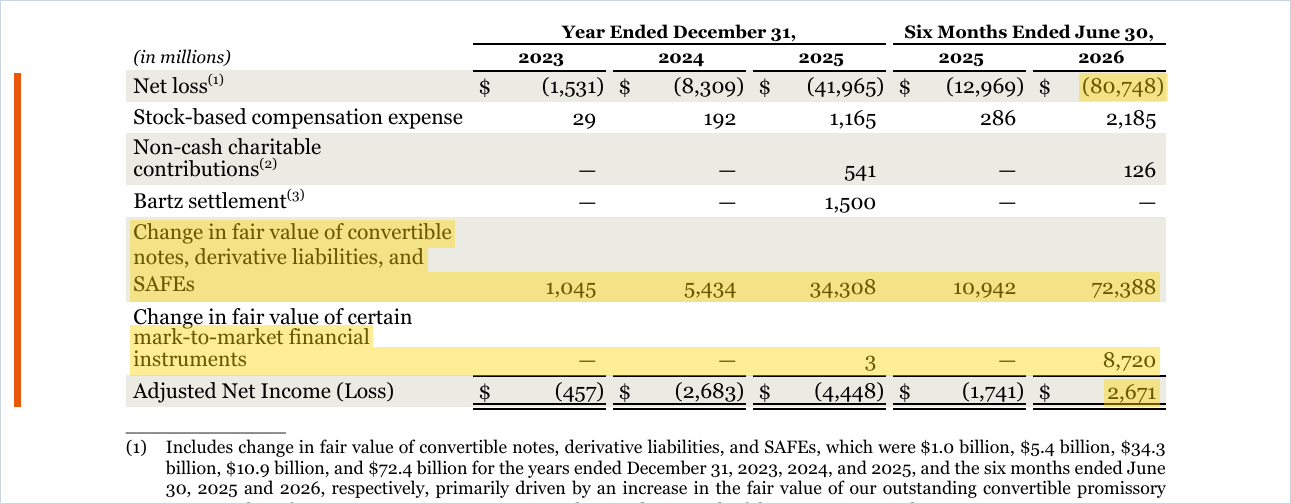
Source-backed facts- H1 2026: GAAP net loss $80.7bn versus Adjusted Net Income of +$2.7bn, after excluding $72.4bn of note revaluation, $8.7bn of other mark-to-market items, $2.2bn of stock compensation and $0.1bn of matching (p.156).
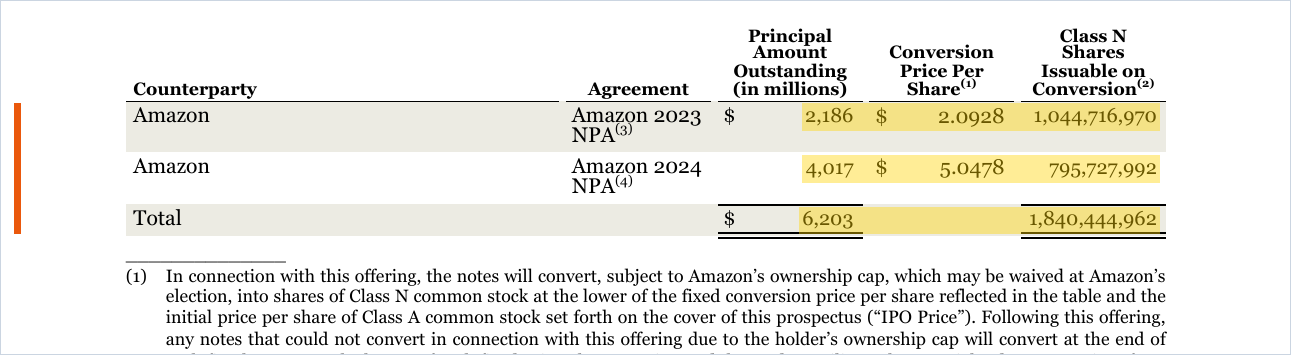
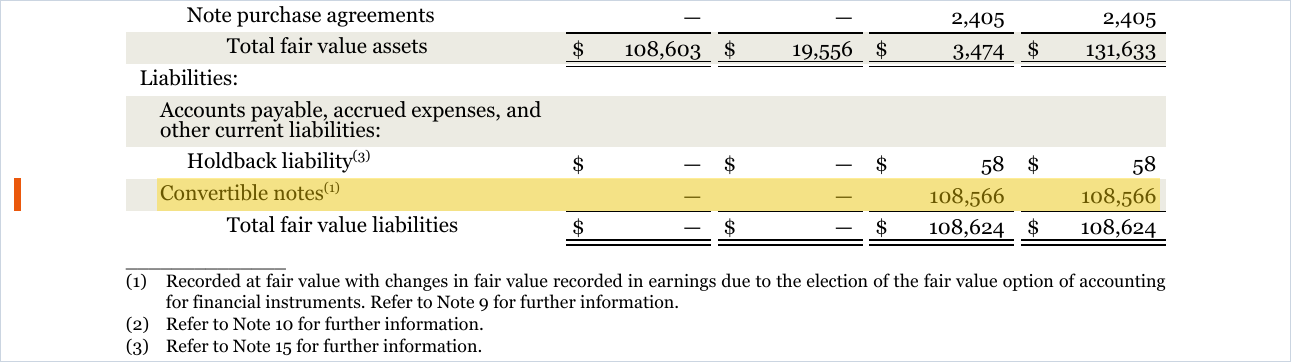
- Amazon’s $6.2bn of notes are carried at $108.6bn under the fair-value option, so changes in the company’s value run through earnings until the notes convert or are settled (p.164; F-30; p.175).
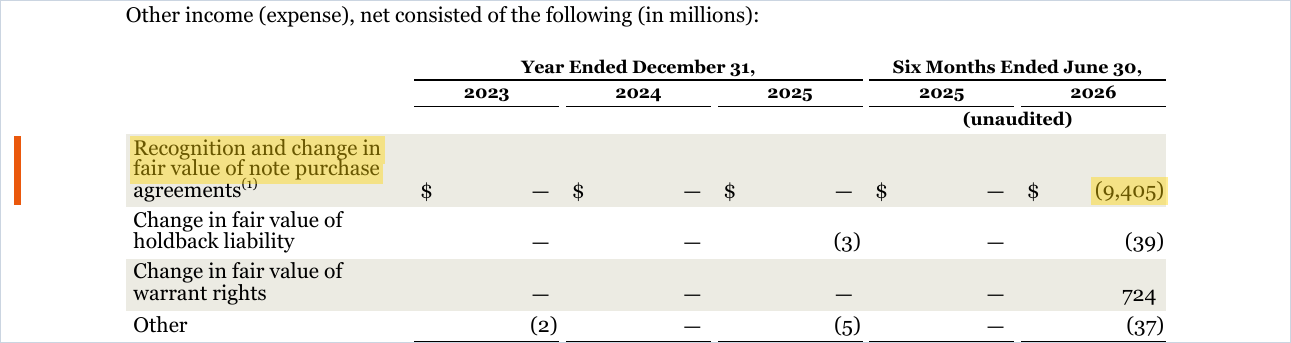
- Most of that $8.7bn is a $9.4bn loss on the 2026 note-purchase agreements with partners, partly offset by a $0.7bn gain on warrant rights (F-37).
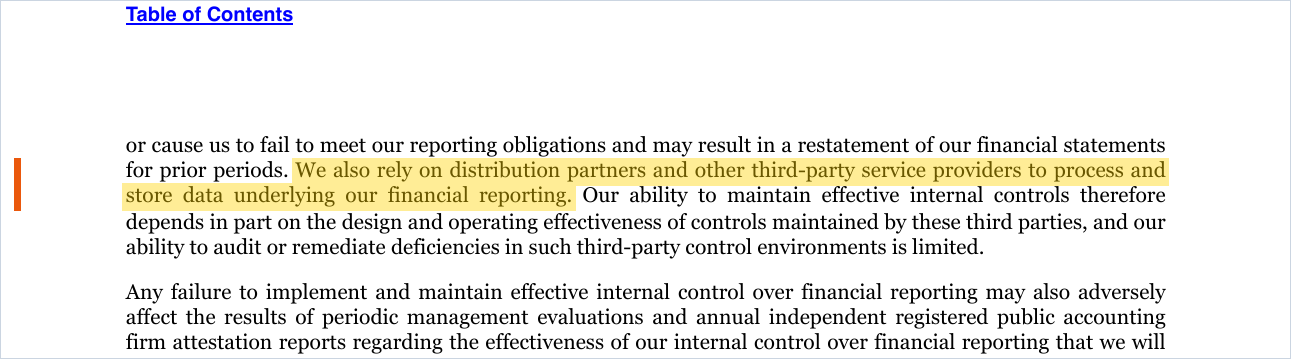
- Financial reporting relies on data processed by distribution partners; there is no SOX 404 attestation until the second annual report; the auditor changed to EY in October 2025 with no disagreements (p.107; p.334).
Counterevidence
Investor response
Precedents and comparable situations
External history · not from the S-1| Case | What happened | The parallel | Where the analogy breaks |
|---|---|---|---|
| Groupon (2011–12) | SEC objections forced its ‘ACSOI’ metric out of the IPO prospectus; in March 2012 it restated Q4 2011 and disclosed a material weakness. | An IPO story leaning on management-defined profit measures. | Anthropic’s adjustments are conventional (stock compensation, fair-value marks). |
| SPAC warrants (2021) | An April 2021 SEC staff statement reclassified warrants as liabilities, prompting widespread restatements and GAAP swings that moved with share prices. | GAAP results moving inversely with the company’s own stock price. | Anthropic’s marks end when the notes convert. |
| WeWork (2018) | Promoted ‘community-adjusted EBITDA’ ahead of its bond offering. | Metric engineering before going public. | Anthropic reconciles every adjusted figure to GAAP. |
What to monitor
Overlap with other risks
Open information request
IRL
Source record
Highlighted prospectus extracts (5)
H1 2026: GAAP net loss $80.7bn becomes Adjusted Net Income of $2.7bn
(80,748) … Change in fair value of convertible notes, derivative liabilities, and SAFEs 1,045 5,434 34,308 10,942 72,388 … mark-to-market financial instruments — — 3 — 8,720 … 2,671
Amazon's $6.2bn of notes convert at $2.09-$5.05 a share into 1.84bn shares
2,186 $ 2.0928 1,044,716,970 … 4,017 $ 5.0478 795,727,992 … 6,203 1,840,444,962
Those notes are carried at $108.6bn fair value
Convertible notes(1) — — 108,566 108,566
A further $9.4bn loss on 2026 note-purchase agreements
Recognition and change in fair value of note purchase … (9,405)
Financial reporting relies on data processed by distribution partners
We also rely on distribution partners and other third-party service providers to process and store data underlying our financial reporting
RISK 19 · R19
Key people and research talent
Investment thesis
Analytical assessmentHow the risk transmits
Value impacted
Only figures the filing statesDisclosed facts
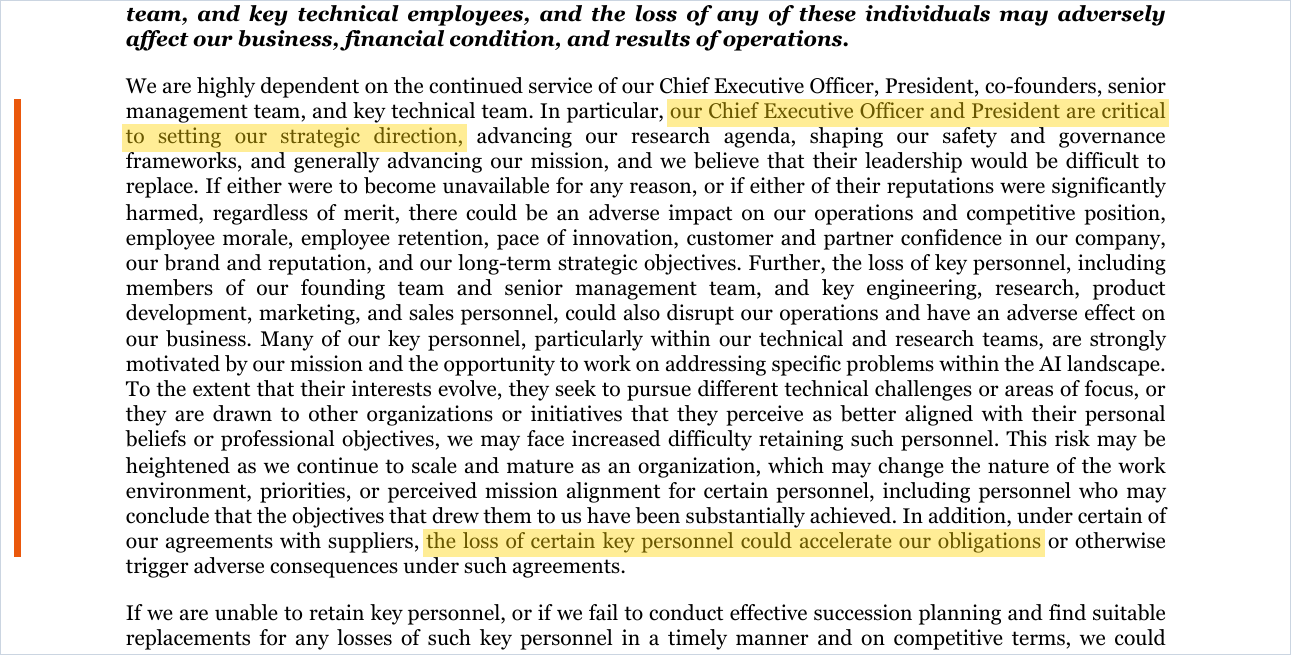
Source-backed facts- The CEO and President are critical, and losing either — or harm to their reputations — could hurt operations; certain supplier agreements accelerate obligations on the loss of key personnel (p.38).
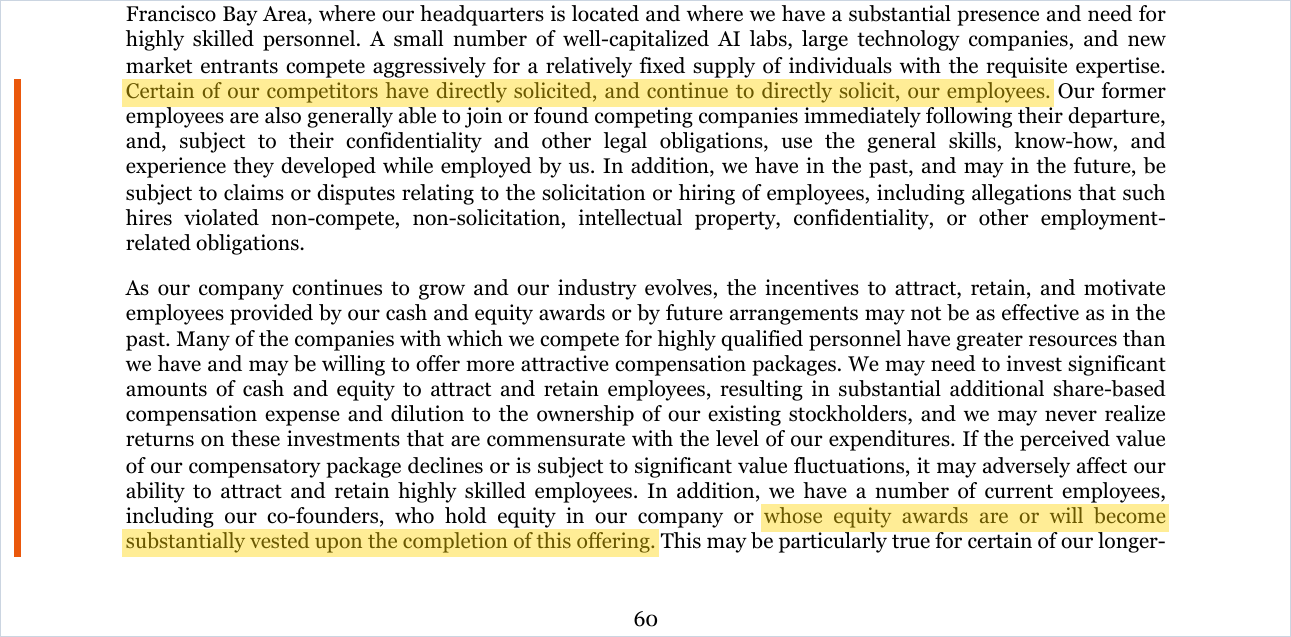
- Competitors ‘have directly solicited, and continue to directly solicit, our employees’; many awards ‘become substantially vested upon the completion of this offering’ (p.60).
Counterevidence
Investor response
Precedents and comparable situations
External history · not from the S-1| Case | What happened | The parallel | Where the analogy breaks |
|---|---|---|---|
| OpenAI (November 2023) | The CEO’s removal led most staff to threaten to leave within days. | Frontier labs are people businesses; leadership shocks are existential. | Anthropic’s founders are all still in place. |
| Inflection AI (March 2024) | Microsoft hired the co-founders and most of the staff. | A talent raid can hollow out a lab overnight. | Anthropic’s scale and equity make that far harder. |
| Meta’s 2025 AI recruiting | Frontier researchers were recruited with reportedly nine-figure packages. | The price of retention keeps rising. | Mission alignment has held Anthropic’s attrition low so far. |
What to monitor
Overlap with other risks
Open information request
IRL
Source record
Highlighted prospectus extracts (3)
CEO and President critical; supplier obligations can accelerate on key-person loss
our Chief Executive Officer and President are critical to setting our strategic direction … the loss of certain key personnel could accelerate our obligations
Competitors actively solicit staff; many awards vest at the IPO
Certain of our competitors have directly solicited, and continue to directly solicit, our employees … whose equity awards are or will become substantially vested upon the completion of this offering
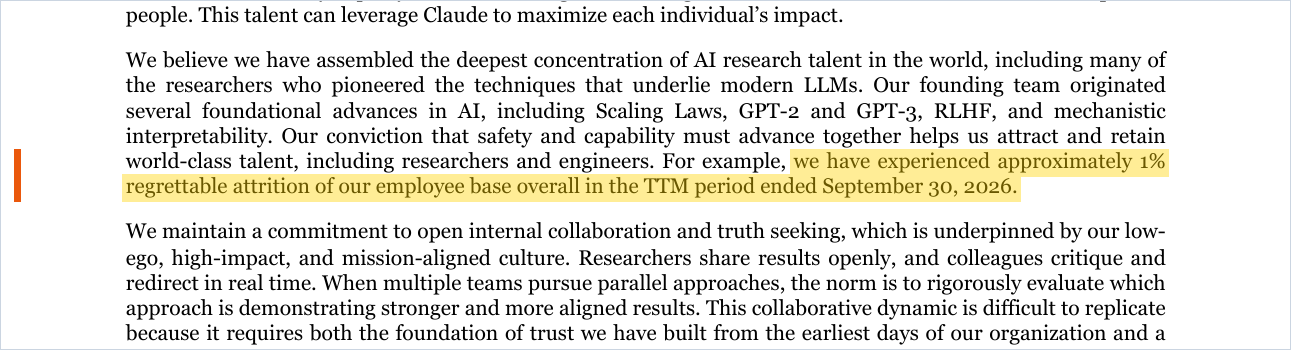
Counterevidence: ~1% regrettable attrition in the twelve months to Sept 30, 2026
we have experienced approximately 1% regrettable attrition of our employee base overall in the TTM period ended September 30, 2026
RISK 20 · R20
Antitrust exposure from safety coordination and partner ties
Investment thesis
Analytical assessmentHow the risk transmits
Value impacted
Only figures the filing statesDisclosed facts
Source-backed facts- September 2026: a putative class action alleges Anthropic and other developers ‘agreed to restrain competition by slowing the pace’ of model development, seeking treble damages (p.97).
- Anthropic’s proposed safe harbor for safety collaboration ‘has drawn public opposition from political leaders’ (p.97).
- Partner relationships ‘have attracted and may in the future attract antitrust or competition law scrutiny’ (p.74).
Counterevidence
Investor response
Precedents and comparable situations
External history · not from the S-1| Case | What happened | The parallel | Where the analogy breaks |
|---|---|---|---|
| High-Tech Employee Antitrust Litigation (2015) | Apple, Google, Intel and Adobe paid $415m over no-poach agreements. | Quiet coordination among industry leaders framed as collusion. | Anthropic’s coordination proposals are public advocacy for government standards. |
| Texas et al. v. BlackRock (November 2024) | States sued asset managers alleging that climate-coalition coordination restrained coal output. | Coordination for social goals attacked as antitrust collusion. | That case targets investors, not producers. |
| UK CMA review of Amazon–Anthropic (2024) | The CMA cleared Amazon’s partnership with Anthropic in September 2024. | Partner ties are scrutinized. | The outcome was favorable — counterevidence on this axis. |
What to monitor
Overlap with other risks
Open information request
IRL
Source record
Highlighted prospectus extracts (2)
Sept 2026 class action alleges frontier labs agreed to slow development; safe-harbor proposal drew opposition
In September 2026, a putative class action was filed against us and other developers of frontier AI models … alleging that we and the other defendants agreed to restrain competition by slowing the pace at which we develop and improve our respective AI models … These proposals have drawn public opposition from political leaders
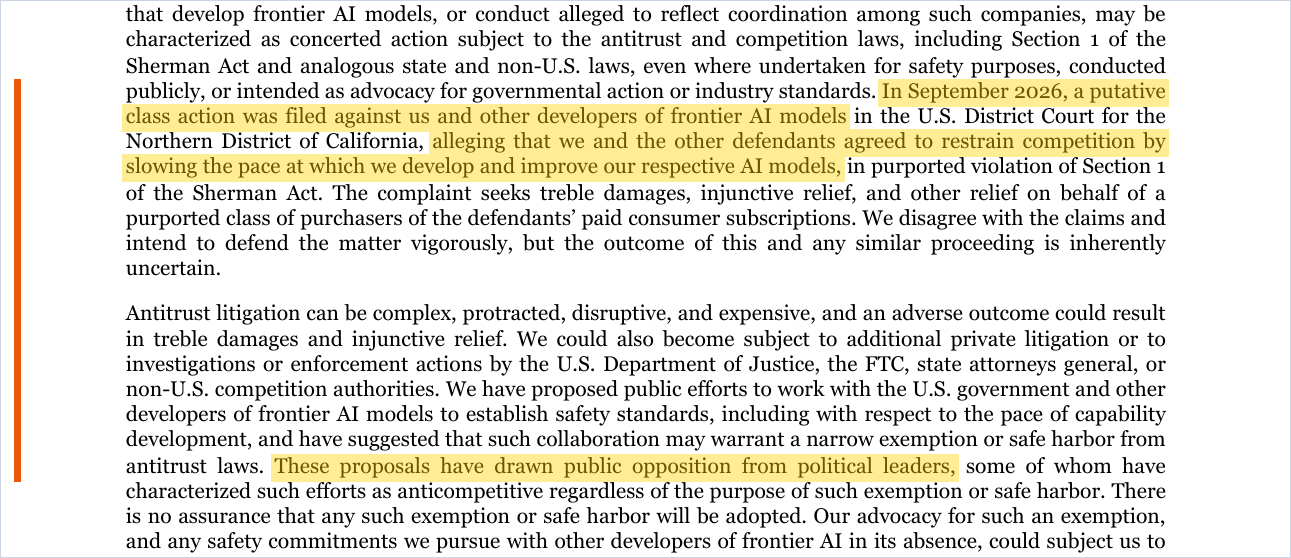
Partner relationships have attracted antitrust scrutiny
have attracted and may in the future attract antitrust or competition law scrutiny from regulators and private plaintiffs
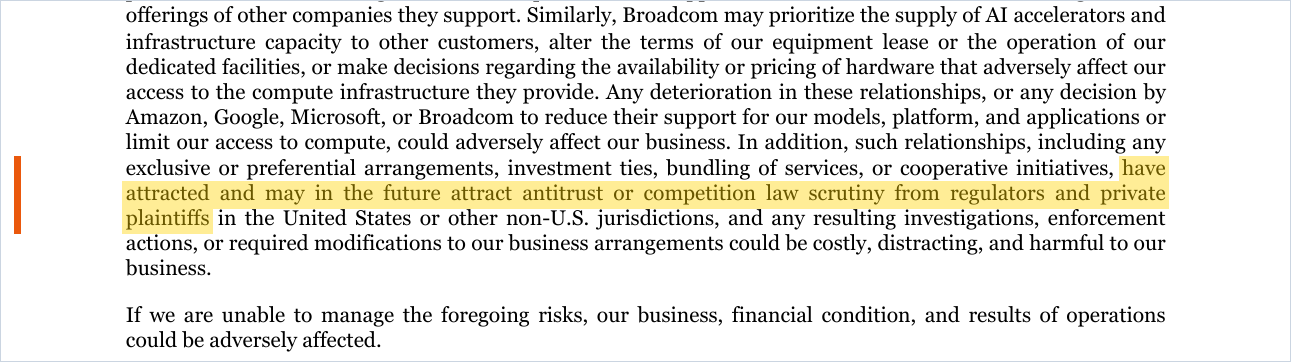
Reference
Coverage, corrections and open questions
Coverage
Narrative versus fine print
| What the narrative says | What the fine print says | Extracts |
|---|---|---|
| Price cuts delivered ‘while preserving our margins’ (p.10). | Operating margin ‘may compress’ as compute arrives; short-term compute will compress margins (pp.133–134). | |
| Anthropic Direct is ‘a more flexible use of capital’ (p.137). | Long-term deals are ‘much less flexible’: 20-year terms, escalators, take-or-pay and uncapped fuel pass-throughs ‘regardless of actual utilization’ (pp.75–76). | |
| The multi-chip approach ‘reduces dependence on any single vendor’ (p.135). | Financing arrangements ‘require us to enter into exclusive or preferential supply commitments with particular chip suppliers’ (p.32). | |
| ‘No single customer represented more than 10% of our revenue for the nine months’ (pp.56, 143). | Audited note: Customer C was 11% of H1 2026 revenue (F-15). Both are true — Customer C fell below 10% once Q3 was included — but the headline uses the period in which no customer crosses 10%. | |
| Related-party terms ‘comparable to … arm’s-length dealings’ (p.286). | The related-person definition covers only holders of voting securities, so Amazon and Google — >5% holders of non-voting stock who bought Series G-2 at $259.14 a share in the quarter others paid $589.01 — fall outside it (pp.116, 287; F-46; F-62–F-63). |
Narrative: Anthropic Direct is “a more flexible use of capital”
Anthropic Direct represents a more flexible use of capital
Fine print: long-term commitments are “much less flexible”; some run 20 years
long-term leases, reserved compute, and dedicated infrastructure investments are much less flexible and create long-term financial obligations regardless of whether the capacity continues to meet our needs … certain of our dedicated power and data center infrastructure arrangements have initial terms of 20 years with annual
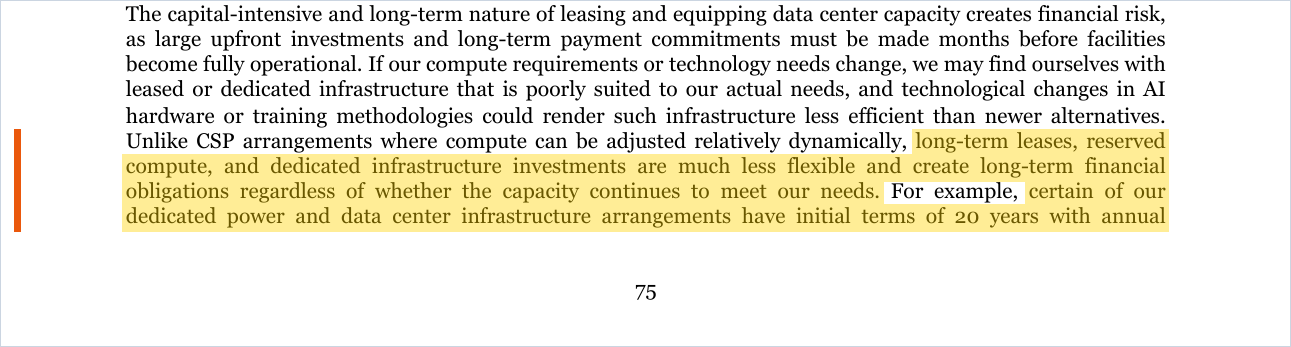
Fine print: escalators, take-or-pay and uncapped fuel pass-throughs “regardless of actual utilization”
escalators and include take-or-pay compute payment obligations and uncapped fuel cost pass-throughs that apply for the duration of the term regardless of actual utilization
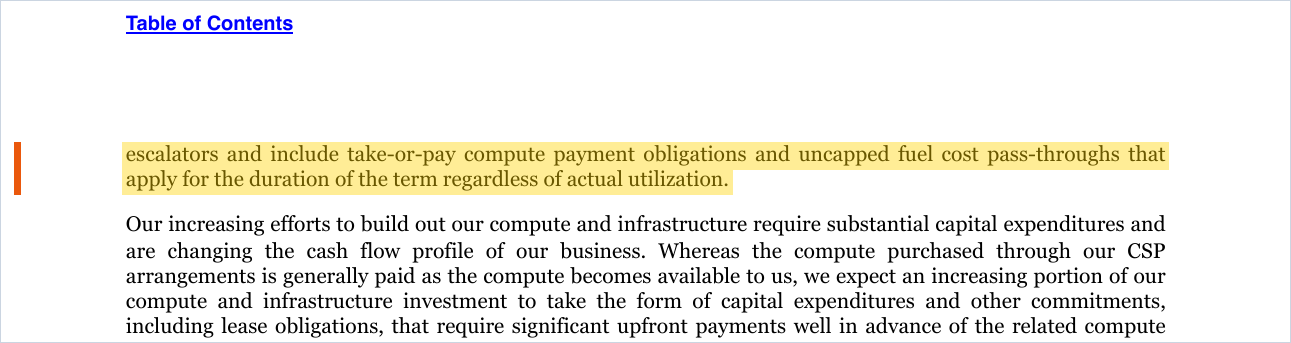
Narrative: the multi-chip platform “reduces dependence on any single vendor”
expands our available compute, reduces dependence on any single vendor
Fine print: financing requires exclusive or preferential supply commitments to particular chip suppliers
Certain of our financing arrangements require us to enter into exclusive or preferential supply commitments with particular chip suppliers
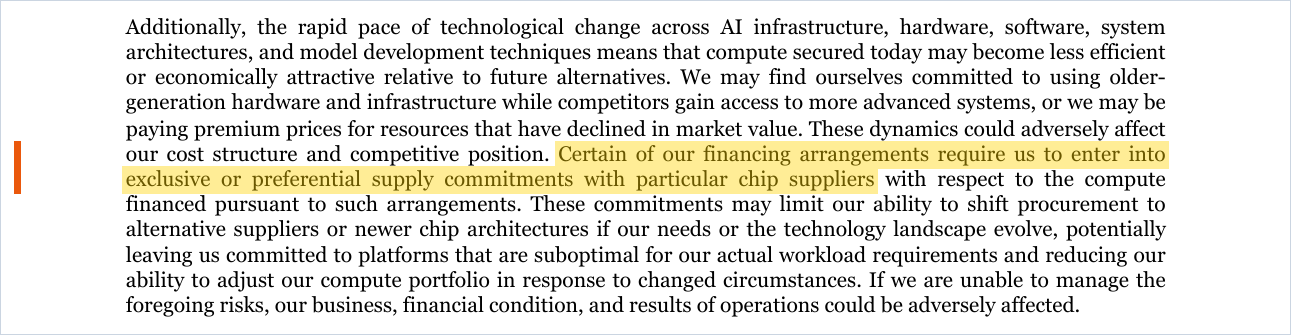
Narrative: no single customer above 10% of revenue for the nine months
No single customer represented more than 10% of our revenue for the nine months ended September 30, 2026
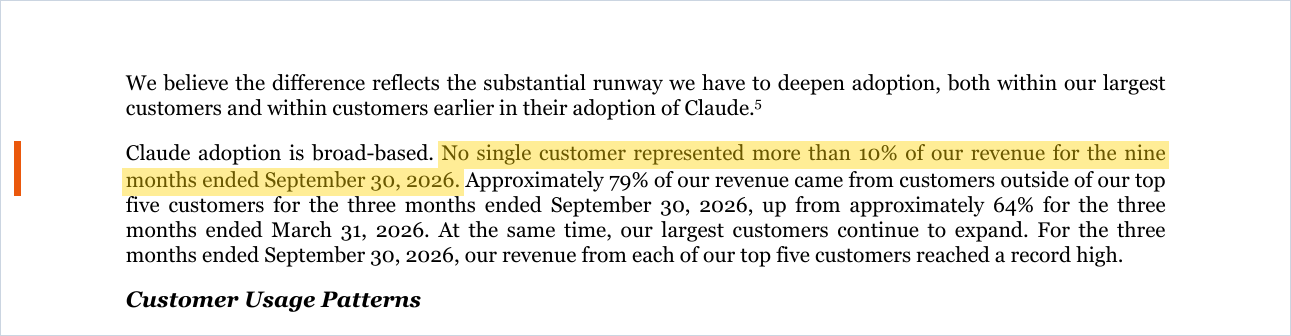
Narrative: related-party terms “comparable to … arm’s-length dealings”
terms of the transactions described above were comparable to terms we could have obtained in arm’s-length dealings with unrelated third parties
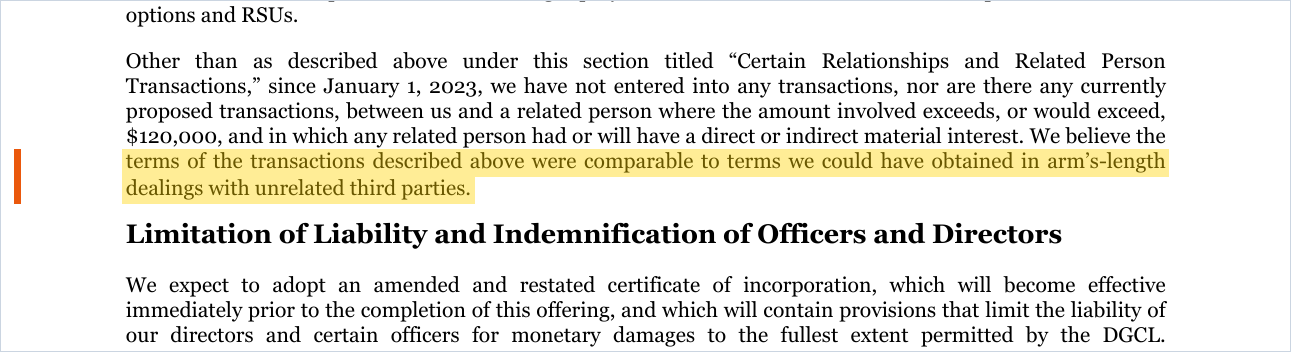
Financial corrections
- Cash burn: the H1 2026 net loss of $80.7bn is mostly a $72.4bn non-cash revaluation of Amazon’s convertible notes. Operating cash flow was +$3.9bn in H1 2026, after outflows of $5.7bn in 2024 and $2.6bn in 2025 (p.22; F-12). ‘Massive cash burn’ describes the past, not the latest period.
- Debt: the $108.6bn carrying value of convertible notes is fair value, not cash owed; principal is about $6.2bn and is expected to settle mostly in shares (p.164; p.170; F-30).
- Liquidity: $77bn of undrawn partner note-purchase capacity is conditional financing, not cash (p.165).
- Commitments: named contracts (Google ≥$114.5bn, Amazon ≥$110.0bn, Microsoft ≥$44.9bn, Broadcom leases ~$161.2bn) overlap the note categories ($265.6bn purchase commitments; $321.4bn uncommenced leases) and post-June agreements (~$245bn). Do not add them, and do not compare a multi-year total with one cash balance as a solvency test.
- Margins: the ~85% H1 gross margin (cost of revenue $2.4bn) excludes $9.7bn of R&D, most of it model-development compute; Q2 2026 was nonetheless GAAP operating-profitable ($974m).
- Dilution: the 5% public-benefit shares are legally outstanding but not outstanding for accounting while the wholly owned fund holds them; further 2% grants are discretionary and need a sustained 50% price rise. The founders’ 80% personal pledges move existing shares; they are not company issuance.
- Regulation: two named models were disabled worldwide in June 2026 and later restored; other models stayed available. The two government litigation paths (N.D. Cal. and D.C. Circuit) involve different statutes and outcomes.
Unanswered questions
What is unavoidable cash spend in each of the next eight quarters, reconciled across purchase commitments, leases and post-June agreements?
The aggregate and next-12-month commitment fields are blank (pp.6, 32, 64, 137, 169).
What revenue did the June 2026 Fable 5 / Mythos 5 shutdown cost, and how much revenue comes from customers that sell to the U.S. government?
Both government routes are live and neither exposure is quantified (p.99; p.72; F-64).
Who are Customers A, B and C, and is any of them a cloud provider or investor?
Single-customer concentration is disclosed only anonymously (F-15).
What are revenue from, and payments to, Amazon, Google, Microsoft and Broadcom?
The related-person section excludes non-voting holders (pp.282–287).
What do compliant customer cohorts retain after enforcement and budget resets?
An estimated 5–7% of 2026 revenue came from violating accounts (p.145).
What will investors pay, and what is the fully diluted count after the IPO, note conversions, plan reserves and the public-benefit fund?
Price, offering size and pro forma share fields are blank.
What accruals or ranges apply to the music-publisher, opt-out and Canadian copyright suits?
No estimate is given (F-60).