
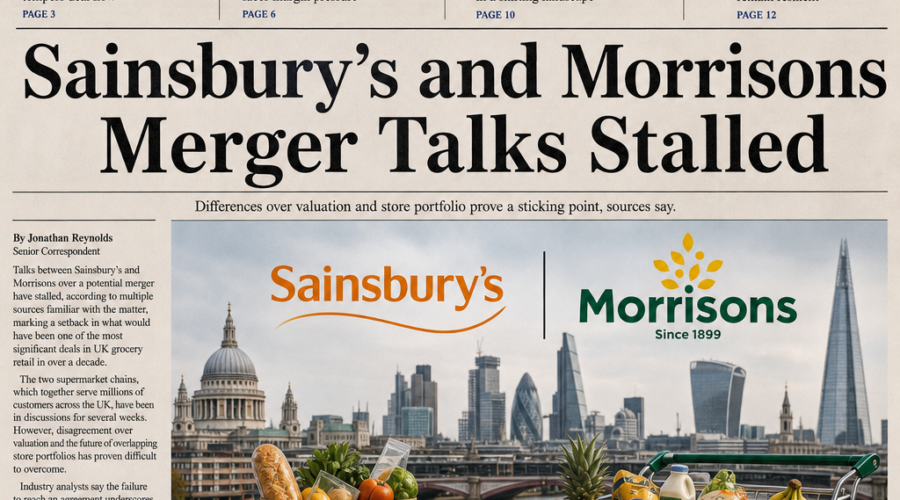
J Sainsbury plc and Wm Morrison Supermarkets Limited engaged in exploratory discussions regarding a multibillion-pound corporate merger between November 2025 and February 2026, according to the Financial Times on 5 October. The prospective transaction would have united the second and fifth largest grocery chains in the United Kingdom to create a combined entity commanding a 23.6 percent market share, placing it directly behind market leader Tesco plc. Although Sainsbury’s ultimately walked away without issuing a formal proposal, the preliminary negotiations expose the mounting pressure on traditional British grocers to consolidate.
Private equity firm Clayton, Dubilier & Rice controls Morrisons and faces massive leverage challenges following its 2021 buyout, forcing the sponsor to explore exit strategies in a high interest rate environment. United Kingdom grocery margins remain intensely compressed by the sustained market share expansion of German discount chains Aldi and Lidl. Traditional supermarkets must achieve immense operational scale and supply chain dominance to compete on price without destroying profitability, driving competitors to seek horizontal combinations despite immense regulatory hurdles.

The prospect of merging the two retailers immediately recalls the Competition and Markets Authority blocking Sainsbury’s proposed £7.3 billion acquisition of Asda Group Limited in 2019 on pricing grounds. Morrisons carries £7.52 billion in debt as of October 2025, according to The Herald on 5 October, a financial burden that complicates any potential equity valuation. Absorbing that balance sheet would have required Sainsbury’s to engineer a highly complex debt restructuring while simultaneously preparing for mandatory store divestments in hundreds of local markets.
Deal terms at a glance
Because the parties only held preliminary talks that did not progress to a formal offer, the companies generated no official term sheet or regulatory filing regarding the combination.
| Parties | J Sainsbury plc and Wm Morrison Supermarkets Limited (Clayton, Dubilier & Rice) |
| Price | Not disclosed |
| Implied equity value | Not disclosed |
| Implied enterprise value | Not disclosed |
| Consideration | Not disclosed |
| Premium | Not disclosed |
| Financing | Not disclosed |
| Conditions | Talks ended prior to formalisation |
| Expected timetable | Not applicable |
Advisers
Neither J Sainsbury plc nor Clayton, Dubilier & Rice formally retained or publicly named financial advisers or legal counsel for this specific potential transaction. The Financial Times and Reuters reported on 5 October that the talks remained entirely informal and preliminary.
How the deal came about
The private equity sponsor initiated exploration of strategic alternatives for its supermarket asset late last year. Discussions between the respective executive teams commenced in November 2025, according to the Financial Times on 5 October. The dialogue focused on the theoretical benefits of combining operations to combat the relentless market share gains of discount grocers.
Tesco plc currently controls 27.8 percent of the British grocery market, according to Worldpanel by Numerator data cited by the Financial Times on 5 October. J Sainsbury plc holds a 15.2 percent market share, while Morrisons controls 8.4 percent. The proposed combination would have created a retailer with a 23.6 percent market share, establishing a powerful duopoly at the top of the sector.
Representatives for Sainsbury’s and Morrisons debated the structural logic of a combination over a three-month period. Management teams analysed overlapping footprints and potential supply chain synergies. The talks ultimately collapsed in February 2026 when Sainsbury’s elected to abandon the negotiations, according to the Financial Times.
Both Sainsbury’s and Morrisons declined to comment to Reuters and the Financial Times on 5 October. Clayton, Dubilier & Rice similarly refused to address the reports when contacted by Sky News on 5 October. No active negotiations are taking place, according to Reuters on 5 October. Retail executives informed Sky News that Clayton, Dubilier & Rice remains open to future combinations with major peers, and the Financial Times noted that sources close to the parties did not rule out restarting discussions in the future.
Valuation and comparables
The participants never disclosed specific transaction structures, share exchange ratios, or legal merger terms, according to the Financial Times on 5 October. The media broadly characterised the potential transaction as a multibillion-pound deal, but the parties established no formal valuation multiples.
The closest historical comparable deal is Clayton, Dubilier & Rice acquiring Morrisons in 2021 for £7.0 billion, according to Reuters on 5 October. That transaction took Morrisons private after a prolonged bidding war. The private equity sponsor paid a substantial premium to secure the asset during an era of low interest rates, deploying a highly leveraged capital structure.
Another direct comparable is Sainsbury’s attempt to acquire Asda Group Limited for £7.3 billion in 2019. The Competition and Markets Authority blocked that transaction entirely. Regulators concluded the merger would lead to higher prices in local areas and national grocery pricing, reducing the quality of retail services.
Financing and structure
The parties did not disclose specific debt refinancing or deal financing structures considered during the talks, according to the Financial Times on 5 October. A formal bid would have required Sainsbury’s to address the massive liabilities currently held by the target company.
Morrisons carries heavy leverage resulting from its 2021 leveraged buyout. The debt load at the supermarket chain expanded to £7.52 billion as of October 2025, according to The Herald on 5 October. That capital structure forces Morrisons to direct massive amounts of operational cash flow toward interest payments, limiting the company’s ability to compete aggressively on price against debt-free discounters.
Any corporate combination would require the acquiring entity to either assume the debt, refinance the obligations, or demand that Clayton, Dubilier & Rice take a significant haircut on its equity position. Sainsbury’s avoided these financial engineering challenges by walking away from the negotiating table in February 2026.
Risks, conditions and key dates
The transaction faced immense regulatory execution risk from the outset. Analysts and sector observers informed the Financial Times and The Herald on 5 October that clearance would almost certainly be conditional upon substantial store divestments to resolve local concentration issues. Any combination would trigger an extensive Phase 2 review by the United Kingdom Competition and Markets Authority.
No filings have been submitted to the Financial Conduct Authority, the London Stock Exchange Regulatory News Service, or Companies House, because the talks ended prior to any disclosable transaction milestone, according to searches of those databases on 5 October.
- 2019: The Competition and Markets Authority blocks Sainsbury’s £7.3 billion acquisition of Asda Group Limited.
- 2021: Clayton, Dubilier & Rice acquires Wm Morrison Supermarkets Limited for £7.0 billion.
- November 2025: Sainsbury’s and Morrisons initiate exploratory merger discussions.
- February 2026: Sainsbury’s walks away from the negotiations.
- 5 October 2026: Financial media outlets report the existence of the collapsed talks.
Where reports disagree
Media organisations offer conflicting assessments of the target company’s current standing in the British retail hierarchy. The Financial Times and The Independent reported on 5 October that Morrisons is Britain’s fifth-largest grocer, trailing Tesco, Sainsbury’s, Asda, and Aldi. City AM and Reuters reported on the same day that Morrisons is the sixth-largest grocer in the United Kingdom. This discrepancy reflects differing methodologies regarding whether German discounter Lidl has successfully bypassed Morrisons in total market share.
Financial publishers also published contradictory figures regarding the immediate market reaction to the leaked merger talks on 5 October. Alliance News reported that J Sainsbury plc shares traded down 0.4 percent to 322.10 pence. Sharecast reported that the shares traded up 0.1 percent to 323.70 pence.
Sources
Press and analysis
- Morningstar, Press J Sainsbury Held Merger Talks With Rival Morrisons Sky News
- Financial Times, 5f235c48-9a4e-4bb6-a454-0915abc2d5df
- The Guardian, Sainsburys Morrisons Merger Talks
- The Herald, Sainsburys Morrisons Held Talks Possible Merger
- The Independent, Sainsbury Morrisons Murger Aldi Asda
- City A.M., Sainsburys And Morrisons Held Talks Over Blockbuster Merger
Facts as of 5 October 2026.