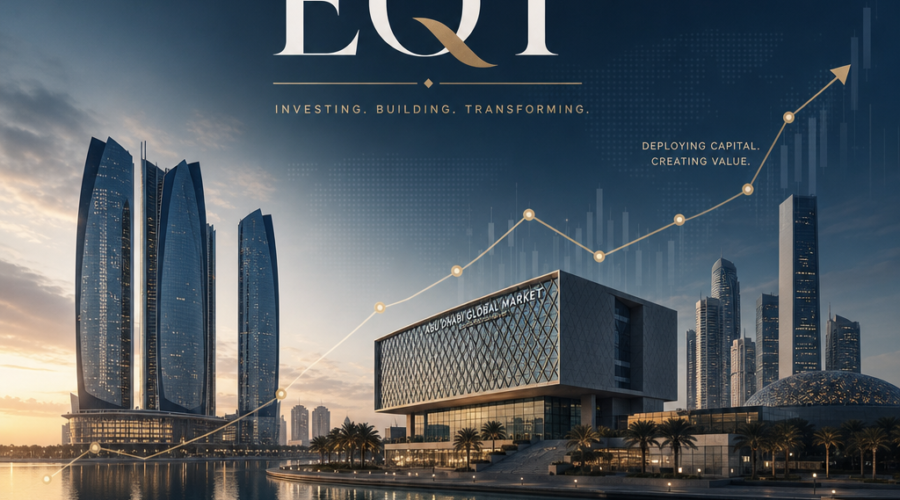
Stockholm-listed private equity firm EQT launched a dedicated Middle East platform and opened an office in Abu Dhabi Global Market on September 23, 2026, establishing an operational base in the Gulf Cooperation Council. EQT manages $389 billion in client assets across private capital and infrastructure strategies, expanding its regional operations to target direct investments alongside sovereign institutions. The expansion shifts EQT from episodic fundraising fly-ins to permanent local dealmaking, positioning the firm inside a jurisdiction where sovereign wealth funds oversee more than $1.8 trillion in collective balance sheets.
The institutional imperative driving alternative asset managers toward the Persian Gulf centers on corporate origination rather than passive limited partner syndication. While North American and European buyout fundraising experienced extended distribution drag through 2025 and 2026, sovereign entities in the United Arab Emirates and Saudi Arabia mandated direct industrial co-investment and domestic asset allocation as conditions for fund commitments. By embedding investment partners directly into the financial district of Al Maryah Island, EQT aligns its investment teams with sovereign wealth fund mandates that demand local capital formation, cross-border corporate carve-outs, and operational stewardship.

Financial center metrics demonstrate the scale of this migration, as the tally of active financial services entities operating within Abu Dhabi Global Market climbed 27% during the first half of the year to 392 registered firms. EQT installed Jimmy Mahtani, who chairs private capital for India and Southeast Asia, as Chairman of GCC operations, while appointing Smiyet Belrhiti as Head of Middle East and Senior Executive Officer. This leadership structure pairs cross-border Asian deal flow with Middle Eastern capital deployment, answering whether top-tier buyout groups can secure proprietary transactions in sectors outside traditional oil and gas reserves.
Operating Architecture on Al Maryah Island
EQT placed its physical headquarters in Unit 16/17 on the third floor of Al Maryah Tower, operating under oversight from the Financial Services Regulatory Authority. The regional platform coordinates private capital and infrastructure teams alongside capital raising professionals. This multi-asset setup mimics the One EQT framework used across European and North American branches, integrating buyout specialists with infrastructure personnel.
Smiyet Belrhiti, who brings two decades of regional transaction history, manages day-to-day operations and deal origination in the United Arab Emirates. EQT CEO and Managing Partner Per Franzén stated that the Gulf platform allows EQT to deploy active ownership strategies directly into businesses undergoing structural modernization. Rather than treating the Gulf as a pure source of limited partner commitments, the Abu Dhabi base operates with dedicated execution capacity for buyouts, corporate recapitalizations, and energy transition joint ventures.
Sovereign Asset Concentration in Abu Dhabi
Institutional allocators in Abu Dhabi direct vast balance sheets across global public equities, real assets, and direct buyouts. The concentration of state capital creates clear terms of engagement for incoming general partners.
| Entity Name | Estimated Assets ($B) | Primary Focus Areas |
|---|---|---|
| Abu Dhabi Investment Authority | 990 | Global public equities, private equity, infrastructure |
| Mubadala Investment Company | 302 | Direct investments, technology, life sciences |
| ADQ | 200 | Logistics, utilities, domestic transformation |
| Lunate Capital | 105 | Private markets, credit, fund of funds |
The table draws on public disclosures and institutional estimates tracked by sovereign wealth monitor Global SWF. These state pools enforce specific parameters on incoming global sponsors, requesting domestic office footprints, local hiring commitments, and direct co-investment rights.
Portfolio Support and Corporate Expansion
EQT already retains portfolio assets with operating divisions in the Gulf Cooperation Council. The firm operates private school provider Nord Anglia Education, alongside information technology services provider Virtusa, cloud banking platform Banking Circle, consumer electronics firm Nothing, and water management operator SAUR. The presence of active portfolio entities allows EQT to use regional operations to drive cross-border rollups and bolt-on acquisitions.
Nord Anglia Education operates premium international campuses in Abu Dhabi, Dubai, and Qatar, serving as a core educational asset in the Gulf. EQT aims to direct capital into additional add-on acquisitions across healthcare delivery systems, commercial enterprise software, and supply chain infrastructure. The physical Abu Dhabi team assists portfolio executives with local regulatory compliance, public-private concession negotiations, and commercial contracts across the United Arab Emirates and Saudi Arabia.
Rival General Partners Deepen Regional Ties
EQT joined a roster of alternative asset managers that have secured regulatory authorisations from Abu Dhabi Global Market. Alternative credit specialist Blue Owl Capital opened its Abu Dhabi office in June to deploy private debt. Blackstone, Brookfield Asset Management, TPG, and General Atlantic maintain on-the-ground offices across Abu Dhabi and Dubai, competing for co-underwriting mandates on mega-cap corporate buyouts.
Market data compiled by Bain & Company demonstrates that Middle East sovereign wealth funds committed more than $50 billion to global alternative investment partnerships in 2025 alone. General partners that lack a regional footprint encounter friction during capital allocations, as regional limited partners reduce allocations to managers that operate exclusively out of London, New York, or Stockholm.
Corporate Carve-Outs and Regional Deal Flow
Beyond capital raising, EQT targets corporate divestitures and public infrastructure privatizations across member states. Regional governments are carving out commercial utility assets, transport systems, and digital connectivity assets to fund national industrial budgets. These privatization initiatives supply mid-market and large-cap sponsors with deal volume during periods of constrained European transaction activity.
Jean Eric Salata, Chair of EQT Group, noted that EQT established relationships with institutional leaders in Abu Dhabi over three decades before opening the physical office. The firm plans to expand its Middle East platform from Abu Dhabi into adjacent Gulf Cooperation Council markets over time, using its team on Al Maryah Island to monitor regional auctions, structure private capital solutions, and source cross-border M&A investments.