
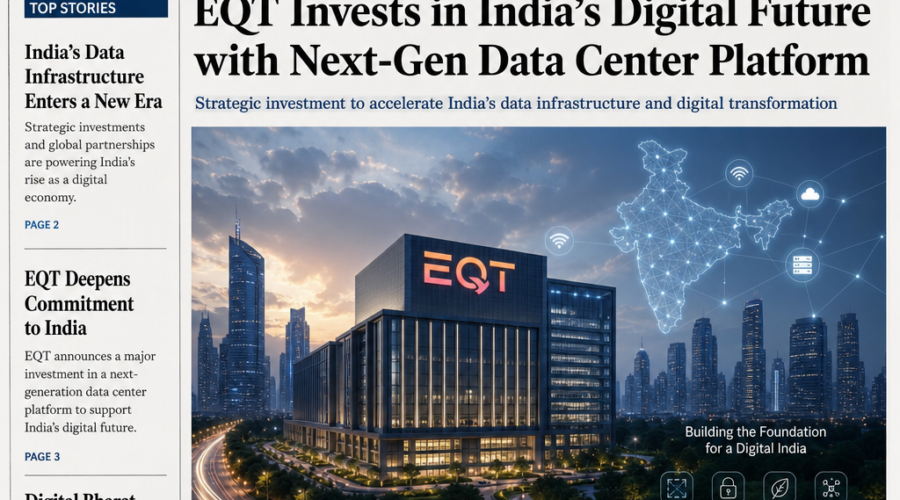
Stockholm-listed private markets manager EQT announced on September 16, 2026, that it plans to deploy $50 billion across India by 2030, marking the largest capital programme ever declared by a foreign buyout group in the country. Roughly $30 billion of the capital will target digital infrastructure, led by data center construction to serve hyperscalers and artificial intelligence developers. EQT will direct another $5 billion toward solar, renewable energy, and power generation assets dedicated to those server facilities, while setting aside between $15 billion and $20 billion for traditional buyout and growth equity transactions.
The allocation shows how global alternative asset managers are restructuring emerging-market strategies around energy and processing bottlenecks rather than standard consumer or business-services buyouts. By marrying compute capacity directly with grid-level power generation, EQT treats digital real estate as a utility-scale asset class rather than an expansion of enterprise software. This capital rotation indicates that future private market returns across South Asia depend on controlling physical megawatts and real property rather than pure software multiples.

Since entering the country in 1998, EQT has committed $26 billion across 30 Indian investments, deploying $7 billion since 2023. The new plan doubles that cumulative three-decade outlay within four years. India currently operates roughly one gigawatt of operational data center capacity, and EQT forecasts the market will expand to five gigawatts by 2030. Securing land, power purchase agreements, and transmission rights for that four-gigawatt deficit requires immediate capital commitments, explaining why global sponsors are committing vast balance sheets to Asian digital corridors.
Capital Allocation Strategy across Digital Assets and Private Capital
Speaking at a media round table in Mumbai, Jean Eric Salata, chair of EQT, outlined the precise breakdown of the $50 billion investment envelope. Digital compute and power infrastructure comprise 70% of the planned deployment, reflecting changes in client allocations among sovereign wealth and pension funds.
| Segment | Target Capital Allocation | Operating Platforms and Vehicles | Primary Sector Focus |
|---|---|---|---|
| Digital Infrastructure | $30 Billion | EdgeConneX, AdaniConneX JV | Hyperscale campus buildouts, AI compute clusters |
| Renewable Power and Energy Storage | $5 Billion | EQT Infrastructure funds | Dedicated solar, wind, and battery storage |
| Private Equity and Mid-Market Buyouts | $15 Billion to $20 Billion | BPEA IX, EQT Private Capital Asia | Healthcare, financial services, industrial manufacturing |
The scale of the digital infrastructure commitment builds on an existing base. EQT has already deployed approximately $10 billion into Indian data centers. The planned $20 billion in follow-on capital will finance physical buildouts through EdgeConneX, which EQT acquired in 2020. In India, EdgeConneX operates through AdaniConneX, a 50-50 joint venture established in 2021 with Adani Enterprises. Adani Group separately pledged to invest $100 billion by 2035 in green data centers, aligning local developer resources with EQT capital access.
Coupling Hyperscale Compute Capacity with Renewable Generation
Institutional limited partners have shifted underwriting criteria for technology infrastructure toward verified grid connectivity. Power availability has emerged as the chief regulatory and engineering constraint for hyperscalers such as Microsoft, Amazon Web Services, and Google. By earmarking $5 billion for clean power generation, EQT intends to co-locate server halls with behind-the-meter solar arrays and battery storage installations.
Data from McKinsey & Company indicates that power availability now dictates over 60% of data center location decisions globally. In Mumbai and Chennai, coastal landing stations allow subsea internet cable access, but local electricity distribution grids face transmission constraints. EQT plans to bypass utility bottlenecks by structuring bilateral power purchase agreements that feed green power directly into EdgeConneX facilities.
Salata stated in Mumbai that India currently accounts for less than 5% of the total infrastructure assets held by EQT globally. The firm views this relative underallocation as an opportunity to construct integrated systems where the power generation asset and the power-consuming computing hub exist under identical fund ownership structures.
Private Equity Execution Beyond Physical Assets
Alongside the infrastructure platform, EQT plans to deploy at least $2 billion annually into corporate buyouts through 2030. In April 2024, EQT closed its regional flagship buyout vehicle, BPEA IX, at $15.6 billion, providing dedicated capital for large transactions across Asia.
Hari Gopalakrishnan, co-head of private capital in Asia at EQT, said in Mumbai that Indian private equity buyout volumes fell below $15 billion last year. Gopalakrishnan projects annual buyout transaction volume will reach $50 billion by 2030 as founder-led businesses transfer control and global conglomerates carve out non-core subsidiaries. EQT intends to direct buyout equity into specialized segments:
- Pharmaceutical manufacturing and contract development organizations.
- Specialty retail financial services, building on existing ownership of Credila Financial Services.
- Healthcare delivery networks, expanding the footprint established through Indira IVF Hospital.
- Industrial manufacturing supply chains aligned with Indian government production incentives.
EQT distributed $40 billion to investors globally over the trailing twelve months, equivalent to roughly 30% of net asset value, Salata said. The Bain & Company Global Private Equity Report recorded average industry distribution rates near 10% during the same trading period, giving EQT fund-raising traction among sovereign institutional allocators.
Sponsor Competition in the Indian Digital Economy
The aggressive timeline set by EQT escalates an ongoing capital race among North American and European buyout institutions. Blackstone, Brookfield Asset Management, and Warburg Pincus have each assembled Indian digital infrastructure arms over the last three years. Brookfield manages an Indian data center platform in partnership with Digital Realty, while Blackstone launched its Lumina CloudInfra vehicle to build gigawatt-scale capacity across Mumbai and Hyderabad.
Advisors at Goldman Sachs note that the cost of developing Tier III and Tier IV data centers in India averages between $7 million and $9 million per megawatt of critical IT load. Expanding domestic compute capacity from one gigawatt to five gigawatts implies minimum aggregate industry capital expenditure of $32 billion by 2030. EQT aims to fund more than half of that aggregate capital requirement through its AdaniConneX joint venture and direct equity balance sheet.
EQT closed Thursday trading in Stockholm with total group assets under management of €246 billion. The $50 billion Indian deployment schedule runs through December 31, 2030.