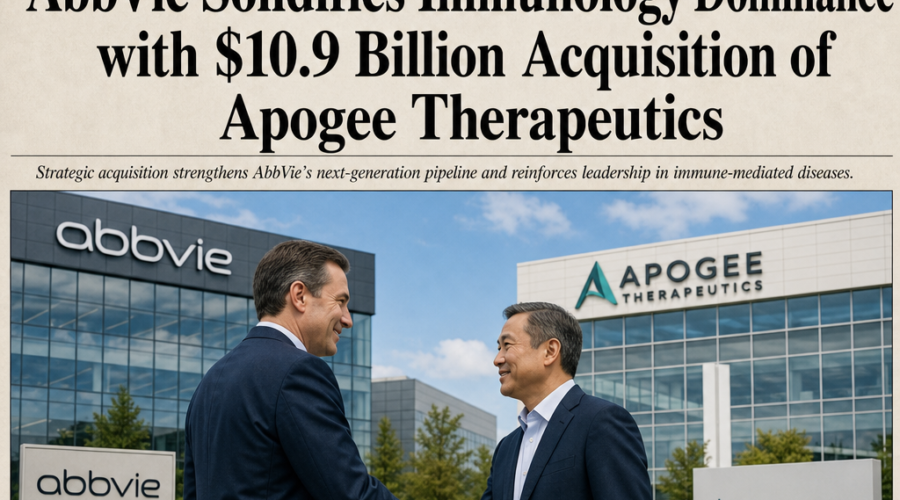
AbbVie (NYSE: ABBV) today announced the successful completion of its acquisition of Apogee Therapeutics (NASDAQ: APGE), an all-cash transaction valued at approximately $10.9 billion. Under the terms of the merger, which officially closed on September 3, 2026, Apogee shareholders received $135.11 per share, representing a substantial premium for the clinical-stage biotech and its portfolio of long-acting antibodies. This strategic move effectively folds Apogee into AbbVie’s specialized immunology unit, giving the pharmaceutical giant control over a next-generation pipeline designed to disrupt the multi-billion-dollar atopic dermatitis and asthma markets.
The deal’s thesis rests on a fundamental shift in the immunology landscape: the move from mere efficacy to dosing convenience and extended durability. While the industry has long been dominated by bi-weekly or monthly injections, Apogee’s lead asset, zumilokibart (formerly APG777), has demonstrated the potential for significantly longer dosing intervals through its half-life extension technology. By securing this asset, AbbVie is not just buying a drug; it is architecting a “mega-blockbuster” strategy to defensive its market share against emerging competitors like Sanofi and Regeneron’s Dupixent, ensuring that its post-Humira growth trajectory remains anchored by superior clinical profiles and patient convenience.

A critical, non-obvious driver of this transaction is the financial math behind AbbVie’s 2030s revenue roadmap, which necessitates high-conviction pipeline bets as Skyrizi and Rinvoq eventually face their own lifecycle hurdles. AbbVie has confirmed that while the acquisition will be dilutive to adjusted EPS by roughly $0.46 in 2027, the internal rate of return is predicated on zumilokibart achieving peak sales potential that justifies the $135.11 per share price tag. With zumilokibart slated to enter Phase 3 trials in late 2026, the industry is now questioning how quickly AbbVie can accelerate these timelines to achieve its stated goal of earnings accretion by 2032.
Strategic Rationale: Beyond the Humira Patent Cliff
For years, Wall Street’s primary narrative for AbbVie was the “Humira cliff.” However, by late 2026, the company has effectively pivoted. While Humira revenues have cratered by nearly 50% year-over-year in recent quarters, the combined performance of Skyrizi and Rinvoq has more than offset the decline, with Skyrizi alone matching Humira’s peak quarterly revenues of $5.5 billion. The Apogee acquisition is the latest “bolt-on” in a string of aggressive moves—following the ImmunoGen and Cerevel Therapeutics deals—to ensure the company does not become a victim of its own success.
The Crown Jewel: Zumilokibart (APG777)
The centerpiece of the Apogee acquisition is zumilokibart, an anti-IL-13 monoclonal antibody. In Phase 2 clinical trials, the asset showed “best-in-class” potential for treating moderate-to-severe atopic dermatitis. Unlike existing therapies that require frequent administration, zumilokibart’s extended half-life could allow for quarterly or even less frequent dosing. This operational advantage is essential in a crowded field where patient adherence is a significant barrier to long-term efficacy.
- Lead Asset: Zumilokibart (APG777), targeting IL-13 for atopic dermatitis.
- Combination Strategy: APG273, a dual-targeting antibody for IL-13 and TSLP, aimed at the asthma and COPD markets.
- Platform Technology: Half-life extension technology that provides a competitive moat against biosimilars and standard biologics.
Financial Terms and Guidance Reaffirmation
Despite the $10.9 billion price tag, AbbVie’s management has maintained a disciplined stance on capital allocation. The deal was funded through a combination of cash on hand and new debt issuance, a move that rating agencies suggest will not impact AbbVie’s A2/A- credit profile. Immediately following the deal’s close, AbbVie reaffirmed its third-quarter 2026 adjusted diluted EPS guidance of $3.84 to $3.88 and its full-year 2026 guidance range of $13.87 to $14.07.
Near-term EPS Impact
Investors should note that the transaction includes a deliberate “j-curve” in profitability. The initial dilution reflects the heavy R&D investment required to push Apogee’s assets through expensive Phase 3 global trials. The following table illustrates the projected impact on AbbVie’s earnings profile:
| Financial Metric | 2026 Impact (Partial Year) | 2027 Projected Impact | Accretion Milestone |
|---|---|---|---|
| Adjusted Diluted EPS | ($0.14) | ~($0.46) | Begins 2032 |
| R&D Spend (Incremental) | $300M – $400M | $700M+ | N/A |
M&A Trends: The 2026 Biotech Renaissance
The AbbVie-Apogee deal is a microcosm of a broader trend in biotech M&A trends 2026. Large-cap pharmaceutical companies, flush with cash and facing the loss of exclusivity (LOE) on legacy blockbusters, are aggressively hunting for de-risked, clinical-stage assets. Analysts at firms like Goldman Sachs and J.P. Morgan have noted that 2026 is on track to be the most active year for biotech dealmaking since 2020, with a specific focus on private equity exit strategies in SaaS and healthcare technology becoming secondary to the hunt for novel biologics.
Industry-Wide Implications
The acquisition sends a clear signal to the market: the bar for entry in immunology has been raised. Competitors must now account for durability of response as a primary endpoint. This deal also underscores the value of “platform” biotechs that can produce multiple assets from a single engineering approach, rather than single-drug “one-hit wonders.”
Execution Risks and Integration
While the strategic fit is clear, execution risks remain. Integrating a high-growth biotech team into a global pharmaceutical infrastructure often leads to talent attrition. AbbVie CEO Robert Michael emphasized during the closing announcement that maintaining the “innovative spirit” of the Apogee team is a priority. Furthermore, the regulatory landscape for IL-13 inhibitors is becoming increasingly stringent, and any delay in Phase 3 readouts could push the 2032 accretion target further into the future.
Key Milestones to Watch
- Q4 2026: Initiation of Phase 3 “APEX” trials for zumilokibart in atopic dermatitis.
- H1 2027: Phase 2 data readouts for APG273 in asthma.
- 2028: Potential BLA (Biologics License Application) filing for zumilokibart.
In the high-stakes world of pharmaceutical M&A, the acquisition of Apogee Therapeutics is more than just a pipeline addition; it is a declaration of intent. AbbVie is betting $11 billion that the future of immunology is not just about clearing skin or opening airways, but about doing so with a convenience profile that makes current standards of care obsolete. For C-level executives in the life sciences space, the message is clear: innovation is no longer enough—durability and dosing are the new currencies of the blockbuster era.