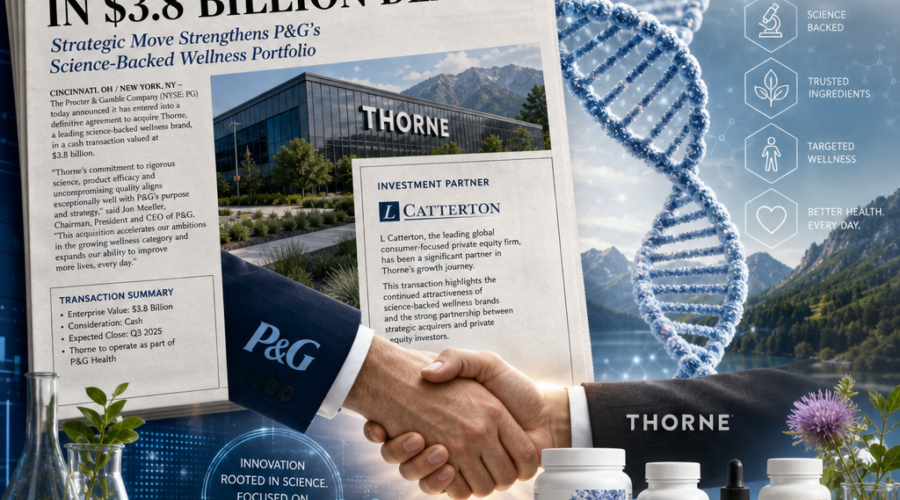
In a definitive move to capture the high-margin, high-growth “self-care” economy, Procter & Gamble (NYSE: PG) has entered into a definitive agreement to acquire Thorne, a leader in clinical-grade nutritional supplements, from L Catterton for $3.8 billion in an all-cash transaction. The deal, announced on August 4, 2026, represents one of the most successful private equity round-trips in the consumer sector this decade, delivering a windfall for L Catterton just under three years after the firm took Thorne private.
Most “AI for Diligence” tools are lying to you. The truth is, they are just ChatGPT wrappers. Experience Kai – a Fortune-100 proven AI harness for M&A/ PE Diligence

💼 Purpose-built harness for Due Diligence
The acquisition underscores a structural shift in the consumer packaged goods (CPG) landscape. As legacy household staples face volume headwinds and pricing sensitivity, strategic buyers are increasingly pivoting toward premium health and wellness M&A. For P&G, Thorne serves as a high-performance engine to reach younger, health-conscious demographics—specifically Millennials and Gen Z—who prioritize preventative healthcare over reactive treatment.
The L Catterton Playbook: Value Creation through Clinical Credibility
L Catterton’s exit at a $3.8 billion valuation marks a significant premium over the approximately $680 million paid to take Thorne private in late 2023. This nearly 6x return on investment was fueled by an aggressive transformation strategy focused on digital infrastructure and AI-powered personalization.
- Financial Performance: Under L Catterton’s stewardship, Thorne’s revenue surged from approximately $230 million in 2022 to an expected $650 million in 2026, maintaining a compound annual growth rate (CAGR) exceeding 30%.
- Technological Edge: The development of Taia™, Thorne’s proprietary AI wellness advisor, transitioned the company from a traditional supplement manufacturer to a personalized health platform.
- Demographic Expansion: While Thorne originated as a practitioner-exclusive brand, a pivot to direct-to-consumer (DTC) channels saw its active customer base grow to 7 million by 2026, with over 60% of sales now originating from consumers under the age of 40.
Strategic Rationale: Why P&G Paid a Premium
P&G CEO Shailesh Jejurikar emphasized that the acquisition is “not just about supplements, but about data-driven health.” Thorne will be integrated into P&G’s Personal Health Care division, joining a portfolio that includes Metamucil, Align Probiotic, and New Chapter. The deal allows P&G to bridge the gap between traditional OTC pharmacy products and the emerging science-backed supplement market.
Table 1: Strategic Synergy Analysis
| Strategic Driver | Benefit to Procter & Gamble |
|---|---|
| Channel Diversification | Immediate access to a robust DTC ecosystem and over 47,000 healthcare practitioner relationships. |
| Demographic Bridge | Capturing “Pre-aging” Gen Z and Millennial spenders who are currently under-indexing in P&G’s legacy health brands. |
| Premium Margins | Thorne’s high-margin, subscription-based model provides a hedge against inflationary pressures in raw material logistics. |
| R&D and IP | Acquiring a library of clinically validated formulations and AI-driven diagnostic tools. |
The VMS Market: A Competitive “Arms Race”
The deal follows a period of intense activity in the Vitamins, Minerals, and Supplements (VMS) sector. Earlier in 2026, Unilever acquired Grüns for an estimated $1.2 billion, while Nestlé Health Science has been aggressively rebalancing its portfolio toward medical nutrition. According to Bain & Company’s 2026 M&A Midyear Report, “scale-based acquisitions in wellness are now the primary vehicle for CPG incumbents to combat the erosion of traditional brand loyalty.”
Institutional interest in cross-border M&A trends 2026 suggests that premium wellness assets are no longer considered “discretionary” but “essential” in a post-pandemic economy where consumer spending on longevity and metabolic health remains resilient. For P&G, the acquisition also serves a defensive purpose, effectively pricing out competitors like Unilever and Haleon, both of whom were reported to have explored bids for Thorne.
Financial Advisory and Closing
The transaction is expected to close in the fourth quarter of 2026, subject to customary regulatory approvals. Perella Weinberg served as the lead financial advisor to Thorne, with Kirkland & Ellis providing legal counsel to L Catterton. P&G was advised by Jones Day. While P&G has not signaled immediate layoffs, the integration process is expected to focus on scaling Thorne’s manufacturing through P&G’s global supply chain and expanding the brand’s footprint into European and Asian markets.
The Bottom Line for C-Suite Leaders
For investment professionals, the P&G-Thorne deal serves as a blueprint for private equity exit strategies in SaaS-like consumer models. The successful exit was not predicated on cost-cutting, but on the aggressive adoption of technology and clinical validation. As we look toward 2027, the focus for dealmakers will likely shift from broad-based wellness to specialized sub-sectors, including GLP-1 companion nutrition and healthy aging solutions, as the “home-as-the-new-clinic” trend continues to mature.