
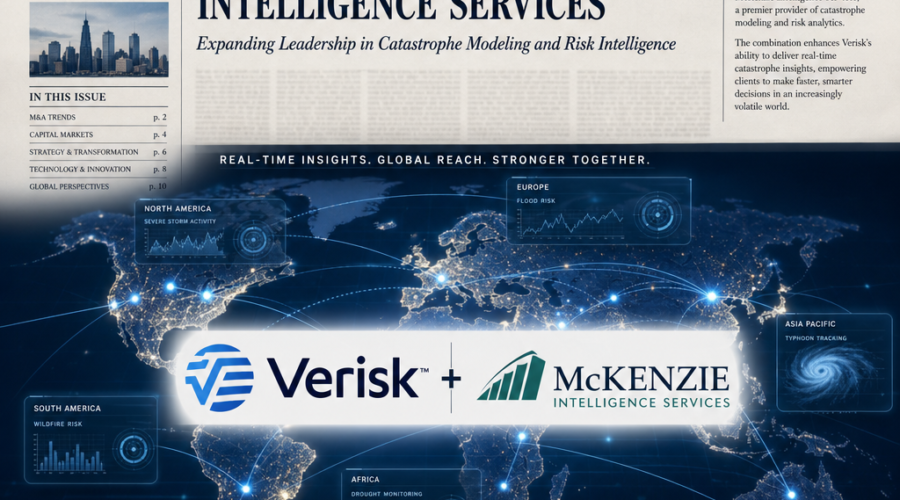
JERSEY CITY, N.J. and LONDON — July 29, 2026 — Verisk (Nasdaq: VRSK), a global leader in insurance data and technology, has announced the acquisition of McKenzie Intelligence Services (MIS), a UK-based specialist in geospatial intelligence and event-response analytics. The transaction integrates MIS’s military-grade intelligence capabilities into Verisk’s Catastrophe and Risk Solutions business, addressing a critical need for real-time data in an increasingly volatile global risk environment.
Most “AI for Diligence” tools are lying to you. The truth is, they are just ChatGPT wrappers. Experience what real AI for Diligence looks like, built like Claude Code, but for M&A/ PE Diligence:
💼 When Claude Code Marries Due Diligence!
The deal follows a period of rapid growth for MIS, which was previously backed by Maven Capital Partners. Since Maven’s initial investment in 2023, MIS expanded its footprint in the U.S. and developed proprietary tech for property-level damage assessment. The sale delivered a 3.0x return for the Maven VCTs, underscoring the high valuation of advanced geospatial analytics for insurers in the current market.
Strategic Rationale: Speed Over Modeling
While Verisk has long dominated the market with its probabilistic catastrophe models (such as those from AIR Worldwide), the acquisition of MIS signals a shift toward real-time disaster intelligence. Traditional models are excellent for pre-event underwriting and capital allocation; however, the actual response to events like Hurricane Fern (which caused an estimated $4 billion in insured losses in February 2026) requires immediate, post-event visibility.
“Verisk and MIS share a commitment to helping clients make faster, more confident decisions before, during, and after catastrophic events,” said Rob Newbold, President of Verisk Catastrophe and Risk Solutions. By integrating MIS’s platform, Verisk aims to provide insurers with property-level assessments within hours of an event, facilitating “claims triage” and more accurate loss estimation.
Addressing the Rise of “Human-Driven Perils”
One of the most significant aspects of this acquisition is the enhancement of Verisk’s capabilities in Strikes, Riots, and Civil Commotion (SRCC) and political violence. As of mid-2026, SRCC risk has climbed to the top tier of executive concerns. According to the Allianz Risk Barometer 2026, political violence and war have overtaken civil unrest as the primary exposure for global businesses, particularly following recent escalations in the Middle East.
MIS provides “military-grade” intelligence that monitors conflict zones and civil unrest in real-time. This fills a vital gap in the political violence risk analytics market, allowing reinsurers to assess exposure as events unfold, rather than waiting for ground reports. In the U.S., which was ranked as the third-highest-risk country for civil unrest in Verisk Maplecroft’s 2026 Index, this real-time visibility is becoming a standard requirement for commercial property underwriting.
Table 1: Verisk’s Recent Expansion in Catastrophe Technology
| Deal / Launch | Year | Strategic Focus |
|---|---|---|
| McKenzie Intelligence (MIS) | 2026 | Real-time geospatial intelligence & SRCC analytics. |
| Verisk Synergy Studio | 2026 | Cloud-native platform for unified cat modeling & exposure management. |
| Verisk Model Exchange | 2025 | Open access to third-party catastrophe risk models. |
| S&P Global Energy Collab | 2026 | Insurance-adjusted climate risk intelligence. |
Market Implications and Financial Framing
Verisk stated that the acquisition is not expected to have a material impact on its 2026 financial results. However, the move is deeply aligned with the strategy outlined during Verisk’s 2026 Investor Day, where CEO Lee Shavel emphasized durable, compounding growth through the deployment of AI across proprietary datasets.
In its Q2 2026 results released concurrently with the deal, Verisk reported revenue of $806 million, up 5.8% on an organic constant currency basis. The firm’s strong subscription-based model provides the capital necessary for these targeted acquisitions. The insurtech M&A landscape in 2026 has been characterized by this type of “strategic bolt-on” where established giants like Verisk or Moody’s (which acquired CAPE Analytics in 2025) absorb niche AI and geospatial players to build “moats” around their data ecosystems.
Conclusion for the C-Suite
For insurance executives, the Verisk-MIS deal highlights a broader paradigm shift in risk assessment. The era of relying solely on historical data is ending. As climate change increases the frequency of “secondary perils” and geopolitical volatility blurs the lines between war and civil commotion, the competitive advantage will go to firms that can operationalize geospatial intelligence in insurance claims.
By folding MIS into its “Synergy Studio” ecosystem, Verisk is positioning itself not just as a provider of models, but as a real-time command center for the global insurance industry. For CFOs and Chief Risk Officers, this integration promises to reduce the “operational drag” of complex claims and close the global protection gap through more precise, real-time risk-adjusted pricing.