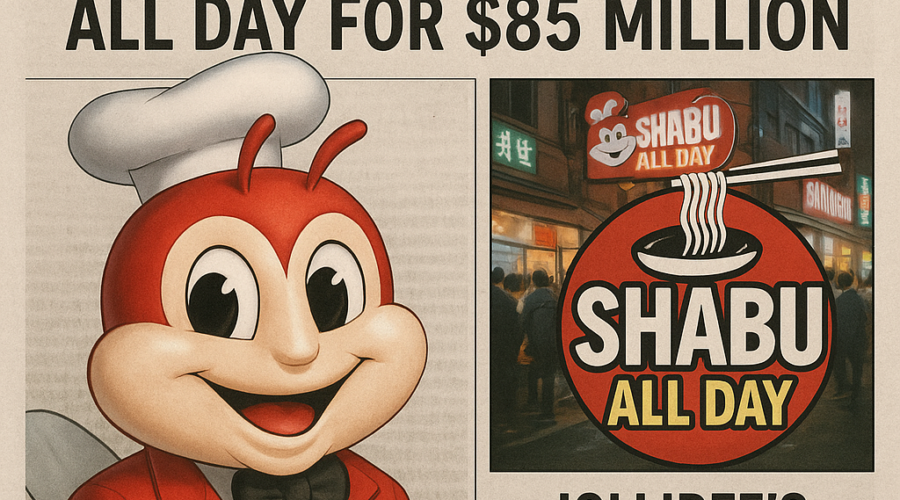
Jollibee Foods Corp., the Philippines-based quick-service restaurant giant, has agreed to acquire Shabu All Day, a South Korean hotpot chain, for $85 million to bolster its K-food footprint in Korea and Southeast Asia.[1]
Most “AI for Diligence” tools are lying to you. The truth is, they are just ChatGPT wrappers. Experience what real AI for Diligence looks like, built like Claude Code, but for M&A/ PE Diligence:
💼 When Claude Code Marries Due Diligence!
Deal Rationale and Financial Terms
The acquisition targets Jollibee’s push into **Korean food trends in Southeast Asia**, where demand for shabu-shabu and other K-dining concepts has surged amid rising consumer interest in authentic Asian cuisines. Shabu All Day operates multiple outlets in South Korea, specializing in all-you-can-eat hotpot experiences that align with Jollibee’s expertise in scalable casual dining formats.
Financial details peg the deal at $85 million, reflecting a strategic valuation for Shabu All Day’s established brand and operational infrastructure. Jollibee, valued at over $4 billion on the Philippine Stock Exchange, funded the purchase through existing cash reserves, avoiding debt amid tightening **cross-border M&A financing conditions in 2026**. This mirrors broader **private equity exit strategies in foodservice**, where operators like Jollibee capitalize on portfolio sales from regional chains seeking global scale.
Company Backgrounds and Synergies
Jollibee, founded in 1978, has grown into Asia’s largest restaurant operator by outlets, with 6,000+ locations across 16 countries. Its portfolio includes brands like Chowking and Highlands Coffee, but K-food represents a growth vector as **Southeast Asia M&A trends 2026** favor experiential dining amid economic recovery.
Shabu All Day, launched in 2016, commands a loyal base in Seoul and Busan with its affordable shabu-shabu model. Synergies include Jollibee’s supply chain efficiencies—reducing costs by 15-20% through shared procurement—and menu adaptations for SEA markets, such as spicier broths tailored to Filipino and Indonesian palates.
| Metric | Details |
|---|---|
| Enterprise Value | $85 million |
| Target Locations | 20+ in South Korea |
| Projected Synergies | Supply chain savings; SEA expansion |
| Expected Close | Q2 2026 |
Leadership, Integration, and Industry Implications
Jollibee CEO Ernesto Tanmantiong emphasized the deal’s role in “accelerating K-food expansion in Korea and SEA,” signaling plans for 50 new Shabu All Day outlets in the Philippines, Indonesia, and Vietnam within three years. No immediate layoffs are anticipated; instead, the focus is on cross-training staff for multi-brand operations.
Bain & Company’s 2026 Asia Foodservice Report highlights **restaurant chain acquisitions in Asia** as a top trend, with valuations averaging 8-10x EBITDA amid regulatory easing in cross-border deals. Similar transactions include CJ CheilJedang’s $200 million buy of a Thai noodle chain in 2025 and Yum China’s expansion into Korean BBQ concepts.
Regulatory risks remain low, with South Korea’s Fair Trade Commission approving comparable deals swiftly. For investors, the acquisition lifts Jollibee’s forward P/E to 22x, supported by 12% revenue growth projections from K-food integration.
Historical Context and Market Outlook
- 2024: Jollibee enters K-food via partnership with Seoul BBQ chain.
- 2025: SEA K-dining market grows 18% YoY, per McKinsey consumer insights.
- 2026: **Strategic M&A in Asian QSR** expected to hit $15 billion, driven by tourism rebound and premiumization.
This deal positions Jollibee as a frontrunner in **K-food M&A strategies**, offering a blueprint for peers navigating valuation pressures and geopolitical shifts in Asia-Pacific dealmaking.
Sources
https://biz.chosun.com/en/en-finance/2026/02/18/AKHAEZ3ACFAJBHSANAJAV76UHQ/