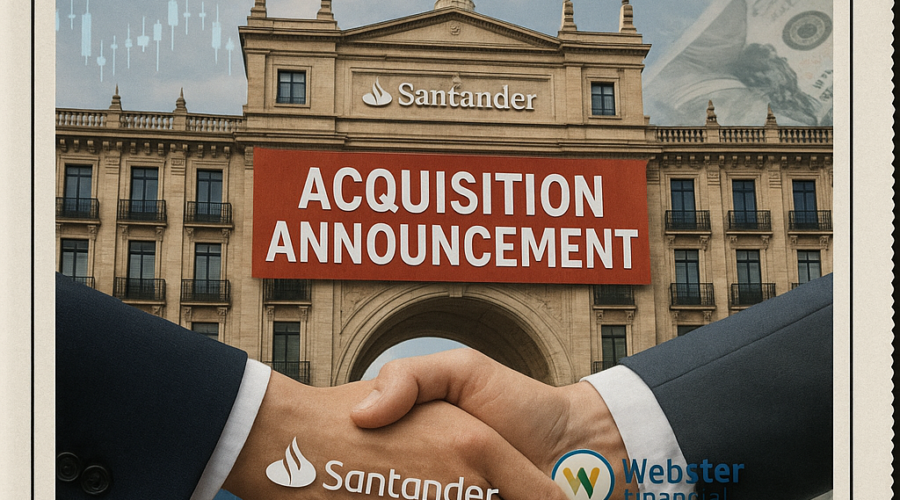
Banco Santander announced on February 3rd, 2026, its intent to acquire Webster Financial Corporation for $12.2 billion in a cash-and-stock transaction. This acquisition is structured to provide Webster shareholders with $48.75 in cash and 2.0548 Santander American Depository Shares per common share. The deal aims to create a top-ten U.S. retail and commercial bank by assets, significantly expanding Santander’s presence across the Northeast and Mid-Atlantic regions. This transaction marks Santander’s largest U.S. banking acquisition in recent years, signaling a strategic commitment to scaling its American operations through consolidation rather than solely organic growth.
- Acquirer
- Banco Santander
- Target
- Webster Financial Corporation
- Announced Date
- February 3rd, 2026
- Enterprise Value
- $12.2 billion
- Transaction Type
- Cash-and-Stock Acquisition
- Offer Price per Share
- $48.75 cash + 2.0548 Santander ADSs
- Combined Assets (Pro Forma)
- $327 billion
- Target Headquarters
- Stamford, Connecticut
- Target Branches
- 202
- Target ATMs
- 380
- Target In-State Deposits (2024)
- $33 billion
- Strategic Driver
- U.S. retail and commercial banking expansion, regional market penetration
null
Banco Santander announced February 3rd, 2026 it will acquire Webster Financial Corporation for $12.2 billion in a cash and stock transaction, creating a top-ten retail and commercial bank in the U.S. by assets.[1] Under the agreement, Webster shareholders will receive $48.75 in cash and 2.0548 Santander American Depository Shares for each Webster common share.[3]
Most “AI for Diligence” tools are lying to you. The truth is, they are just ChatGPT wrappers. Experience what real AI for Diligence looks like, built like Claude Code, but for M&A/ PE Diligence:
💼 When Claude Code Marries Due Diligence!
Strategic Rationale and Market Position
The acquisition positions Santander to establish a significant foothold in the U.S. retail and commercial banking market. The combined entity will hold approximately $327 billion in assets, substantially expanding Santander’s presence across the Northeast and Mid-Atlantic regions.[1] Webster, headquartered in Stamford, Connecticut, operates 202 branches and 380 ATMs across Connecticut, Massachusetts, Rhode Island, New York, and New Jersey, with $33 billion in in-state deposits as of 2024.[1]
This transaction represents Santander’s largest U.S. banking acquisition in recent years and signals the Spanish lender’s commitment to scaling its American operations through strategic consolidation rather than organic growth alone. The deal addresses a critical gap in Santander’s U.S. franchise, which has historically lagged competitors in regional market penetration.
Webster Financial’s Growth Trajectory
Webster enters this transaction as the largest bank headquartered in Connecticut by deposits.[1] The institution has pursued an aggressive acquisition strategy over the past two decades, including the landmark $10 billion acquisition of Sterling National Bank in 2022, which elevated its asset base to $65 billion and expanded its New York metropolitan footprint.[1] Prior acquisitions include Citibank branches in Boston (2016), HSA Bank (2005), and Ametros Financial (2023).[1]
John Ciulla served as chairman and CEO at the time of the announcement.[1] Webster’s diversified business model extends beyond traditional banking, encompassing Webster Business Credit Corporation (asset-based lending), Budget Installment Corporation (insurance premium finance), and HSA Bank (health savings account administration).[1]
Deal Structure and Shareholder Considerations
The mixed cash-and-stock consideration provides Webster shareholders with both immediate liquidity and upside exposure to Santander’s equity performance. The deal structure reflects current market conditions for regional bank acquisitions, where buyers typically blend cash components to ensure deal certainty with equity components to manage capital deployment.[3]
Investor rights firms have begun investigating whether the transaction terms represent fair value for Webster shareholders, a standard procedural step in large financial services M&A transactions.[3]
Implications for U.S. Regional Banking Consolidation
The Santander-Webster transaction underscores ongoing consolidation in the U.S. regional banking sector, where scale and geographic diversification have become critical competitive advantages. The deal reflects foreign banks’ continued appetite for U.S. banking franchises despite regulatory scrutiny and capital requirements. For Webster shareholders, the transaction provides an exit at a meaningful premium to pre-announcement trading levels, while for Santander, it accelerates its transformation into a top-ten U.S. retail and commercial banking competitor.
The transaction is expected to close subject to customary closing conditions and regulatory approvals, including review by U.S. banking regulators.
“`
Sources
https://en.wikipedia.org/wiki/Webster_Bank, https://www.marketscreener.com/news/santander-questionable-switch-to-the-us-ce7e5adadd8ff520, https://www.businesswire.com/news/home/20260204188973/en/SLAB-Stock-Alert-Halper-Sadeh-LLC-is-Investigating-Whether-the-Sale-of-Silicon-Laboratories-Inc.-is-Fair-to-Shareholders, https://glenbrook.com/payments-news/all-payments-news/