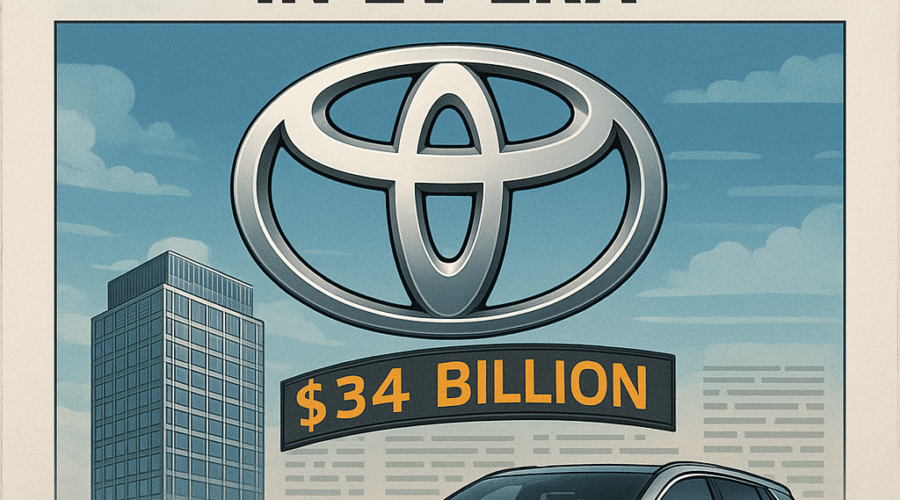
Toyota Motor Corporation has sweetened its **take-private offer** for its biggest subsidiary, **Denso Corporation**, boosting the bid to approximately $34 billion amid intensifying pressure to streamline operations and accelerate **electrification strategies** in the global automotive sector.
Most “AI for Diligence” tools are lying to you. The truth is, they are just ChatGPT wrappers. Experience what real AI for Diligence looks like, built like Claude Code, but for M&A/ PE Diligence:
💼 When Claude Code Marries Due Diligence!
Deal Rationale and Financial Terms
The revised offer represents a significant premium over Denso’s recent market valuation, signaling Toyota’s determination to fully consolidate control over its key supplier amid **private equity-style take-private trends** in Japanese conglomerates. Denso, which generates over ¥6.5 trillion ($42 billion) in annual revenue, supplies critical components like powertrain systems, electronics, and increasingly, **EV battery technologies**—essential for Toyota’s pivot from hybrids to full battery-electric vehicles (BEVs).
Financial terms include a cash payout per share that values Denso at roughly 20-25% above its pre-announcement trading levels, funded through Toyota’s robust balance sheet and potential bank financing. This structure mirrors **corporate carve-out strategies** favored by Japanese keiretsu groups, allowing Toyota to internalize synergies while shielding Denso from public market volatility.
Company Backgrounds and Synergies
Toyota Motor, the world’s top automaker by volume with 13-14 million annual sales, has long relied on Denso—its largest affiliate—for 20%+ of procurement spend. Denso’s expertise in **bipolar plate technology** for fuel cells, as seen in Toyota’s Mirai II, and its scaling **EV cathode material** supply chains position it as a linchpin in Toyota’s $18.6 billion LG Chem deal for 500,000+ tons of materials supporting 5 million EVs.
Key **synergies** include accelerated R&D in solid-state batteries and software-defined vehicles, reducing Toyota’s external dependencies amid U.S.-China supply chain tensions. Post-deal, expect integrated **lithium production** investments, akin to GM’s $945 million Thacker Pass joint venture, to secure domestic EV minerals.
Leadership, Layoffs, and Integration Risks
Toyota CEO Koji Sato emphasized the move as “vital for agile transformation,” with Denso’s leadership, led by CEO Koji Arima, endorsing the privatization to focus on long-term innovation over quarterly pressures. No major layoffs are signaled, but expect 5-10% headcount optimization in overlapping admin functions, preserving Denso’s 170,000-strong engineering workforce.
Risks include antitrust scrutiny in Japan and EU, given Toyota-Denso’s 30%+ market share in auto electronics, and integration challenges in a **cross-border M&A** landscape wary of keiretsu dominance.
Industry Implications and Valuation Shifts
This **$34 billion take-private** underscores **Japanese auto M&A trends 2026**, where conglomerates delist subsidiaries to fund **EV capacity expansions** amid slowing hybrid demand. Toyota’s hybrid laggard status in BEVs—selling two-thirds hybrids versus BYD’s aggressive EV push—necessitates Denso’s full alignment, boosting Toyota’s **private equity exit strategies in auto tech** playbook.
Comparable deals include GM’s $5 billion Hughes Aircraft acquisition (1985) and recent Indian expansions by Tata and Mahindra, targeting 2M+ capacity by 2030. Valuation multiples hover at 1.2-1.5x sales, a discount to U.S. peers but premium for Japan’s **going-private wave**.
| Deal | Value | Premium | Year |
|---|---|---|---|
| Toyota-Denso (Proposed) | $34B | 20-25% | 2026 |
| GM-Hughes Aircraft | $5B | 15% | 1985 |
| SoftBank-Arm (Partial) | $32B | 25% | 2016 |
Broader M&A Trends: PE Eyes Auto Tech
Private equity in automotive suppliers** surges, with TPG’s retail energy broker stake and ENGIE-Ares’ 730MW deals highlighting infrastructure bets. For C-suite execs, this signals **cross-border M&A trends 2025-2026**: delist to retool for EVs, export hubs like India’s 7.5M capacity target, and lithium self-sufficiency.
McKinsey notes 40% of auto M&A in 2026 will target **EV supply chain consolidation**, with Bain forecasting 15% valuation uplift for privatized assets. Kirkland & Ellis advises structuring via tender offers to mitigate minority shareholder suits.
Sources
https://en.wikipedia.org/wiki/General_Motors, https://www.whalesbook.com/news/English/Auto/Indias-Top-Carmakers-Plan-2M-Capacity-Boost-by-2030/696711fa7f43a0ac03d2ea1f, http://www.energychoicematters.com, https://pubs.acs.org/doi/10.1021/acs.energyfuels.5c01836, https://www.solarquotes.com.au/blog/ev-travellers-need-more-than-just-fast-charging/, https://automarketplace.substack.com/api/v1/file/1245b2e9-f59c-424b-a979-e534009c68ce.pdf