

Cintas Corporation’s proposed $5.2 billion all‑cash acquisition of rival UniFirst marks the most consequential consolidation move in North American uniform rental and route-based business services in more than a decade, with direct implications for pricing power, route density, and regulatory scrutiny in a mature but cash‑generative sector.[4][5][6]
Most “AI for Diligence” tools are lying to you. The truth is, they are just ChatGPT wrappers. Experience what real AI for Diligence looks like, built like Claude Code, but for M&A/ PE Diligence:
💼 When Claude Code Marries Due Diligence!
Deal Overview and Strategic Context
On December 22, 2025, Cintas proposed a roughly $5.2 billion cash offer for UniFirst, a uniform and workplace services rival with overlapping geographies and similar rental/route economics.[4][6] MarketBeat characterizes this bid as Cintas’ third attempt to acquire UniFirst, underscoring a long-standing strategic interest in absorbing its competitor’s routes and contracts.[6]
Cintas, a leading provider of uniform rental, facility services, and safety products, has been benefiting from steady organic growth and operating leverage, reporting quarterly revenue of $2.8 billion (up 9.3% year over year) and a net margin of 17.6%, with return on equity above 40%.[1][2][3] The company has set FY 2026 EPS guidance of $4.81–$4.88, signaling continued earnings growth on a standalone basis.[1][2][3]
Headline Terms (Indicative, Based on Public Reporting)
- Implied equity value: ≈$5.2 billion in cash for UniFirst.[4][6]
- Structure: proposed all‑cash acquisition; detailed merger agreement terms have not yet been fully disclosed in public filings as of the latest reporting.[4][6]
- Consideration mix: 100% cash increases deal certainty for UniFirst shareholders but raises financing and leverage considerations for Cintas.
- Prior approaches: Cintas’ third bid suggests prior informal or formal overtures were rebuffed, implying potential negotiating tension over valuation and control.[6]
Industrial Logic: Why Cintas Wants UniFirst
The proposed takeover is framed in market commentary as a battle for “route dominance” in the U.S. uniform rental and service market, reflecting a classic scale and density play in a recurring-revenue, logistics‑intensive business model.[1][2][3][5]
1. Route Density and Operating Leverage
Uniform rental and facility services are fundamentally route‑based, high fixed-cost businesses. Profitability is driven by truck and plant utilization, customer density, and churn control. Combining Cintas and UniFirst would:
- Increase route density in overlapping metropolitan and regional markets, enabling higher stops per route and lower cost per delivery.
- Unlock plant utilization benefits by consolidating production and laundry facilities where there is geographic overlap.
- Provide additional leverage over fuel, fleet, and consumables procurement through higher volumes.
This mirrors value-creation patterns seen in other route-based sectors such as waste management, pest control, and industrial distribution, where scale M&A has historically delivered meaningful cost synergies and margin expansion.
2. Strengthening Recurring Revenue and Customer Stickiness
Cintas already operates a diversified portfolio of contracted, recurring revenue offerings—uniform rental, facility services, and safety supplies—that tend to be non‑discretionary for clients in regulated sectors (e.g., healthcare, food, manufacturing). UniFirst brings:
- An additional base of multi‑year uniform and facility service contracts.
- Exposure to a similar but partially distinct small and mid‑market client set across North America.
- Opportunity to cross‑sell higher value-added services (safety, hygiene, specialized garments) into UniFirst’s legacy accounts.
3. Scale Economics and Corporate Cost Synergies
With Cintas’ current market capitalization around $76 billion and a P/E multiple in the mid‑50s, the company trades at a premium to many industrial peers, reflecting investor confidence in its growth and margin profile.[3] The acquisition of UniFirst would likely target:
- Corporate overhead rationalization (duplicative headquarters, IT, finance, HR, and regional management layers).
- Procurement synergies in textiles, chemicals, and equipment.
- Harmonization of pricing and service tiers, especially in overlapping routes where competition has historically suppressed yields.
Given Cintas’ high ROE and robust free cash flow, applying its operating system to UniFirst’s footprint could raise UniFirst’s margin structure closer to Cintas’ best‑in‑class benchmarks over time.[1][2][3]
Illustrative Strategic and Financial Impact
Strategic Positioning: Post‑Deal Landscape
| Metric | Cintas (Standalone) | UniFirst (Standalone, Directional) | Combined Strategic Implication |
|---|---|---|---|
| Core business | Uniform rental, facility services, safety products[1][2][3] | Uniform rental and related workplace services[6] | Deeper penetration of North American uniform rental and facility services |
| Revenue trend | 9.3% YoY quarterly revenue growth to $2.8B[1][2][3] | Facing growth and margin pressure; mixed analyst sentiment[6] | Blend of growth and turnaround, with synergy-led uplift potential |
| Profitability | ~17.6% net margin; ROE > 40%[1][2][3] | Lower returns vs. top-tier peers; under pressure from costs[6] | Upside from applying Cintas’ playbook to weaker UniFirst economics |
| Market position | Sector leader[5] | Scaled national competitor[6] | Significant consolidation toward a dominant national platform |
Financing and Balance Sheet Considerations
Cintas has historically returned cash to shareholders via dividends and share repurchases, with a $1 billion share buyback authorized in late 2025 (about 1.3% of shares).[1][2][3] A $5.2 billion all‑cash acquisition of UniFirst would represent a step‑change capital allocation decision, with implications for:
- Leverage: Likely incremental debt raise and temporary elevation in net leverage, depending on mix of cash on hand and new financing.
- Capital returns: Potential moderation or re‑sequencing of share repurchases to prioritize integration and balance sheet management.
- Credit perspective: Rating agencies will focus on pro‑forma leverage, integration risk, and the stability of route-based cash flows.
Given the stability of subscription-like, route-based cash flows and Cintas’ strong ROE, many investors may tolerate a temporary rise in leverage if synergy visibility is high—an important theme in current corporate M&A financing strategies 2025–2026.
Regulatory and Antitrust Risks
The combination of two major players in the U.S. uniform rental market will inevitably attract antitrust scrutiny. As of the latest reporting, specific regulatory positions have not been publicly detailed, but executives and deal advisors should anticipate:
- Market definition debates: Whether regulators view the relevant market as “uniform rental” specifically, or broader workplace and facility services, will critically shape concentration metrics.
- Regional concentration analysis: Route density benefits imply numerous local markets where Cintas–UniFirst would exceed traditional share thresholds, potentially triggering asset divestiture requirements.
- Precedent: Historic route-based consolidation in waste management and rental services has been cleared with targeted divestitures; a similar pattern is plausible here.
For legal and compliance teams focused on U.S. antitrust risk in industrial services M&A, early, data‑driven market share mapping and scenario planning (including voluntary divestiture packages) will be key to deal certainty.
UniFirst Shareholder Perspective
UniFirst’s shareholders face a trade‑off between a cash exit at a takeover premium and remaining exposed to the company’s standalone turnaround prospects and potential future bids. Recent coverage highlights:
- Mixed analyst sentiment, with an average rating leaning towards “reduce” or “hold”.[6]
- Downward revisions to near-term earnings forecasts (e.g., William Blair cutting FY 2026 EPS expectations from $8.62 to $7.08).[6]
- More constructive medium‑term views on earnings recovery, with some analysts raising FY 2027 EPS estimates.[6]
Against this backdrop, a sizeable cash premium from a strategic buyer with a strong operating track record will be attractive to many long‑term holders, especially those skeptical of management’s ability to independently restore growth and margins.
Implications for Competitors, Customers, and Labor
Competitive Dynamics
A successful Cintas–UniFirst combination would accelerate consolidation in the uniform and facility services market, with ripple effects for both regional and national competitors:
- Smaller regional players may position themselves as customer‑friendly alternatives emphasizing flexibility, service, and local relationships.
- Private equity sponsors could pursue roll‑up strategies of independent operators as an alternative scale platform, a theme consistent with recent interest in route-based and business services buyouts.
- Large corporate buyers of uniform services may see reduced vendor choice in some markets, potentially leading to modest pricing pressure over time.
Customer Impact
For enterprise procurement leaders, key questions include:
- Will Cintas rationalize UniFirst’s pricing to its own standards, effectively increasing uniform rental and facility services costs over medium term?
- Will service levels improve due to better technology, inventory management, and route optimization—or will integration complexity temporarily disrupt quality?
- How will contract renewals and RFPs be managed in markets where Cintas and UniFirst currently both serve the same client?
Workforce and Layoffs
While no detailed workforce plan has been disclosed, typical synergies in such deals come from:
- Corporate and back-office consolidation (duplicative HQ and regional admin roles).
- Rationalization of overlapping routes and plants, including potential facility closures or reconfigurations.
- Re‑deployment of frontline service staff as routes are redesigned.
Given the labor‑intensive nature of both businesses, management will be under pressure—from investors and regulators—to articulate a credible plan that balances synergy capture with local employment and service continuity.
Historical Parallels and Precedents
This transaction aligns with a broader pattern of scale-driven M&A in route-based services seen in waste management, building services, and equipment rental. Key learnings from past deals include:
- Early, rigorous route engineering is essential to realize promised density and cost benefits.
- Integration complexity correlates strongly with differences in IT systems, service standards, and pricing architectures.
- Re
Sources
https://www.marketbeat.com/instant-alerts/filing-nisa-investment-advisors-llc-sells-16785-shares-of-cintas-corporation-ctas-2026-01-09/, https://www.marketbeat.com/instant-alerts/filing-cerity-partners-llc-sells-5378-shares-of-cintas-corporation-ctas-2026-01-09/, https://www.marketbeat.com/instant-alerts/filing-robeco-institutional-asset-management-bv-reduces-stock-position-in-cintas-corporation-ctas-2026-01-09/, https://www.themiddlemarket.com/latest-news/eir-partners-closes-oversubscribed-1b-fund-iii, https://www.marketbeat.com/stocks/NASDAQ/CTAS/news/, https://www.marketbeat.com/stocks/NYSE/UNF/news/
Related Posts

Curaleaf Launches $272 Million Unsolicited Bid for Aurora Cannabis to Create Global Powerhouse
In a move that signals a return to aggressive consolidation within the cannabis sector, U.S. multi-state operator (MSO) Curaleaf Holdings, Inc. (TSX: CURA) announced its intention on August 11,...

Prologis to Acquire U.K. Logistics Giant SEGRO in $18.8 Billion Consolidation Play
LONDON & SAN FRANCISCO — Global logistics powerhouse Prologis, Inc. (NYSE: PLD) has reached a definitive agreement to acquire British peer SEGRO plc (LSE: SGRO) in an all-stock transaction with a...
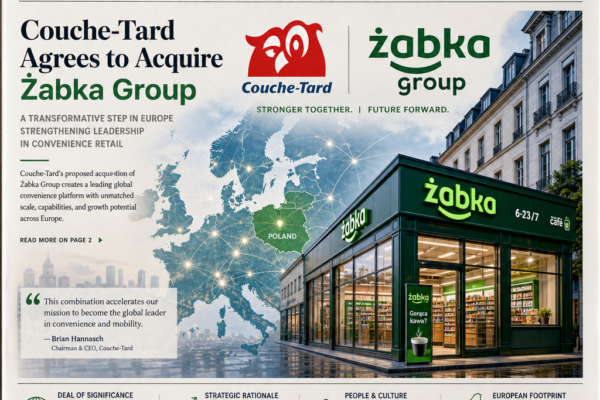
Couche-Tard Inks $8.6B Deal For Poland’s Żabka Group: A New Frontier in European Convenience
In a move that fundamentally reshapes the European retail landscape, Alimentation Couche-Tard Inc. (ACT) announced on July 31, 2026, a definitive agreement to acquire 100% of the issued and...

FIFA’s $20 Billion Commercial Pivot: Inside Infantino’s Plan to Institutionalize the World Cup
In a move that signals a fundamental restructuring of global sports governance, FIFA has moved to carve out its commercial operations into a new, for-profit entity valued at $20 billion. The...