
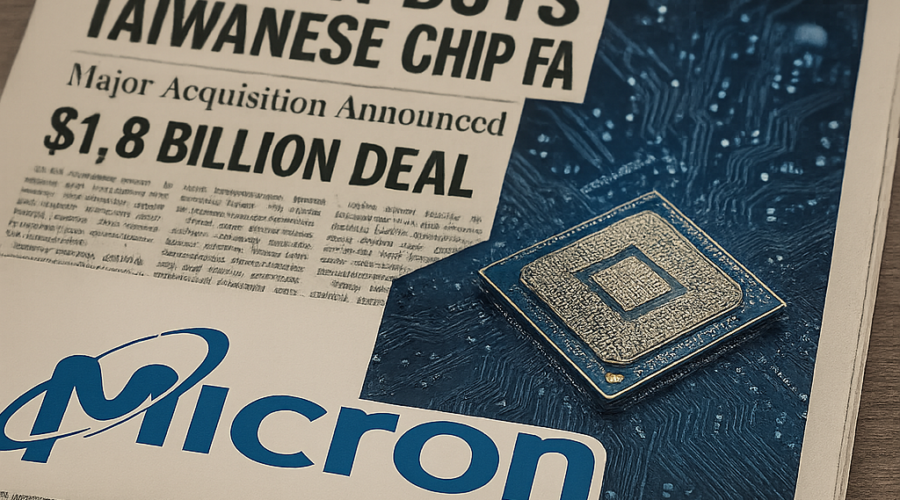
Micron Technology has signed a letter of intent to acquire a fabrication site in Taiwan’s Tongluo from Powerchip Semiconductor Manufacturing Corp. (PSMC) for $1.8 billion, aiming to expand DRAM production amid surging AI-driven memory demand.[1][6][11]
Set and exceed synergy goals with benchmarks and actionable operational initiative level data from similar deals from your sector:
💼 Actionable Synergies Data from 1,000+ Deals!
The P5 cleanroom facility would enable Micron to ramp up output in Taiwan, a key semiconductor hub, as global AI workloads strain high-bandwidth memory (HBM) supplies.[1][3] This cross-border M&A move reflects **semiconductor supply chain realignment strategies** in response to U.S. onshoring pressures and Taiwan’s entrenched manufacturing edge.[5]
Deal Rationale and Financial Terms
Micron, a Boise-based leader in DRAM and NAND flash, targets the acquisition to secure advanced capacity for HBM3E and future nodes critical to AI data centers.[3][10] PSMC, facing strategic shifts, divests the Tongluo site to refocus on specialty processes.[1] The $1.8 billion price tag—payable in cash—aligns with Micron’s aggressive capex, including a separate $100 billion U.S. fab groundbreaking.[3]
Analysts view the deal as accretive, with Micron’s stock up 26.9% year-to-date to $362.75 as of early 2026, trading at a forward P/E of 28.86 amid “Buy” consensus and $200.64 targets.[10] Institutional flows remain strong, though CEO Sanjay Mehrotra’s recent share sales signal caution.[11]
Strategic Context in AI Semiconductor M&A Trends
The transaction underscores **Taiwan semiconductor acquisition trends 2026**, where U.S. firms like Micron deepen Asia ties despite CHIPS Act incentives for domestic builds.[5] Taiwan’s FDI inflows hit $11.39 billion in 2025, up 45%, fueled by AI exports.[5] Comparable deals include TSMC’s U.S. expansions and Nvidia’s supplier shifts amid 25% U.S. tariffs on select chips.[4][5][9]
| Metric | Micron (MU) | TSMC (TSM) |
|---|---|---|
| Market Cap | $245.84B | N/A (Leader in Foundry) |
| YTD Stock Gain (2026) | 26.9% | Up on AI Guidance |
| Key Driver | AI Memory Demand | Blackwell Wafers |
| Recent Capex | $1.8B Taiwan + $100B U.S. | U.S./Japan Fabs |
Industry Implications and Risks
- Synergies: Boosts Micron’s HBM capacity, positioning it for “Nvidia-like growth” per investors, as AI servers demand tripled memory.[3][10]
- Regulatory Hurdles: U.S.-Taiwan tech transfer scrutiny under Trump-era tariffs; CFIUS review likely for IP flows.[5][9]
- Geopolitical Exposure: Enhances Taiwan reliance amid China tensions, counterbalanced by Micron’s U.S. investments.[4]
- Valuation Shifts: SOXX ETF up 40% on AI sentiment; rotation risks if tariffs hit Nvidia suppliers.[7]
Bain & Company notes **private equity exit strategies in semiconductor assets** could accelerate, with PE firms eyeing memory plays amid 3.8% Taiwan GDP forecast tied to AI.[5] McKinsey highlights HBM shortages persisting through 2027, validating Micron’s capacity grab.[10]
Leadership under CEO Sanjay Mehrotra emphasizes innovation in AI workloads, with no immediate layoffs signaled.[10] Closing hinges on due diligence, expected mid-2026.
Sources
https://techsoda.substack.com/p/micron-and-psmcs-strategic-realignment, https://www.marketbeat.com/stocks/NYSE/TSM/news/, https://www.tipranks.com/news/nvidia-like-growth-says-top-investor-about-micron-stock, https://www.tipranks.com/news/topic/tsm, https://www.taipeitimes.com/News/biz, https://www.investing.com/news/company-news, https://www.ainvest.com/news/soxx-40-surge-tracking-ai-trade-viral-sentiment-2601/, https://www.tipranks.com/news/cathie-wood-buys-amd-tsmc-and-other-growth-stocks-trims-stakes-in-kratos-defense-1-17-2026, https://www.business-standard.com/topic/semiconductor-industry, https://www.marketbeat.com/stocks/NASDAQ/MU/, https://www.marketbeat.com/stocks/NASDAQ/MU/news/, https://theedgemalaysia.com/flash-categories/Tech