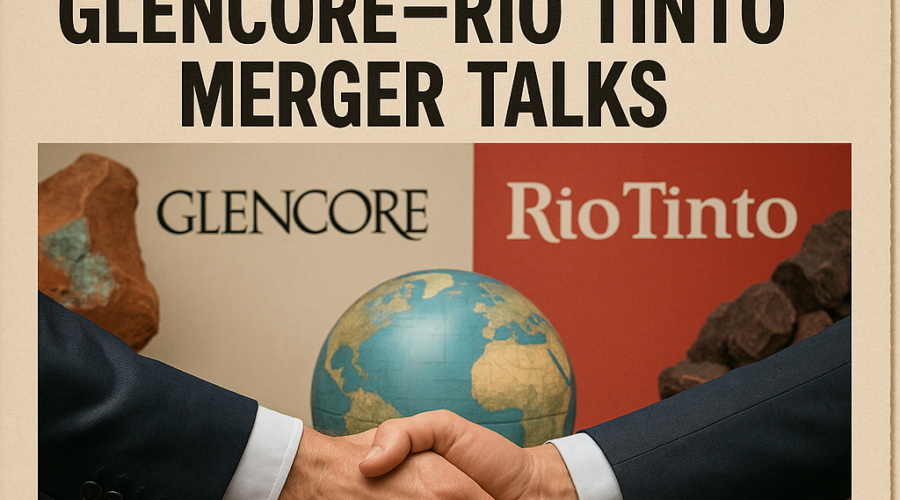
Glencore and Rio Tinto have confirmed they are in preliminary merger and acquisition talks that could create the world’s largest mining group, with a combined valuation in the $200–260 billion range, eclipsing current leader BHP and reshaping global markets for copper, iron ore and other critical commodities.[1][2][3][4]
Set and exceed synergy goals with benchmarks and actionable operational initiative level data from similar deals from your sector:
💼 Actionable Synergies Data from 1,000+ Deals!
Deal Status: Early-Stage, High-Stakes, No Certainty
Glencore has formally acknowledged “preliminary discussions” with Rio Tinto regarding a possible combination of some or all of their businesses, explicitly including the option of an all-share merger between the two companies.[1][3][4]
Both parties state that their current expectation is that any transaction would be structured as a Court‑sanctioned scheme of arrangement whereby Rio Tinto would acquire Glencore.[1][3][4]
Under the UK Takeover Code, Rio Tinto has until 5:00 p.m. (London time) on 5 February 2026 to either announce a firm intention to make an offer for Glencore (Rule 2.7) or to confirm it does not intend to make an offer (Rule 2.8).[1][5]
Both companies stress there is no certainty that any offer will be made, nor as to the terms or structure of a potential transaction.[1][3][4]
Scale and Strategic Logic: Building the World’s Largest Miner
Recent market estimates suggest a combined Glencore–Rio Tinto group would have a market value between roughly $207 billion and $260 billion, depending on share prices and methodology, decisively surpassing BHP as the largest listed mining company worldwide.[2][3][4]
| Player | Approximate Equity/Enterprise Value | Strategic Profile |
|---|---|---|
| Combined Rio Tinto–Glencore (pro forma) | $207–260 billion range[2][3][4] | Tier‑one iron ore and copper, diversified base metals, energy, and trading |
| BHP Group | Below pro forma RT–Glencore total[2][4] | Largest diversified miner today; iron ore, copper, coal, potash |
| Anglo American–Teck (proposed) | ~$53 billion copper‑focused miner[4] | Top‑five copper producer on completion[4] |
The industrial logic goes beyond headline size. Analysts highlight that a Rio Tinto acquisition of Glencore would combine:
- Rio Tinto’s portfolio of tier‑one iron ore and copper assets, long reserve life and balance‑sheet discipline.[3][6]
- Glencore’s diversified exposure to base metals and energy plus a highly profitable marketing and trading business designed to monetize price volatility.[6]
Fastmarkets notes that the strategic rationale is about optionality across commodities, geographies and price cycles—scale plus portfolio diversity that can lower cost of capital and support investment through downturns as capital intensity and execution risk in new mines increase.[6]
Copper, Energy Transition and AI: Why This Deal Is Happening Now
Global miners are “racing to bulk up in metals like copper” expected to benefit from the energy transition and power‑hungry artificial intelligence, sparking a new wave of mining M&A and project expansion.[3][4]
Rio Tinto has publicly targeted increasing its copper output to 1 million tons per year by 2030, and acquiring Glencore’s copper portfolio would materially accelerate that goal.[4]
Industrial Info Resources highlights that costs for new mines are skyrocketing due to stricter ESG expectations and lengthy permitting, making it “cheaper for companies to acquire than grow organically in some cases,” a key driver behind the current upswing in mining M&A as 2026 begins.[4]
Context: Parallel Consolidation in Copper
The renewed talks follow the announced merger of Anglo American and Teck Resources, expected to create a roughly $53 billion copper‑focused heavyweight and a top‑five global copper producer.[3][4]
Against that backdrop, a Rio Tinto–Glencore combination would be a defining move in the emerging “consolidation for copper” theme and is likely to feature prominently in boardroom discussions about cross‑border M&A trends in mining, energy transition metals M&A and copper supply security through 2030.
Governance, Culture and Leadership: Integration Risk at Scale
This is the second serious engagement between the two groups in a little over a year: Glencore approached Rio Tinto in late 2024, but that proposal did not proceed.[2][3][6]
Rio Tinto has seen significant leadership change since that 2024 approach. The company’s new CEO, Simon Trott, took over in August 2025, succeeding Jakob Stausholm, and is seen as more open to large‑scale transactions.[3]
Under Trott, Rio Tinto aims to become “leaner” with fewer non‑core assets, even as it considers transformational M&A.[3]
Investors already point to potential cultural friction as a key risk factor:
- Glencore is perceived as having a trading‑driven, opportunistic and strongly results‑focused culture.[3][6]
- Rio Tinto is generally viewed as more traditional, engineering‑centric, and conservative in capital allocation.[3][6]
One Rio Tinto shareholder has publicly argued that aspects of Glencore’s trading‑oriented culture “could actually be good for Rio” if discipline on valuation and structure is preserved.[3]
Regulatory and Political Hurdles: Competition, Conduct and Coal
Any Glencore–Rio Tinto mega‑merger would face intense scrutiny from competition and political authorities across multiple jurisdictions, particularly in copper and iron ore, which are already highly consolidated and systemically important.[6]
Antitrust and Market Concentration
Fastmarkets notes that iron ore and copper are sectors where regulators are “acutely aware” of macroeconomic importance, including links to industrial policy, energy‑transition targets and inflation.[6]
Even modest increases in concentration could trigger remedies such as forced divestments, directly affecting deal economics and potentially complicating any global integration blueprint.[6]
Legacy Conduct Issues and US Sensitivities
Glencore only recently concluded long‑running US Department of Justice and Commodity Futures Trading Commission investigations into allegations of bribery and market manipulation, resolving them through settlements.[6]
This history is expected to weigh heavily in US reviews of any transaction, especially if a combined group would wield greater influence in key commodity trading chains.
Thermal Coal and ESG Complexity
Coal exposure is another structural challenge. Rio Tinto has largely exited coal, while Glencore remains deeply involved in coal mining and marketing.[6]
Any deal will have to navigate not only antitrust law but also rapidly evolving ESG, climate and energy policy expectations, as regulators and governments increasingly treat coal and high‑carbon assets as politically charged.
Market Reaction and Investor Lens
Upon confirmation of the talks, Glencore’s US‑listed shares rose around 6%, while Rio Tinto’s Australian‑listed shares fell as much as 6.4%, marking its largest intraday decline since July 2022.[3]
The divergent price action reflects a familiar pattern in large all‑share mergers: expected premium accrues to the target (Glencore) while shareholders of the putative acquirer (Rio Tinto) discount deal risk, potential overpayment and integration uncertainty.
Implications for CEOs, Boards and Dealmakers
1. Validation of “Acquire Rather Than Build” in Mining
The Rio Tinto–Glencore talks reinforce a broader structural shift: as greenfield project costs, ESG obligations and permitting times increase, inorganic growth via M&A becomes more attractive than building new mines from scratch in many jurisdictions.[4][6]
For investment committees and strategy teams exploring long‑term copper exposure or critical minerals supply security, this deal will likely become a reference case in evaluating capital‑intensive resource M&A.
2. Trading and Marketing Capabilities as a Strategic Asset
Glencore’s marketing and trading arm is central to the deal’s industrial logic, signaling that risk‑management and trading capabilities are now seen as structural competitive advantages, not just optional adjacencies, in large‑scale mining.[6]
Boards in other resource and energy companies may increasingly explore bolt‑on acquisitions of trading houses, joint ventures or deeper marketing alliances to replicate similar optionality across commodity cycles.
3. Higher Regulatory Bar for Mega‑Deals
Given recent enforcement trends, this process will be closely watched by competition authorities as a test case for future mega‑mergers in concentrated resource sectors.[6]
Deal architects should assume extensive remedy modeling—particularly for copper, iron ore and coal—as well as multi‑track negotiations with regulators in the EU, UK, US, China and key producing countries.
What to Watch Between Now and 5 February 2026
- Rio Tinto’s “put up or shut up” deadline: Whether Rio Tinto announces a firm all‑share offer or formally walks away under Rule 2.8 of the UK Takeover Code.[1][5]
- Indications of structure: Scope of assets included, treatment of coal, possible pre‑emptive divestments to ease regulatory paths.
- Governance blueprint: Board composition, leadership roles and approach to integrating Glencore’s trading culture into Rio’s more traditional mining governance framework.
- Signals from peers: Responses from BHP, Anglo American–Teck and other majors—whether through defensive moves, counterbids, or follow‑on consolidation, especially in copper and battery metals.
SEO‑Relevant Strategic Angles for Professionals
For C‑suite leaders, private equity sponsors and advisors monitoring cross‑border M&A trends 2026, this situation touches multiple high‑interest themes: energy transition metals M&A, mining mega‑mergers, copper consolidation strategies, and the role of commodity trading in mining corporate strategy.
Whether or not a firm offer emerges, the Glencore–Rio Tinto talks will likely become a key case study in large‑scale mining economics, regulatory risk in commodity mergers and future portfolio strategy for diversified miners through 2030.[4][6]
Sources
https://www.glencore.com/media-and-insights/news/statement-regarding-rio-tinto, https://www.axios.com/2026/01/08/glencore-rio-tinto-mining, https://www.mining.com/web/glencore-rio-tinto-resume-talks-on-mining-mega-deal-ft-reports/, https://www.industrialinfo.com/news/article/mining-giants-rio-tinto-and-glencore-back-in-mergeracquisition-talks--351605, https://www.riotinto.com/en/news/releases/2026/statement-regarding-glencore-plc-glencore, https://www.fastmarkets.com/insights/rio-tinto-to-buy-glencore-hotter-commodities-andrea-hotter/