
“`html
The Deal That Didn’t Close
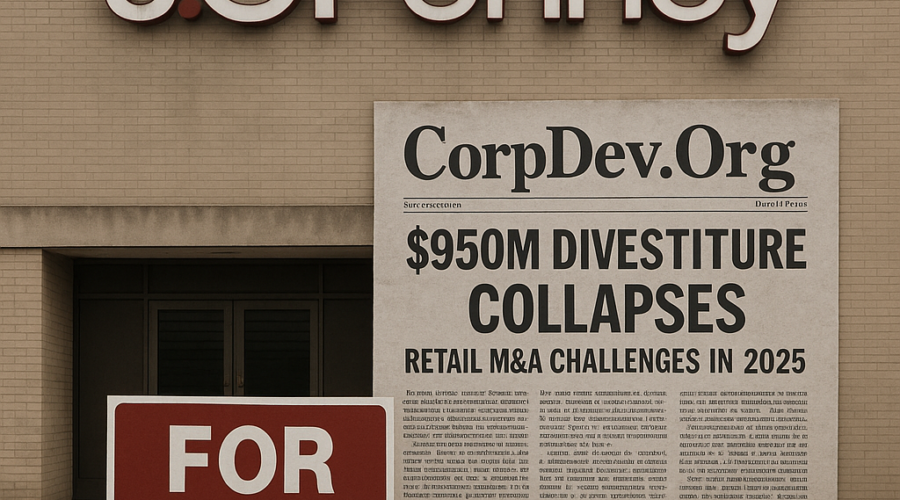
The collapse of a $950 million transaction to divest 120 J.C. Penney stores represents a significant setback for the struggling department store chain and signals deepening challenges in the retail M&A landscape. The failed deal, which would have represented one of the largest retail store portfolio sales in recent years, underscores the structural headwinds facing traditional brick-and-mortar retailers and the tightening appetite among buyers for distressed retail assets.
Set and exceed synergy goals with benchmarks and actionable operational initiative level data from similar deals from your sector:
💼 Actionable Synergies Data from 1,000+ Deals!
For J.C. Penney—already navigating a complex financial restructuring following its emergence from bankruptcy in 2021—the transaction’s failure forces a recalibration of its portfolio optimization strategy and raises critical questions about the company’s path to sustainable profitability. The deal’s collapse also reflects broader market dynamics: declining foot traffic in traditional shopping centers, compressed retail valuations, and buyer hesitation around long-term lease obligations that characterize modern retail real estate.
Deal Context: Why J.C. Penney Pursued the Divestiture
Strategic Rationale
J.C. Penney’s decision to pursue a large-scale store divestiture was rooted in sound strategic logic. The company, which operates approximately 700 stores nationwide, has been under pressure to optimize its real estate portfolio—a critical lever for improving cash flow and reducing fixed costs. The 120-store package represented roughly 17% of the company’s store base, suggesting a targeted, rather than wholesale, rationalization.
The divestiture was intended to accomplish several objectives:
- Liquidity generation: Raise approximately $950 million in gross proceeds to strengthen the balance sheet and fund debt reduction or operational investments.
- Cost structure optimization: Eliminate underperforming locations and reduce the burden of long-term lease obligations, many of which carry unfavorable economics.
- Portfolio concentration: Focus remaining stores on high-traffic, profitable locations in key metropolitan markets.
- Operational efficiency: Reduce complexity in supply chain, logistics, and store management by operating a leaner footprint.
These objectives align with industry best practices for distressed retail restructuring. Competitors including Bed Bath & Beyond, Bed Bath & Beyond, and other legacy retailers have pursued similar store rationalization strategies as part of broader turnaround efforts.
The Buyer Profile
While specific buyer details have not been fully disclosed, retail portfolio acquisitions of this scale typically attract one of several buyer categories:
- Discount retailers or off-price operators seeking to acquire established locations at favorable lease rates.
- Real estate investors or REIT-affiliated entities interested in acquiring the lease rights and subletting to alternative tenants.
- Regional or emerging retail chains looking to expand footprint through acquisition rather than organic growth.
- Private equity sponsors with retail expertise and operational playbooks for turnaround or repositioning.
The failure to close suggests that the buyer—likely facing its own capital constraints, due diligence concerns, or revised financial projections—determined that the deal economics no longer justified proceeding.
Why the Deal Failed: Root Causes and Market Dynamics
1. Valuation Disconnect and Lease Economics
The most probable cause of deal failure centers on valuation and lease economics. A $950 million price tag for 120 stores implies an average valuation of approximately $7.9 million per store—a figure that likely reflects the underlying real estate value, lease terms, and operational performance of the portfolio.
However, retail lease valuations have come under significant pressure. Many department store leases carry:
- Long remaining terms (10–20+ years) with escalating rent obligations.
- Percentage rent clauses tied to sales performance, creating upside/downside exposure.
- Co-tenancy clauses that allow rent abatement if anchor tenants depart.
- Deteriorating shopping center economics as traditional retail traffic declines.
A buyer conducting detailed due diligence may have discovered that the true economic value of the lease portfolio—after accounting for occupancy risk, rent abatement scenarios, and the cost of repositioning underperforming locations—was materially lower than the asking price. This valuation gap likely proved insurmountable.
2. Macro Headwinds: Retail Sector Weakness
The broader retail environment in late 2025 remains challenging. Key headwinds include:
- Consumer spending moderation: Discretionary retail spending has slowed as consumers navigate higher interest rates and inflation concerns.
- E-commerce cannibalization: Apparel and home goods—traditional J.C. Penney categories—continue to shift online, reducing in-store traffic.
- Shopping center distress: Many traditional enclosed malls face declining traffic, rising vacancy rates, and deteriorating property values.
- Buyer capital constraints: Retail-focused private equity and strategic buyers have faced valuation pressure and reduced dry powder, limiting acquisition appetite.
In this environment, a buyer’s willingness to commit $950 million to a legacy retail portfolio—with inherent operational and real estate risks—has diminished significantly.
3. Due Diligence Red Flags
Standard M&A due diligence likely uncovered operational or financial metrics that gave the buyer pause:
- Same-store sales trends: If the 120-store portfolio underperformed company averages, this signals structural weakness.
- Lease profitability: Stores operating at negative or razor-thin margins create long-term drag.
- Real estate quality: Aging shopping centers with limited co-tenancy appeal or high vacancy rates reduce asset value.
- Customer demographics: Shifts in local demographics may have reduced the addressable market for traditional department store offerings.
4. Financing and Capital Markets Tightening
If the buyer was a financial
Sources
Related Posts
Hapag-Lloyd in Advanced Talks to Acquire Zim for Over $3.5 Billion Amid Israeli Workers’ Strike
German container shipping giant **Hapag-Lloyd AG** is in advanced negotiations to buy Israeli rival **Zim Integrated Shipping Services Ltd** in a deal valued above $3.5 billion, a move that could...

Reliance Consumer Products Enters Australian Market with Goodness Group Acquisition
null Reliance Consumer Products Limited (RCPL) has acquired a majority stake in Australia's Goodness Group Global, marking the Indian conglomerate's strategic expansion into the Asia-Pacific beverage...
TK Elevator Targets Frankfurt IPO: $29 Billion Valuation Signals Industrial Consolidation Shift
null TK Elevator, the Düsseldorf-based elevator and escalator manufacturer, is preparing for a Frankfurt IPO in the second half of 2026 with a potential valuation of €25 billion (approximately $29...
Henkel Acquires Specialty Coatings Firm Stahl for €2.1 Billion in Strategic Industrial Push
Henkel AG & Co. KGaA has agreed to purchase Stahl Holdings B.V., a Dutch specialty coatings provider, from private equity firm Wendel SE for €2.1 billion, marking a key expansion in **adhesives...