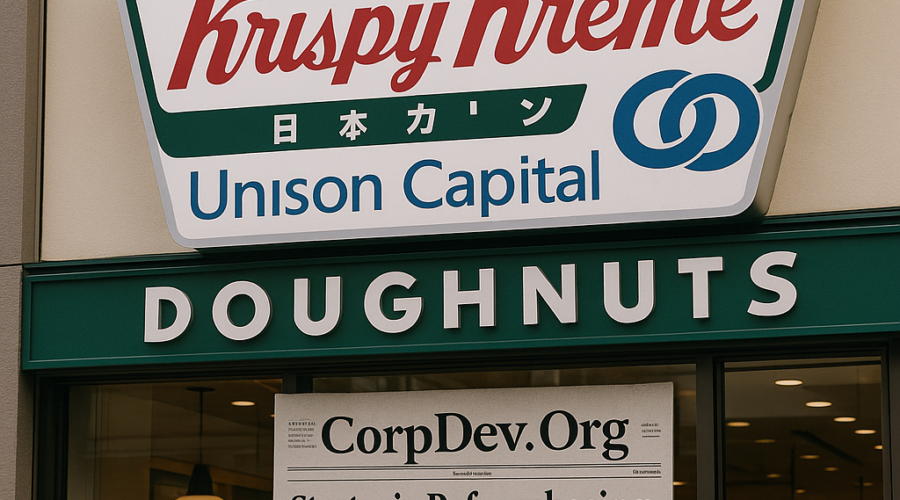
Krispy Kreme is divesting its Japan operations to Unison Capital, marking the doughnut chain’s first international refranchising deal as part of a broader debt-reduction and turnaround strategy.[1]
Set and exceed synergy goals with benchmarks and actionable operational initiative level data from similar deals from your sector:
💼 Actionable Synergies Data from 1,000+ Deals!
Deal Background and Strategic Rationale
Announced alongside the 20th anniversary of Krispy Kreme’s entry into Japan in 2006, the transaction hands over a mature market with **89 stores** and nearly **300 fresh delivery access points** across Tokyo, Osaka, and other key cities.[1] CEO Josh Charlesworth highlighted the move as progress on the company’s August turnaround plan, which prioritizes reducing debt through partnerships with experienced local operators—a tactic increasingly common in **private equity-backed refranchising strategies** for consumer brands facing capex pressures.[1]
Krispy Kreme’s hub-and-spoke model, relying on large production facilities to supply daily fresh doughnuts, has driven success but strained finances amid uneven sales volumes from past partnerships, including the recent U.S. McDonald’s exit in July.[1] Refranchising Japan allows the company to offload operational costs while retaining brand oversight, aligning with **Q4 2025 international M&A trends** where U.S. franchisors seek Asia-Pacific exits to bolster balance sheets.
Unison Capital: Proven Partner for Japan Consumer Growth
Unison Capital, a Tokyo-based private equity firm founded in 1998, has managed approximately **$5 billion** across funds targeting Japan and South Korea, with a portfolio spanning bubble tea, noodles, sushi, and wine retail.[1] Co-Founder and Managing Partner Tatsuya Hayashi views the acquisition as a platform to expand Krispy Kreme’s loyal Japanese customer base, emphasizing shared values in quality and the “joyful” brand experience.[1]
Unison’s track record in foodservice mirrors successful **private equity investments in Japanese F&B**, such as exits from regional chains via operational scaling and localized menu innovation—key for navigating Japan’s premium snack market, where Krispy Kreme has thrived for two decades.[1]
Implications for Krispy Kreme’s Global Footprint
- Debt Relief and Focus Shift: Japan ranks among Krispy Kreme’s most established international markets; the sale frees capital for core U.S. growth and further refranchising in 40+ countries.[1]
- Industry Precedent: Echoes **cross-border refranchising deals** like Domino’s Japan pivot to local PE in 2023, signaling a 2025 trend of Western brands partnering with Asia-focused funds amid rising yen volatility and supply chain costs.
- Risk Factors: Success hinges on Unison maintaining sales velocity; historical PE entries in Japan consumer have yielded 2-3x returns via store optimization, but demand softness could pressure multiples.
This deal positions Krispy Kreme for leaner international expansion, while Unison Capital leverages its **Japan private equity consumer playbook** to potentially double the footprint—underscoring how **strategic refranchising in Asia** is reshaping global QSR dealmaking.
Sources
https://www.brandiconimage.com/2025/12/krispy-kreme-marks-two-decades-in-japan.html
CorpDev.Org Analysis: Refranchising as Capital Structure Engineering
This transaction exemplifies how refranchising has evolved from a straightforward operational strategy into sophisticated capital structure engineering for consumer brands facing post-pandemic balance sheet pressures. Krispy Kreme’s Japan exit isn’t simply about operational delegation—it’s a masterclass in strategic deleveraging that converts fixed assets and operating liabilities into recurring royalty streams while preserving brand equity.
The timing reveals critical insights about franchise system maturity curves. At 20 years in-market with 89 stores, Krispy Kreme Japan had reached the optimization ceiling under corporate ownership. Further unit growth would require substantial capex for new production hubs, while the hub-and-spoke model’s operational complexity limits margin expansion. By exiting at this inflection point, Krispy Kreme monetizes accumulated brand value before diminishing returns set in, while Unison Capital acquires a platform with immediate cash flow and untapped densification opportunities in secondary Japanese cities.
For corporate development practitioners, the deal structure likely includes retained branding rights, ongoing ingredient supply agreements, and technology licensing—creating annuity-like revenue with minimal capital intensity. This approach is particularly instructive for U.S. consumer brands with international portfolios built during the pre-2020 expansion era. As rising interest rates make corporate-owned international networks increasingly expensive to maintain, expect a wave of similar private equity-facilitated refranchising across mature Asia-Pacific markets, particularly in categories where local operators possess superior market knowledge and lower cost of capital for store-level investments.