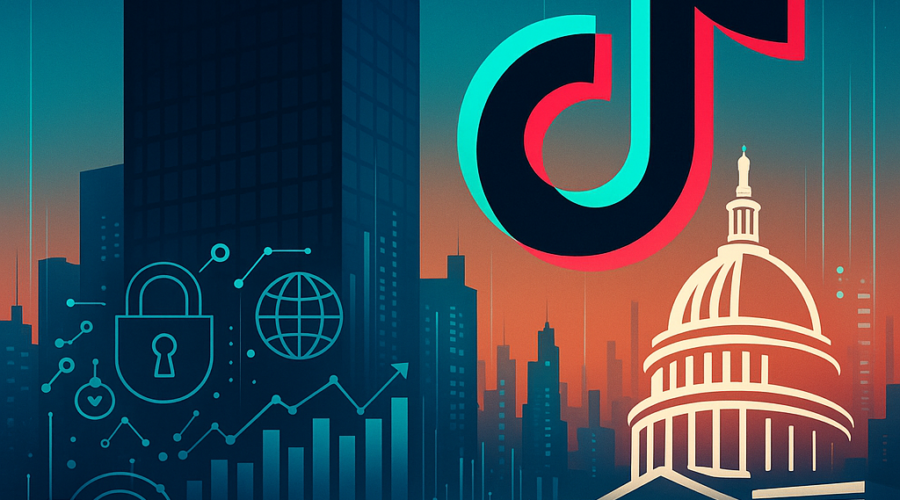
TikTok has signed an agreement to transfer control of its U.S. operations to an investor consortium led by Oracle and including private equity and sovereign-backed investors, a move that aims to satisfy U.S. political pressure but leaves open legal and technical questions about whether the result meets the “clean‑break” standard in recent U.S. law and court rulings[1].
💼 M&A / PE diligence in 24 hours? Yes, thanks to AI!
Deal overview and ownership structure
The memorandum, reported publicly on Dec. 18, 2025, sets out a spin‑off in which a newly formed U.S. company will run the American version of TikTok and be majority‑controlled by mostly American and Gulf investors, with Oracle (led by Larry Ellison), private equity firm Silver Lake and UAE state‑backed MGX collectively holding a substantial stake and operational influence[1].
- Investor group: Oracle, Silver Lake and MGX are named as principal investors in the new U.S. entity[1].
- ByteDance retention: Existing ByteDance investors will retain roughly one‑third of the new entity and ByteDance itself is expected to hold about 20%[1].
- Governance: A seven‑member board — principally American appointees — will oversee the U.S. operation, with responsibilities including content moderation policy and algorithm oversight[1].
Why Washington pressured a sale — legal and national security context
Congress passed legislation in 2024 that would have banned TikTok in the U.S. unless ByteDance divested the app; that statute was upheld by the Supreme Court in January 2025, creating sustained bipartisan pressure to separate U.S. operations from Chinese ownership[1].
Administration and congressional concerns focused on two issues: potential covert access to U.S. user data and possible manipulation of recommendation algorithms for influence operations. The announced structure is intended to address those risks by placing data and moderation control under the new U.S. company[1].
Key points of contention — does the deal meet the “clean‑break” requirement?
Critics — including former U.S. officials familiar with TikTok policy — argue the transaction resembles a franchise or licensing arrangement rather than a full divestiture, because ByteDance and its investors retain material economic and governance stakes and the underlying algorithmic technology may remain linked to China[1].
- Data and algorithm retraining: The agreement reportedly requires the U.S. algorithm to be retrained using only American data and places U.S. data under closer oversight — but independent verification and technical details of retraining, provenance, and isolation of models are not publicly available[1].
- Residual ties: With ByteDance retaining around 20% and other ByteDance investors holding near one‑third, U.S. critics say the structure fails the statutory aim of a full separation from ByteDance influence[1].
Immediate implications for users, regulators and markets
For U.S. users, the transaction promises that the U.S. version of TikTok will operate under an American‑led board and that data controls will be strengthened; however, less than 10% of TikTok’s global users are U.S.‑based, so one service will effectively split into a U.S.‑centric product and an international ByteDance‑run product[1].
For regulators, the deal raises questions: enforcement officials and litigants will likely evaluate whether legal requirements for divestment are satisfied and whether national security risks are demonstrably mitigated by technical and governance safeguards[1].
For M&A and private equity markets, the transaction demonstrates a growing template for cross‑border carve‑outs driven by geopolitics — a mix of strategic corporate buyers, PE firms, and sovereign or state‑backed capital combining to purchase sensitive assets where outright sale to a single strategic buyer may be politically infeasible[1].
Deal rationale for the investor group
- Strategic control of a massively engaged user base: TikTok’s U.S. audience (a subset of its ~2 billion global users) represents high monetization potential through advertising and commerce if regulatory access is secured[1].
- Technology and monetization upside: Owning operations gives investors access to recommender dynamics and ad‑tech revenue streams that are scarce assets in digital media markets[1].
- Policy gain: Purchasing U.S. operations resolves—or attempts to resolve—an existential regulatory risk that had threatened the app’s American business[1].
What to watch next — milestones and risks
- Regulatory sign‑off and enforcement testing: Federal agencies and possibly courts will scrutinize whether technical segmentation of data and algorithms is enforceable and auditable; independent audits and on‑going government oversight mechanisms will likely be demanded[1].
- Operational separation timeline: Practical retraining and migration of data, personnel and systems are complex and could take many months; any delays or technical shortcomings will sustain political and litigation risk[1].
- Precedent for geopolitically driven carve‑outs: The structure and outcome will shape future cross‑border M&A playbooks for companies with sensitive national‑security overlays — increasing demand for consortium bids combining tech and PE capital with state‑friendly investors[1].
Deal comparables and historical context
Recent years have seen deals where governance, data localization and regulatory carve‑outs dictated structure more than pure valuation: precedent includes forced divestitures and compliance‑heavy spin‑offs in telecoms and cloud infrastructure where buyers needed to demonstrate operational independence from politically problematic home jurisdictions. The TikTok case will likely be cited alongside those transactions as a model (or counter‑example) for future “national security” driven M&A and private equity transactions[1].
Executive takeaways for C‑suite and deal advisors
- When geopolitics drives deal structure: Expect hybrid ownership models combining strategic and financial investors plus state‑linked capital — counsel must design enforceable technical and governance firewalls, not just shareholder agreements[1].
- Technical proof points matter: Auditable model retraining, cryptographic attestations of data provenance, and ongoing third‑party verification will be bargaining chips and potential regulatory conditions[1].
- Valuation volatility: Legal uncertainty and phased operational separation will affect earn‑outs, escrow sizing, and contingent purchase price mechanics in similar transactions[1].
Data, auditability and next steps for investors
Buyers and advisors should insist on:
- Detailed technical migration plans with milestones and independent auditors to attest to data segregation and algorithmic retraining integrity[1].
- Clear governance rights and vetoes for national‑security stakeholders, with contractual remedies for breaches[1].
- Contingent pricing that accounts for litigation risk and potential regulatory reversals if the courts or agencies find the divestiture insufficient[1].
Transparency and political sensitivity
The White House has declined comment on the deal so far, and Oracle, Silver Lake and MGX have not publicly commented, leaving a media and political debate about whether the transaction satisfies congressional intent[1].
Search and SEO context (long‑tail keywords embedded naturally)
This analysis is relevant for executives researching “cross‑border M&A trends 2025”, “private equity exit strategies in regulated tech”, “data localization and algorithmic separation in divestitures”, and “national security driven carve‑outs for social media platforms”.
Sources and reporting
This article synthesizes contemporaneous reporting on the memorandum announcing transfer of U.S. TikTok operations to an Oracle‑led investor group and public commentary about the implications of the structure and retained ByteDance stakes[1].
Sources
https://www.wgcu.org/2025-12-18/tiktok-signs-deal-to-give-u-s-operations-to-oracle-led-investor-group