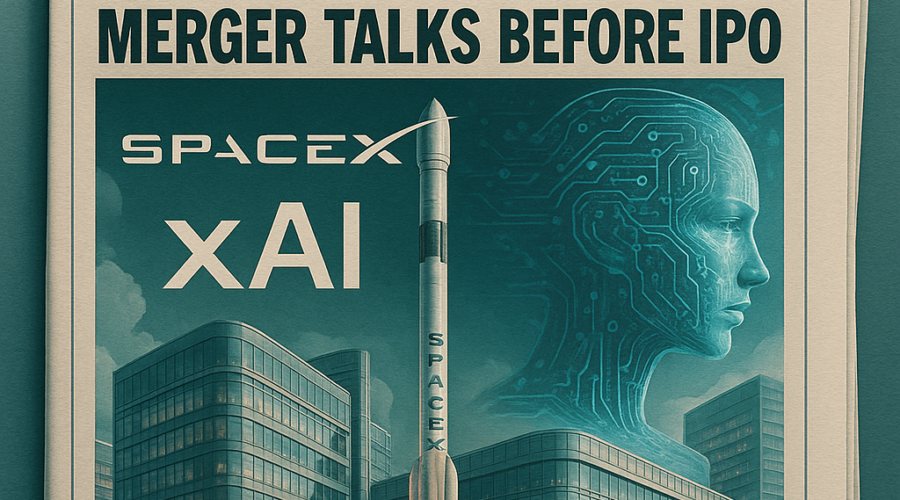
SpaceX and xAI, both led by Elon Musk, are reportedly in merger discussions ahead of SpaceX’s anticipated initial public offering later this year. This potential combination would unify SpaceX’s rocket and Starlink satellite operations with xAI’s Grok chatbot and X platform under a single entity. SpaceX, valued at $800 billion, previously invested $2 billion in xAI, which itself was valued at $80 billion after acquiring X for $33 billion. The consolidation aligns with Musk’s pattern of integrating his ventures, aiming to enable xAI data centers in space and unlock significant synergies through vertical integration in AI-space convergence.
- Target Parties
- SpaceX and xAI
- Key Executive
- Elon Musk (leads both companies)
- Transaction Type
- Merger talks ahead of SpaceX IPO
- SpaceX Valuation
- $800 billion (recent secondary sale)
- xAI Valuation
- $80 billion (after X acquisition)
- X (formerly Twitter) Valuation
- $33 billion (acquired by xAI)
- SpaceX Investment in xAI
- $2 billion (last year)
- Tesla Investment in xAI
- $2 billion (this week)
- Anticipated SpaceX IPO
- Targeted for June (Musk’s timeline)
- Strategic Driver
- Unify operations, enable xAI data centers in space, vertical integration
SpaceX and xAI, both led by Elon Musk, are in discussions to merge prior to SpaceX’s anticipated initial public offering later this year, according to Reuters.[1][2] The potential combination would unify SpaceX’s rocket and Starlink satellite operations with xAI’s Grok chatbot and X platform under a single entity.
Most “AI for Diligence” tools are lying to you. The truth is, they are just ChatGPT wrappers. Experience what real AI for Diligence looks like, built like Claude Code, but for M&A/ PE Diligence:
💼 When Claude Code Marries Due Diligence!
Strategic Rationale and Recent Moves
The merger aligns with Musk’s pattern of consolidating his ventures. SpaceX invested $2 billion in xAI last year, as reported by The Wall Street Journal, while Tesla disclosed a similar $2 billion commitment earlier this week.[1] In a prior transaction, xAI acquired X, valuing xAI at $80 billion and X at $33 billion.[1]
Filings reveal two new Nevada entities, K2 Merger Sub Inc. and K2 Merger Sub 2 LLC, established on January 21, signaling preparatory steps for a deal structure.[1] Analysts view the tie-up as enabling xAI data centers in space, a concept Musk has advocated to leverage SpaceX’s orbital capabilities.[1]
Valuations and IPO Timeline
SpaceX, founded in 2002, achieved an $800 billion valuation in a recent secondary sale, positioning it as the most valuable private company in the U.S.[1] A Financial Times report indicates Musk targets a June public listing, though his timelines often shift.[1]
Private equity firms and strategics monitor such mega-deals closely, as they highlight **cross-border M&A trends 2025** extending into 2026, particularly in AI-space convergence. McKinsey notes that AI infrastructure investments, including orbital data processing, could unlock $1 trillion in synergies by 2030 through vertical integration.
Industry Implications for M&A and Private Equity
This proposed merger exemplifies **private equity exit strategies in high-growth tech**, blending space infrastructure with generative AI. Bain & Company highlights similar consolidations in dual-use technologies, where space assets enhance AI compute scalability amid terrestrial power constraints.
Goldman Sachs strategists project SpaceX’s IPO could rival historic tech listings, with valuation multiples exceeding 50x EBITDA due to Starlink’s 5 million subscribers and reusable launch dominance. Regulatory scrutiny from FTC and SEC may intensify, given Musk’s overlapping leadership across public and private entities.
| Entity | Valuation/Investment | Source/Date |
|---|---|---|
| SpaceX | $800B (secondary sale) | Recent[1] |
| xAI | $80B (X acquisition) | Last year[1] |
| X (formerly Twitter) | $33B (acquired by xAI) | Last year[1] |
| SpaceX in xAI | $2B investment | Last year[1] |
| Tesla in xAI | $2B investment | This week[1] |
KKirkland & Ellis precedents in tech mergers suggest tax-efficient Nevada subs like K2 entities facilitate **strategic M&A in AI and aerospace**. For C-level executives eyeing **private equity investments in space tech**, this deal underscores risks in founder-led consolidations versus rewards in ecosystem control.
Neither company has publicly confirmed the talks.[1][2]
Sources
https://techcrunch.com/2026/01/29/elon-musk-spacex-xai-merger-talks-ipo-reuters/, https://www.marketscreener.com/news/musk-s-spacex-xai-in-talks-to-merge-ce7e5bdfdc89f124