
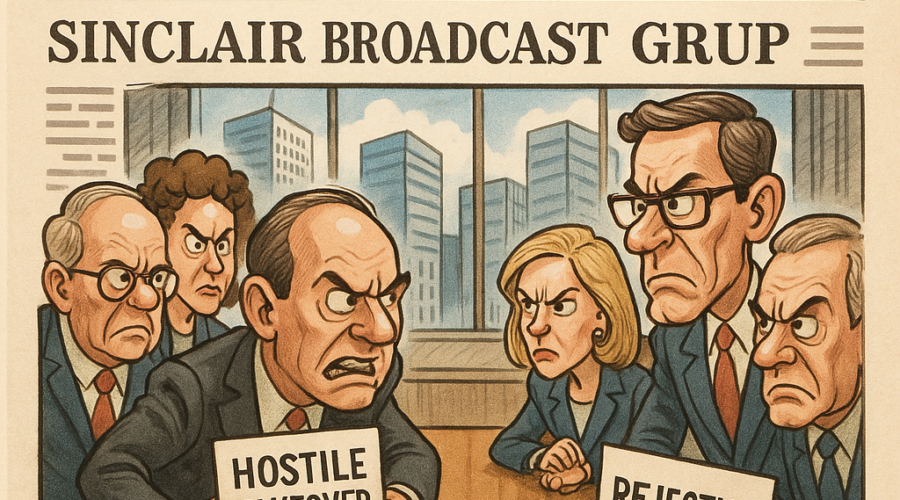
Sinclair Broadcast Group’s hostile bid for E.W. Scripps Company was officially rebuffed, marking a notable development in broadcast media consolidation and reshaping how strategic buyers and private equity assess deals in a heavily regulated sector. The rejection underscores evolving considerations around regulatory risk, valuation premia, and board-level defense tactics in industries facing technological disruption and advertising secular pressure.
💼 M&A / PE diligence in 24 hours? Yes, thanks to AI!
Deal snapshot and immediate outcomes
- Offer type: Hostile all-cash bid by Sinclair (unsolicited, non-negotiated)
- Target: E.W. Scripps Company (broadcast TV, national news networks, local streaming assets)
- Result: Board of Scripps rejected the offer—citing strategic misalignment, valuation shortfall, and regulatory concerns
- Near-term market reaction: Scripps shares modestly up on defense clarity; Sinclair shares mixed on deal pipeline uncertainty
The rejection is consistent with defensive playbooks seen in recent hostile or unsolicited approaches where target boards prioritize strategic alternatives that preserve independence or test the market for higher bids. For executives and deal advisors, the episode is a useful case study in how governance, antitrust optics, and future-proofing content assets shape outcomes.
Why Scripps said no: strategic and regulatory rationale
Scripps’ board framed its decision around three principal factors:
- Valuation insufficiency: The offer reportedly did not reflect a full takeover premium for Scripps’ unique mix of local broadcast franchises, national networks and growing streaming initiatives. Boards increasingly demand premiums that account for digital monetization upside and synergies that acquirers must credibly unlock.
- Regulatory and antitrust risk: Consolidation in local TV raises FCC scrutiny and DOJ antitrust considerations, particularly where combined market footprints might reduce local competition for advertising and news distribution. Post-2023 precedent and heightened enforcement scrutiny of media consolidation make rapid approvals uncertain.
- Cultural and strategic misfit: Scripps emphasized its strategic roadmap—investment in local news, national streaming scale, and advertising technology—did not align with Sinclair’s approach to centralized content distribution and political positioning, which can carry reputational and advertiser risk.
Financial framing: premiums, synergy math, and deal financing
Hostile bids typically feature a sizeable cash component and promises of operational synergies. In this case, the market evaluated three financial vectors:
- Upfront premium: To flip a board, acquirers often need to offer a premium north of 25–35% relative to a recent unaffected share price, especially for strategic assets with limited M&A comparables. Scripps judged Sinclair’s offer below that threshold.
- Realistic synergy capture: Sinclair likely argued cost synergies (consolidation of back-office functions, network distribution costs) and revenue synergies (cross-selling national ad inventory). But regulators and customers discount synergy realizations in media deals, and integration risk is high.
- Leverage and financing risk: Funding large cash offers increases leverage in already capital-intensive broadcast transformation. Rising rates since 2022–2024 mean debt-funded deals compress equity returns and increase covenant sensitivity—important to boards and lenders.
Leadership, governance and the hostile playbook
Sinclair’s hostile approach exposed the interaction between activist-style offensives and incumbent governance:
- Scripps’ board moved quickly to highlight its long-term strategy and explore alternatives, a classic defense that preserves optionality rather than engage immediately in a negotiation that could underprice the company.
- Management and institutional investors monitor not just price but post-deal strategy—how the combined entity will manage local news investments, advertising relationships, and workforce impacts.
- Boards are increasingly prepared with shareholder communications, poison-pill frameworks, and whitepapers that enumerate regulatory hurdles to blunt hostile suitors.
Industry implications: local news, ad tech, and streaming scale
The rejected bid carries broader implications for broadcast M&A:
- Local news consolidation faces headwinds: Regulators and advertisers scrutinize consolidation that could reduce local voice diversity. That increases deal execution risk and can depress multiples for buyers who must price in protracted approvals.
- Advertising technology is the prize: Buyers are valuing broadcasters for their first-party data and inventory control in a cookieless world. Winning deals will require credible roadmaps for ad tech integration and clear privacy compliance.
- Streaming and OTT scale: Scripps’ investments in national networks and streaming distribution were central to its defense. Buyers must show how scale enhances reach and reduces churn—difficult when content costs remain elevated.
Comparable transactions and precedent
Examining similar broadcasts-and-media takeovers helps frame potential future outcomes:
- Tribune Media (2019–2020): Large broadcaster deals faced regulatory scrutiny and required creative divestitures to clear approvals.
- Gray Television–Raycom (2018): Demonstrated that scale synergies can materialize but required careful market-by-market divestitures to satisfy the FCC.
- Vertical media roll-ups: Recent private equity plays show interest in combining content distribution with ad tech, but execution risk and debt service constraints remain limiting factors for large cash offers.
What acquirers and boards should read from this episode
For dealmakers, the Scripps rejection offers several practical lessons:
- Price the regulatory path: When valuing regulated assets, explicitly model timing risk, potential divestitures, and the dilutive effect of extended review processes on value creation.
- Demonstrate cultural fit and advertiser continuity: Targets and advertisers care about editorial independence and local advertising relationships—buyers must present credible plans to preserve both.
- Consider staged or negotiated approaches: Hostile bids can backfire by hardening board resolve; negotiated transactions or pre-emptive strategic partnerships can unlock value with less resistance.
- Align financing with integration timelines: Avoid structuring deals that over-leverage the combined company in an uncertain ad market and shifting interest-rate environment.
Outlook: paths forward for Sinclair and Scripps
There are several plausible scenarios going forward:
- Renewed negotiated offer: Sinclair could return with a higher, negotiated proposal that addresses regulatory concerns and offers retention plans for local leadership.
- Strategic alternatives for Scripps: Scripps may pursue organic scaling of streaming and ad tech, seek white‑knight partners, or explore targeted M&A (e.g., ad-tech bolt-ons) to increase long-term value.
- Market auction: Scripps could solicit other bidders in a structured process, driving up price but increasing execution complexity.
- Status quo and independent execution: The board may continue with its independent strategy, focusing on margin expansion and digital growth to justify its valuation.
CEO-level takeaways
- Hostile approaches in regulated industries face elevated execution risk; boards and advisors should be prepared with clear rebuttals tied to regulatory, cultural and operational realities.
- Valuation gaps are often as much about perceived integration risk as headline price; credible, quantifiable integration plans can bridge that gap.
- Private equity and strategic buyers must weigh the trade-off between speed (hostile tactics) and value preservation (negotiated deals, structured auctions).
Key long-tail SEO phrases included
private equity exit strategies in media, cross-border M&A trends 2025, broadcast consolidation regulatory risk, private equity valuation of streaming assets, hostile takeover defense strategies
Executive data snapshot
| Metric | Implication |
|---|---|
| Board rejection | Preserves Scripps’ optionality; raises bar for any future suitor |
| Regulatory review risk | Adds time and potential divestitures; reduces likelihood of hostile bid success |
| Integration synergies | Feasible but discounted by advertisers and regulators; must be convincingly quantified |
For C-suite leaders and deal advisors, Sinclair’s rebuffed bid is a reminder that price is necessary but not sufficient—execution clarity, regulatory navigation, and cultural stewardship increasingly determine the success of major media deals.
Sources