
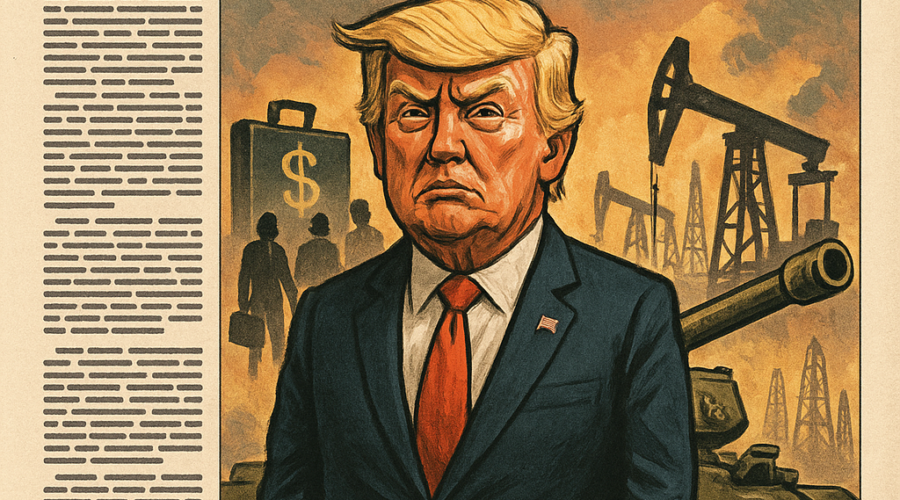
As U.S. interest payments surpass defense spending for the first time since World War II, Trump’s administration faces mounting pressure to privatize military assets, echoing private equity exit strategies in defense sectors while securing Venezuelan oil revenues to offset fiscal strains.[1][2]
Set and exceed synergy goals with benchmarks and actionable operational initiative level data from similar deals from your sector:
💼 Actionable Synergies Data from 1,000+ Deals!
Fiscal Crisis Threshold Crossed: Interest Over Defense
The Congressional Budget Office projects U.S. interest expenses exceeding $1 trillion in fiscal 2026, approaching $1.8 trillion by 2035, already outpacing national defense outlays—a historical tipping point historian Niall Ferguson warns precedes imperial decline.[1] For FY2026, the administration requested just $2.1 billion for Army military construction, signaling potential cuts that critics liken to private equity gutting legacy assets for short-term gains.[2]
This imbalance stems from $4 trillion in Treasury duration extensions since October 2023, betting on Federal Reserve rate cuts that may not suffice amid persistent inflation and consumption-driven deficits.[1] Privatization emerges as a tested mechanism: air traffic control reforms, backed by Trump’s first term, propose spinning off operations into fee-funded private entities to evade budget gridlock, as seen in recent shutdown disruptions.[7]
Venezuela Operation: Territorial Resource Grab as Fiscal Reimbursement
On January 3, 2026, U.S. special forces captured Nicolás Maduro in Operation Absolute Resolve, framed by Trump as “fiscal reimbursement through oil” rather than narco-terrorism enforcement.[1][3] Trump announced Venezuela turning over 30-50 million barrels of high-quality sanctioned oil, valued at up to $2 billion, to be sold at market prices under U.S. control to benefit both nations.[3][4]
Interim leader Delcy Rodríguez, formerly vice president, was sworn in as Maduro faces U.S. charges, with Chevron poised to dominate flows given its Gulf Coast refineries suited for Venezuela’s heavy crude—previously importing 500,000 bpd pre-sanctions.[3][4] Analysts doubt rapid revival of Venezuela’s 303 billion barrel reserves, estimating tens of billions and a decade for full output, yet Trump eyes U.S. firms restarting within 18 months.[3]
| Element | Details | Impact |
|---|---|---|
| Volume | 30-50M barrels | $2B revenue at market price[3][4] |
| Control | U.S. President directs proceeds | Diverts from China, funds transition[4] |
| Operators | Chevron lead; Exxon potential | Gulf refineries optimized for heavy crude[3][4] |
| Risks | Chavista unrest, decade-long rebuild | Investment hinges on stability[5] |
Privatization Playbook: From Stablecoins to Defense Assets?
Trump’s strategy tests three fiscal levers: territorial grabs like Venezuela, digital dollar infrastructure via the GENIUS Act’s stablecoin-Treasury nexus mandating T-bill reserves at trillion-dollar scale, and Bitcoin reserves—contrasting Iraq’s $3-8 trillion cost with zero oil Treasury flow.[1] Opposition leader María Corina Machado’s $1.7 trillion privatization blueprint for Venezuela spotlights hydrocarbons as wealth engines, inviting U.S. private equity amid reversed nationalizations.[5][6]
FTI Consulting maps scenarios: U.S.-led transition could revive 1950s-era GDP per capita highs via foreign capital, but risks Chavista holdouts, unrest, and corruption persist.[5] Echoing air traffic control, defense privatization—separating operations from bureaucracy—could attract private equity investments in military infrastructure, insulating from deficits while modernizing outdated systems like FAA’s NextGen, only 16% complete after two decades.[7]
- Precedents: Canada’s privatized ATC thrives with stable fees, per ICAO standards; Trump 2017 reforms stalled by Congress.[7]
- Army Risks: $2.1B construction budget may force asset sales, mirroring PE carve-outs in overstretched sectors.[2]
- Cross-Border M&A Trends 2026: Venezuela opens energy sector privatization opportunities for U.S. firms, blending geopolitics with deal flow.[5]
Implications for Private Equity and National Security
For C-level executives eyeing defense sector M&A trends 2026, fiscal math demands innovation: PE could deploy capital for military construction or logistics spin-offs, much as stablecoin issuers captive-buy Treasuries.[1][2] Yet Just Security warns of “gutting the Army,” with insufficient funding eroding readiness amid cross-border M&A risks in volatile regimes.[2][5]
Trump’s Venezuela pivot—oil over ideology—signals pragmatism: U.S. Energy Secretary Chris Wright executes the deal, prioritizing American technology partnerships.[4] Investors must stress-test for reversals, as oil prices dipped post-announcement, betting on long-term supply floods.[3]
Sources
https://shanakaanslemperera.substack.com/p/the-privatized-seigniorage-pivot, https://www.justsecurity.org/126217/trump-private-equity-gut-army/, https://www.capitalfm.co.ke/business/2026/01/trump-says-venezuela-will-be-turning-over-up-to-50m-barrels-of-oil-to-us/, https://profit.pakistantoday.com.pk/2026/01/07/venezuela-to-export-2-billion-worth-of-oil-to-us-in-deal-with-washington/, https://www.fticonsulting.com/insights/articles/venezuela-flux-commercial-implications, https://www.aol.com/finance/trumps-venezuela-raid-shines-light-153054594.html, https://www.reviewjournal.com/opinion/commentary-air-traffic-control-privatization-is-long-overdue-3604730/