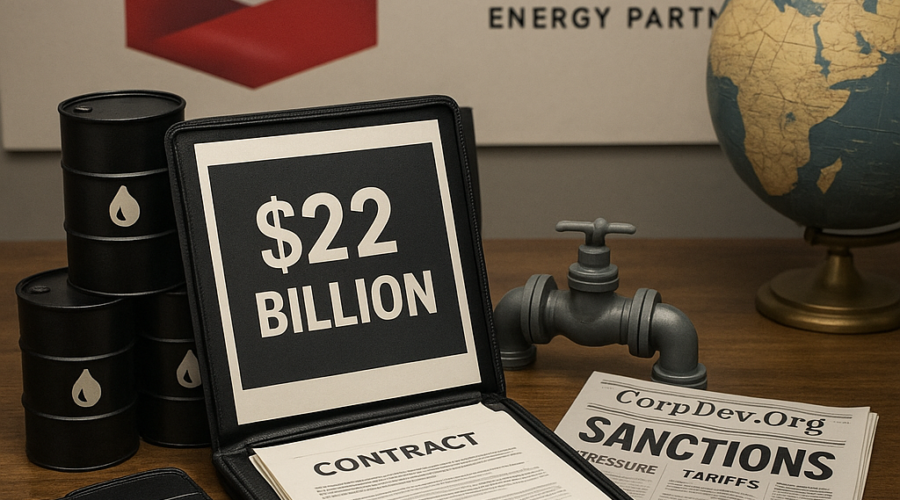
Chevron Corp. and private equity powerhouse Quantum Energy Partners are preparing a joint bid for Lukoil’s entire $22 billion international portfolio, planning to split the assets covering upstream production, refineries, and over 2,000 fuel stations across Europe, Asia, and the Middle East, according to the Financial Times.[2][3][5]
Set and exceed synergy goals with benchmarks and actionable operational initiative level data from similar deals from your sector:
💼 Actionable Synergies Data from 1,000+ Deals!
Deal Rationale: Navigating U.S. Sanctions and Geopolitical Pressures
Lukoil, Russia’s second-largest oil producer, signaled plans to divest its non-Russian assets following stringent U.S. sanctions imposed in October 2025 on both Lukoil and Rosneft, aimed at curtailing Moscow’s oil revenues to force a Ukraine ceasefire.[2][5][7] These sanctions severed access to the U.S. banking system, prompting Lukoil to seek buyers for its global operations—including refineries in Italy and the Netherlands, upstream stakes in Iraq, Uzbekistan, and West Africa—to maintain value amid escalating restrictions.[5]
Quantum Energy Partners, led by oil magnate Wil VanLoh and collaborating with its London-based portfolio firm Artemis Energy, is spearheading the bid, with Chevron as a strategic partner eyeing long-term ownership and operation of the assets.[5][7] This **private equity energy sector consortium bid** reflects a classic play in **sanctions-driven asset fire sales**, where majors like Chevron pair with PE firms to capture discounted high-quality international oil and gas assets while mitigating execution risks.
Competitive Landscape: Crowded Field of Bidders
The Lukoil portfolio has drawn aggressive interest in this **cross-border energy M&A** frenzy:
- Carlyle Group: Engaged in advanced talks that reportedly stalled.[2][5]
- International Holding Company (Abu Dhabi): Among leading contenders alongside Saudi Arabia’s Midad Energy.[2][3][5]
- Others: ExxonMobil, Hungarian MOL, and a consortium led by Xtellus Partners (previously rejected by U.S. regulators); early bidder Gunvor withdrew after Trump administration opposition.[5][7]
U.S. Treasury has extended negotiation permissions until January 17, 2026, signaling cautious openness but intense scrutiny under President Trump’s policy to starve Russian energy exports.[2][7]
Asset Breakdown and Synergies
| Asset Category | Description | Key Regions | Strategic Value |
|---|---|---|---|
| Upstream (Oil & Gas Production) | Exploration and production stakes | Iraq, Uzbekistan, West Africa | Immediate reserve accretion for Chevron |
| Downstream (Refining) | Refineries | Italy, Netherlands | Europe refining capacity amid energy transition |
| Retail Network | >2,000 filling stations | Europe, Asia, Middle East | Quantum’s PE playbook for retail optimization |
For Chevron (NYSE: CVX), the deal offers bolt-on international diversification, complementing its Permian dominance and Gulf of Mexico portfolio, potentially at a sanctions-discounted multiple—echoing historical **distressed energy asset acquisitions** like BP’s post-Deepwater Horizon fire sale.[5] Quantum, with its $20+ billion energy-focused track record, targets **private equity upstream and midstream carve-outs** for operational uplift and exits in 5-7 years.
Risks and Regulatory Hurdles
Approval hinges on U.S. national security reviews, given Lukoil’s sanctioned status and Trump’s hawkish stance—previous deals like Gunvor’s collapsed under similar pressure.[5][7] Broader **OPEC+ spare capacity dynamics** and volatile crude prices (WTI ~$75/bbl as of early 2026) could compress valuations, while EU antitrust scrutiny looms for European downstream assets.
McKinsey’s 2025 Energy M&A Outlook highlights such **geopolitically forced divestitures** as prime opportunities for Western majors, but warns of 40-60% execution risk in sanctioned deals due to financing and compliance barriers—mirroring Rosneft’s stalled sales.
Market Implications: Signal for Energy M&A in 2026
This bid underscores a rebound in **oil and gas M&A transaction volume post-sanctions**, with PE dry powder (~$500B globally per Bain 2025 PE Report) chasing yield in conventional assets amid LNG and renewables slowdowns. Success could catalyze similar plays for Rosneft’s portfolio, reshaping **international oil company footprints** and accelerating Russia’s energy isolation.
Chevron shares dipped 4.46% to $156.54 on January 6, 2026, reflecting deal uncertainty, but longer-term momentum (up 4.65% YoY) positions it well for accretion if cleared.[7]
Sources
https://cryptorank.io/news/feed/4c65b-chevron-quantum-team-up-in-bid-for-lukoils-22b-international-assets-report, https://ng.investing.com/news/stock-market-news/chevron-quantum-energy-seek-bid-for-22-bln-of-lukoil-assets-ft-2277531, https://www.zawya.com/en/projects/oil-and-gas/chevron-quantum-energy-partners-line-up-bid-for-22bln-of-lukoil-assets-ft-reports-p9g4gqq9, https://www.gurufocus.com/news/4099056/chevron-cvx-to-acquire-lukoils-international-assets, https://oilprice.com/Latest-Energy-News/World-News/Chevron-and-Quantum-Prepare-22-Billion-Bid-for-Lukoil-Assets.html, https://www.tradingview.com/news/invezz:ab3496df9094b:0-chevron-quantum-team-up-in-bid-for-lukoil-s-22b-international-assets-report/, https://www.benzinga.com/news/politics/26/01/49745758/chevron-quantum-energy-partners-plan-22-billion-bid-for-russian-oil-giant-lukoils-international-assets-report, https://www.investing.com/news/stock-market-news/chevron-quantum-energy-seek-bid-for-22-bln-of-lukoil-assets-ft-4433935, https://www.globalbankingandfinance.com/chevron-quantum-energy-partners-line-up-bid-22-billion/, https://www.tradingview.com/news/reuters.com,2026:newsml_L6N3Y80AD:0-chevron-quantum-energy-partners-line-up-bid-for-22-billion-of-lukoil-assets-ft-reports/