“`html
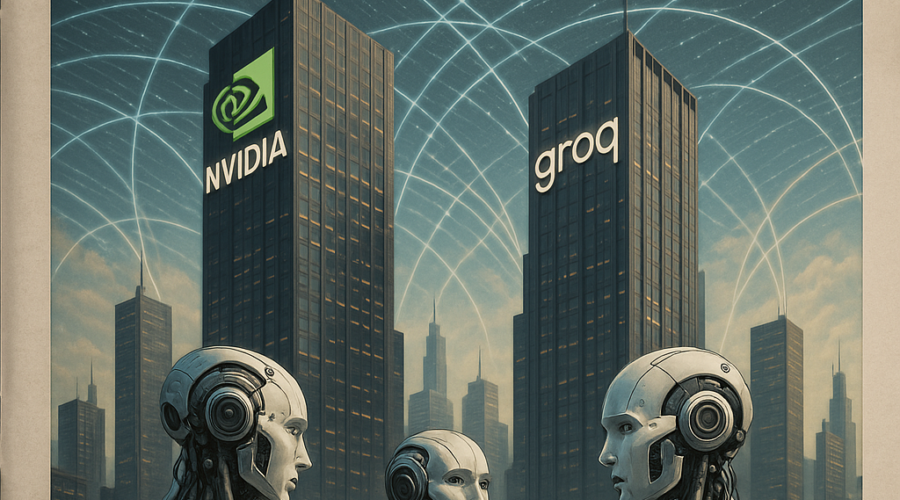
Nvidia has announced a landmark $20 billion non-exclusive licensing agreement with AI chip startup Groq, marking the semiconductor giant’s largest deal to date and signaling a decisive strategic shift toward real-time AI inference capabilities[2]. Under the arrangement, Groq’s founder Jonathan Ross, president Sunny Madra, and key engineers will join Nvidia to advance the company’s low-latency inference technology, while Groq remains operationally independent under new leadership[2][3].
Set and exceed synergy goals with benchmarks and actionable operational initiative level data from similar deals from your sector:
💼 Actionable Synergies Data from 1,000+ Deals!
The Strategic Rationale: From Training to Inference
The deal reflects a fundamental industry transition that has largely escaped mainstream attention until now. The AI market is pivoting decisively away from training-heavy workloads—where Nvidia already dominates—toward continuous, 24/7 inference computing[2]. This shift encompasses robotics, edge inference, always-on data center applications, and real-time AI workloads that demand specialized silicon optimized for speed and latency rather than raw computational throughput[2][4].
Groq’s low-latency Language Processing Unit (LPU) technology addresses a critical gap in Nvidia’s portfolio. While the company’s GPUs excel at training massive language models, inference—the process of running trained models to generate predictions or responses—requires different architectural priorities. By acquiring Groq’s talent and intellectual property, Nvidia simultaneously expands its total addressable market in AI inference and eliminates a potential long-term competitive threat[2].
Financial Positioning and Balance Sheet Strength
The $20 billion transaction underscores Nvidia’s fortress financial position. With $60.6 billion in cash against only $8.5 billion in debt, the company can absorb this strategic investment without financial strain while maintaining capacity for dividends, share buybacks, and future acquisitions[2]. Management guided approximately $65 billion in revenue for the next quarter, implying roughly 65% year-over-year growth, demonstrating that the Groq investment does not constrain near-term capital allocation[2].
Competitive Moat Expansion and Market Implications
The deal strengthens Nvidia’s competitive moat in multiple dimensions. First, it consolidates inference technology leadership by bringing Groq’s specialized ASIC-based approach into Nvidia’s ecosystem[2]. Second, it reduces future competitive threats by absorbing key talent and intellectual property that might otherwise fuel rival startups or established competitors[2]. Third, it positions Nvidia at the center of the next phase of AI adoption, where inference workloads are expected to grow exponentially as AI applications proliferate across industries[2].
Analysts widely acknowledge that the transaction materially expands Nvidia’s addressable market. Baird noted that integrating Groq’s ASIC-based inference technology could significantly broaden Nvidia’s total addressable AI market over time, while Bank of America emphasized that the deal demonstrates management’s strategic awareness of the industry’s evolution toward inference-centric computing[2].
Regulatory Considerations and Deal Structure
The transaction’s structure as a non-exclusive licensing agreement rather than a full acquisition has drawn regulatory scrutiny. Former Assistant Attorney General Jonathan Kanter noted that while the arrangement does not constitute a traditional acquisition, the hiring of Groq’s founder, president, and key engineers—combined with technology licensing—raises questions about whether the deal is designed to avoid antitrust review[1]. Kanter suggested that if regulatory concerns exist, intervention may be warranted; if not, authorities should allow the deal to proceed[1].
The non-exclusive nature of the licensing agreement is significant: Groq retains the right to license its technology to other parties, theoretically preserving competitive dynamics. However, the departure of Groq’s leadership team to Nvidia effectively transfers operational control of the company’s strategic direction, even if formal ownership remains separate[2][3].
Analyst Consensus and Forward Outlook
Wall Street has largely endorsed the transaction. Bank of America reiterated a “Buy” rating with a $275 twelve-month price target, characterizing the deal as a strategic necessity[2]. Baird maintained an “Outperform” rating at the same $275 target, arguing that Groq’s ASIC technology could materially expand Nvidia’s long-term market opportunity[2]. Bernstein kept its “Outperform” stance, noting that while the $20 billion valuation may appear steep, it is manageable given Nvidia’s market capitalization and cash generation[2].
Looking ahead to 2026, the deal’s success will depend on Nvidia’s ability to integrate Groq’s inference technology into its broader AI platform while maintaining the company’s execution on supply chain and cloud demand[2]. The transaction positions Nvidia to capture a disproportionate share of the emerging inference-as-a-service market, where demand is expected to accelerate as enterprises deploy AI applications at scale.
Implications for the Broader AI Ecosystem
The Groq deal signals that the AI industry’s competitive dynamics are entering a new phase. Rather than competing solely on training performance, semiconductor leaders must now demonstrate capabilities across the entire AI workload spectrum—from model development to real-time inference. Nvidia’s $20 billion bet underscores the strategic importance of inference technology and suggests that competitors lacking specialized inference capabilities face increasing pressure to acquire or develop them independently.
For enterprise customers, the deal may accelerate adoption of Nvidia-based inference solutions across robotics, autonomous systems, and edge computing applications. For investors evaluating private equity and M&A opportunities in AI infrastructure, the transaction establishes a new valuation benchmark for inference-focused startups and reinforces the premium that acquirers are willing to pay for specialized AI silicon technology.
“`
Sources