
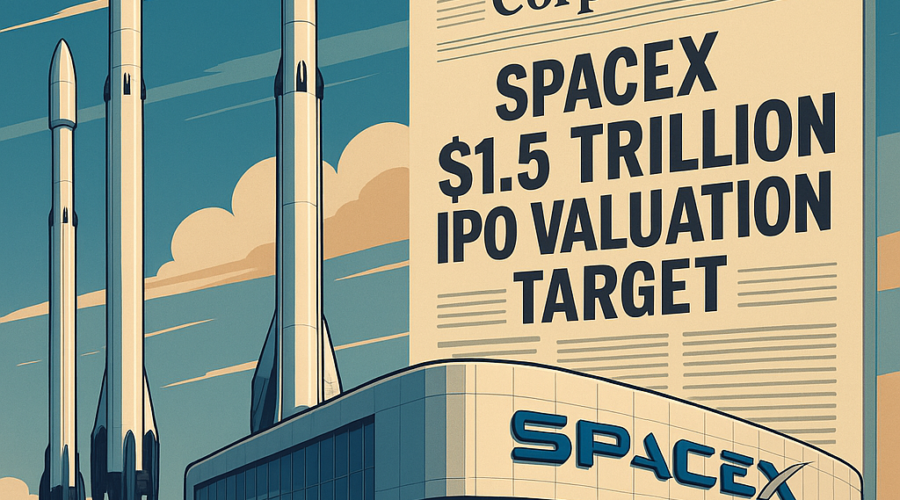
SpaceX, Elon Musk’s aerospace and satellite internet giant, is preparing for an initial public offering (IPO) in 2026 that could become the largest in history, targeting a staggering valuation near $1.5 trillion and aiming to raise over $30 billion. This landmark move would eclipse the previous record held by Saudi Aramco and mark a transformative moment in the space and capital markets sectors.
💼 M&A / PE diligence in 24 hours? Yes, thanks to AI!
IPO Rationale and Financial Outlook
The push toward a public listing is driven primarily by the rapid expansion of SpaceX’s Starlink satellite internet business, which is expected to contribute the majority of the company’s revenue. SpaceX projects revenues of approximately $15 billion in 2025, growing to between $22 billion and $24 billion in 2026. The IPO proceeds are anticipated to fund ambitious projects including the development of space-based data centers and further advancement of the Starship program, which is central to Musk’s lunar and Mars exploration plans.
SpaceX’s recent secondary share sales have implied a valuation north of $800 billion, with insiders selling shares at roughly $420 each. The company is allowing employees to sell about $2 billion worth of shares, while also engaging in buybacks to manage shareholder value ahead of the IPO. At a $1.5 trillion valuation, selling just 5% of the company would require offering around $40 billion in shares, setting a new benchmark for IPO size globally.
Company Background and Strategic Assets
Founded in 2002, SpaceX has revolutionized space launch economics and satellite internet connectivity. Its Starship vehicle is designed for deep space missions, including Mars colonization ambitions. Starlink, the company’s satellite constellation, has rapidly expanded its global broadband footprint, targeting underserved and remote markets with direct-to-mobile internet services.
Notably, SpaceX holds significant cryptocurrency assets, including bitcoin, which aligns with Elon Musk’s broader interest in digital assets and could add a unique dimension to the company’s financial profile post-IPO.
Leadership and Market Position
Elon Musk remains the visionary leader steering SpaceX’s trajectory. The company’s board and Musk have recently made key decisions on hiring and fundraising strategies to accelerate the IPO timeline. Major long-term investors include Founders Fund, 137 Ventures, Valor Equity Partners, Fidelity, and Alphabet’s Google, underscoring strong institutional confidence.
Industry and Market Implications
The SpaceX IPO is poised to reshape the aerospace and satellite internet sectors by unlocking substantial public capital for space infrastructure and innovation. It also signals growing investor appetite for space economy assets and could catalyze further cross-border M&A and private equity activity in space tech.
From a capital markets perspective, this IPO will test investor appetite for mega listings in emerging technology sectors and could influence valuation benchmarks for space-related companies. The scale and ambition of SpaceX’s public debut will likely set new standards for private equity exit strategies in aerospace and satellite communications.
Comparable Mega IPOs and Historical Context
| Company | IPO Year | Valuation at IPO | Funds Raised | Sector |
|---|---|---|---|---|
| Saudi Aramco | 2019 | $1.7 trillion | $29.4 billion | Energy |
| Alibaba Group | 2014 | $231 billion | $25 billion | Technology / E-commerce |
| SpaceX (Projected) | 2026 | $1.5 trillion (target) | $30–40 billion (target) | Aerospace / Satellite Internet |
Outlook and Strategic Considerations for Investors
Investors and deal advisors should monitor SpaceX’s IPO as a bellwether for the space economy’s maturation and the evolving landscape of technology-driven mega IPOs. Key considerations include regulatory scrutiny, geopolitical risks related to satellite operations, and the company’s ability to sustain Starlink’s growth amid increasing competition.
Furthermore, the IPO’s success will hinge on SpaceX’s execution of its ambitious roadmap, including Starship development and space-based data center initiatives, which could redefine infrastructure investment paradigms.
Visual Summary: SpaceX IPO Timeline and Revenue Growth Projection
(Visuals would include a timeline from 2025 secondary share sales to 2026 IPO, and a revenue growth chart from $15B in 2025 to $24B in 2026, highlighting Starlink’s contribution.)
SpaceX’s planned IPO represents a historic convergence of space innovation and capital markets, setting the stage for a new era of public investment in the final frontier.
Sources